Exam Centre Rules Every Pupil Should Know
An exam centre is not like a school classroom on a normal day. It is a controlled space run under the board's rules, with staff the pupil may not know, strict entry checks, fixed seating and a code of conduct that applies from the gate to the final bell. Pupils who know these rules in advance walk in calmly and spend their energy on the paper, while pupils who learn them at the gate often lose time, confidence or even their paper. This guide covers entry, seating, materials, conduct and what happens if something goes wrong, in general terms that apply across boards in Sindh and Pakistan. Your own board's official notice and the instructions printed on your roll number slip always override anything general written here.
Arriving at the Centre
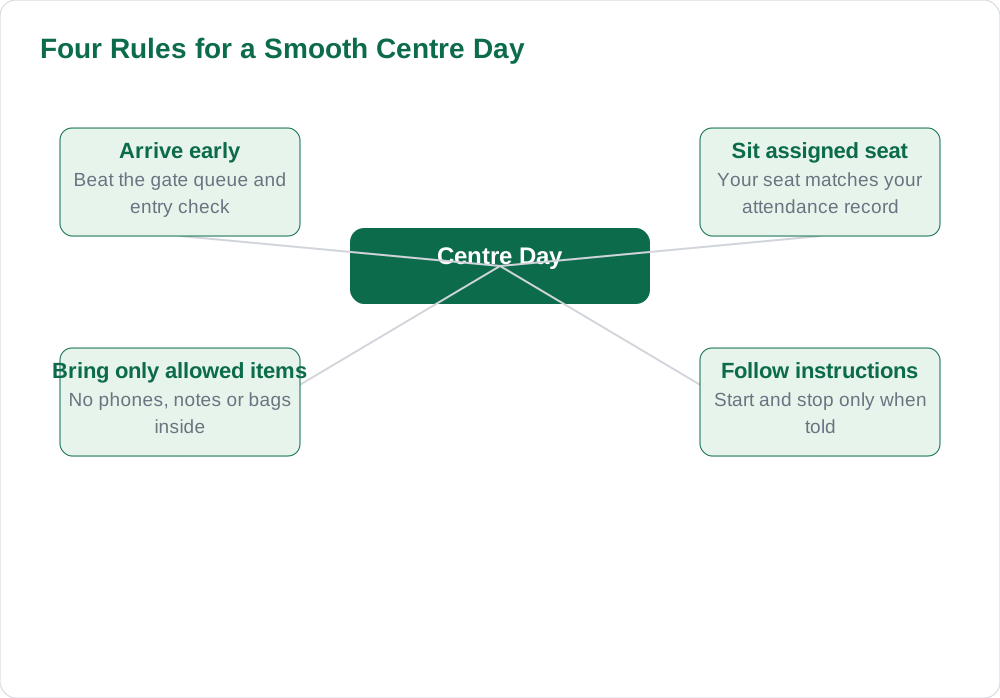
Plan to reach the centre well before the reporting time printed on your slip. Gates usually open for entry checks some time before the paper starts, and there can be a queue, especially at large centres. Bring your roll number slip and any identity document the centre requires, plus your stationery in a transparent pouch if that is the local practice. Leave valuables at home: most centres do not take responsibility for bags, phones or other items left outside the hall, and some do not allow bags inside at all.
At the gate, staff check the slip and may check bags or belongings. Cooperate politely and do not argue about the check; it applies to everyone and it protects the fairness of the examination. If you are directed to a room or seat different from the one you expected, follow the direction and ask a staff member if you are confused, rather than sitting wherever you like. Pupils who arrive after the paper has started are usually dealt with under the board's late-arrival rules, which may mean no entry, so treat the reporting time as a hard deadline, not a suggestion.
Seating and the Start of the Paper
Inside the hall, each pupil has an assigned seat, usually shown on a seating plan or a slip on the desk. Sit only in your assigned seat, because the attendance sheet and the answer sheet are matched to that seat. Keep your roll number slip on the desk where the invigilator can see it, and wait for instructions before opening the question paper or writing anything. The invigilator will usually read out the rules, announce the timing, and tell pupils when to start and when to stop.
When the answer sheet is given out, fill in the required fields carefully before writing answers: roll number, subject, paper and question paper details exactly as instructed. A wrong roll number on the answer sheet is a serious problem, because it can delay or misdirect marking, so double-check each digit. If you are given a damaged question paper or answer sheet, raise your hand at once and ask for a replacement; do not wait until you have already written on it. This is also the moment to check that you have received the correct subject paper.
What You May and May Not Bring
The usual allowed items are pens, pencils, a ruler, an eraser and a geometry set where the subject needs one. Calculators are allowed only for subjects and papers where the board permits them, so do not assume a calculator is fine for every paper. Mobile phones, smartwatches, earphones, notes, books and bags are normally not allowed inside the hall, and in many centres they must be left outside at the owner's risk or handed in under the centre's arrangement. If you are unsure about an item, ask your school before exam day rather than testing the rule at the gate.
Water is usually allowed in a plain transparent bottle, and some centres allow it on the desk. Food is generally not needed for a standard paper, and anything that could disturb others, such as a noisy wrapper, is best avoided. Do not borrow stationery during the paper unless the invigilator permits it, because passing items between desks can look like communication. A small habit that helps: pack your pouch the night before, check it against your subject's needs, and keep your slip in the same place every day so nothing is forgotten in a morning rush. For subject revision before the day, the solved notes library and the books catalogue are useful starting points.
Conduct During the Paper
During the paper, silence and independence are the rules. Do not talk, signal, look at another pupil's work, or pass anything to another desk. If you need help, raise your hand and wait for the invigilator; do not leave your seat without permission. If you need extra answer sheets or a washroom break, the invigilator will arrange it under the centre's rules, and the time is normally not extended. Writing after the stop instruction is also an offence in most centres, so stop promptly when told, even mid-sentence.
Rough work should be done in the space the paper allows, usually on the answer sheet itself where permitted, and not on the question paper, desk or hand. Do not write your name anywhere except where the answer sheet asks for it, and do not write anything that identifies you beyond the required fields, because scripts are meant to be marked without knowing whose they are. Staying calm matters as much as knowing the rules: if a question looks unfamiliar, move on and return to it later rather than panicking, and if another pupil disturbs you, raise your hand quietly instead of reacting.
If Something Goes Wrong
Problems happen: a pupil feels unwell, a question paper has a misprint, or a seat is already occupied. In every case the first step is the same — raise your hand and tell the invigilator, who will refer the matter to the centre superintendent if needed. Do not try to solve it by moving seats, swapping papers or borrowing from another pupil. If you fall ill, the centre has a procedure for it, and an incident report may be written; keep any medical record the centre or your school asks for, because it may be needed later if you apply for any concession the board allows.
If you believe a rule has been applied unfairly, note the facts calmly and report them to your school after the paper, rather than arguing in the hall. Complaints about centre conduct go through the school to the board, with the facts and any witnesses, and they are much stronger when made promptly and in writing. After the paper, leave the hall quietly, take your slip and belongings, and do not discuss answers in a way that disturbs pupils still writing in other rooms. For what happens if a paper is disrupted for everyone, see what to do when an exam is postponed, and for the paper itself, follow your invigilator's instructions on filling in the answer sheet fields.
AI Help: Muse AI
Muse AI is Meta's personal AI assistant, and it can help you prepare for centre day, for example by turning the centre rules into a short night-before packing and timing checklist for your first paper.
Join Muse with invite code LTGSWD — in the Muse app, go to Settings > Redeem token and enter the code.
Disclosure: LTGSWD is the author's Muse invite code.
Muse AI does not give official STBB answers — always verify against your Sindh Textbook Board book and your teacher.
5 key points you must know
- Arrive before the reporting time on your slip — late arrival can mean no entry.
- Sit only in your assigned seat and keep your roll number slip visible on the desk.
- Bring only allowed stationery; phones, notes and bags normally stay outside.
- Raise your hand for any problem — never move seats or swap papers yourself.
- Stop writing the moment the invigilator says stop, even mid-sentence.
Frequently asked questions
Can I bring my mobile phone into the exam hall?
Normally no. Phones, smartwatches and earphones are not allowed inside the hall in most centres, and items left outside are usually at the owner's risk, so it is safest to leave the phone at home.
What happens if I arrive after the paper has started?
Late arrival is handled under the board's own rules and may mean no entry. Treat the reporting time on your slip as a hard deadline and plan the journey with extra time.
Can I sit in a different seat if mine is uncomfortable?
No — sit only in your assigned seat, because attendance and answer sheets are matched to seats. If there is a genuine problem with the seat, raise your hand and let the invigilator deal with it.
What should I do if my question paper has a misprint?
Raise your hand at once and tell the invigilator before you write on it. Do not swap papers with another pupil or try to fix the problem yourself.
Can I go to the washroom during the paper?
Usually yes, with the invigilator's permission and under the centre's rules, often one pupil at a time. The time is normally not added back, so keep breaks short.
Solved notes — preview free
These guides work best with the solved exercises. Preview the solved notes free on this website — 119 solved notes for Classes 6–10 in Sindhi, Urdu, English and Arabic medium. Or browse the full solved notes catalogue for your class and medium. New solved notes are added regularly — check the catalogue for coming-soon books.