Following Invigilator Instructions During Board Exams
The invigilator is the person who runs the examination hall on behalf of the board. They are usually a teacher from another school, appointed so that no candidate is supervised by their own teacher, and their word inside the hall is the board's word. Many pupils feel nervous around invigilators, but understanding their role turns that nervousness into confidence: the invigilator is not there to catch pupils out, but to make sure every candidate gets the same fair conditions. This guide explains what invigilators do, the kinds of instructions they give, why prompt obedience matters, and how to raise a problem through them. Board rules differ in detail, so your invigilator's spoken instructions and the notice on your slip are the final authority in your hall.
Who the Invigilator Is and What They Do
An invigilator supervises the hall from the moment the first candidate enters until the last answer sheet is collected and counted. Their duties include checking roll number slips and seating, distributing and collecting papers and sheets, keeping the hall silent and orderly, watching for unfair means, recording attendance, and writing a report on anything unusual, such as a late arrival, an illness or a disturbance. A centre superintendent oversees the whole centre and decides matters the invigilator refers upward, such as a disputed document or a serious incident.
Invigilators are deliberately not the candidates' own teachers, because impartial supervision is part of fair marking. That distance can feel cold, but it is a protection for the pupil too: no candidate gets special treatment, and every paper is handled the same way. Invigilators also protect candidates from each other, by stopping copying, noise and disturbance, and by making sure no one is given extra time or help. If you think of the invigilator as the referee of the examination, their instructions make much more sense: they keep the contest fair for everyone in the room.
The Instructions You Will Hear
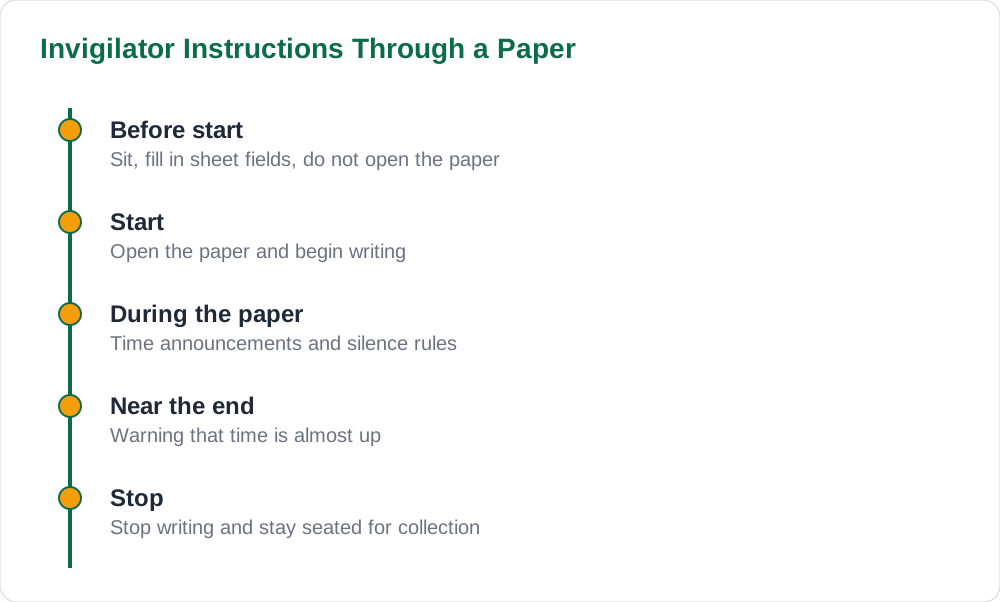
Most instructions fall into a familiar pattern. Before the paper, you will be told when to sit, when to fill in the answer sheet fields, and when not to open the question paper. During the paper, you may be told about time remaining, usually at set intervals, and about rules such as not talking or leaving your seat. Near the end, you will be warned when time is almost up and told to stop writing, tie supplementary sheets if any, and remain seated until sheets are collected. Each of these instructions has a purpose, and each one is timed to the board's schedule for the paper.
Some instructions are specific to the paper, such as which sections are compulsory, whether a calculator is allowed, or how rough work should be marked. Listen to these as carefully as to the general rules, because they can differ from paper to paper even within the same examination. If you miss an instruction because you were settling in, raise your hand and ask politely for it to be repeated; invigilators expect this and would rather repeat an instruction than deal with a mistake later. Do not rely on a neighbour's version of an instruction, which may be wrong or incomplete.
Why Prompt Obedience Protects Your Paper
Following instructions promptly protects the pupil in concrete ways. Stopping when told prevents the answer sheet from being marked as a late-finishing case. Staying seated until collection prevents a sheet from being mixed up or lost. Not opening the paper early prevents an accusation of starting before time. Each rule exists because a past incident showed what happens without it, and a pupil who follows them gives the board no reason to question their paper. Obedience is not about politeness alone; it is about keeping your own result safe.
The reverse is also true: disobeying an instruction can create a formal incident even when the pupil meant no harm. Continuing to write after the stop call, for example, is routinely recorded in the invigilator's report, and the board may decide what to do with that paper. Talking during the paper, even to ask for a pen, can be recorded as communication between candidates. The safest approach is simple: if an instruction is unclear, ask; if it is clear, follow it at once; and if you disagree with it, raise the matter after the paper through your school, not by arguing in the hall.
How to Raise a Problem Through the Invigilator
Problems should be raised by raising your hand and waiting, not by calling out or leaving your seat. State the problem briefly and factually: a damaged paper, a missing sheet, feeling unwell, a disturbing noise, or a seat already occupied. The invigilator will either solve it on the spot or refer it to the superintendent, and may write a note in the hall report. That report matters, because if you later need to explain something about your paper, the board will look at what was recorded at the time, not at a version remembered days later.
If you feel unwell, say so early rather than struggling on silently, because the centre has a procedure for illness and an early report strengthens any later application. If another candidate disturbs you, report it quietly rather than reacting, because a reaction can make you part of the incident. If you believe an invigilator has treated you unfairly, stay calm in the hall, note the facts, and report them to your school afterwards in writing. A prompt, factual, written complaint through the school is far stronger than a heated exchange during the paper.
Respect, Calm and the Rest of the Hall
Politeness toward the invigilator costs nothing and buys a great deal. A greeting, a quiet voice and a raised hand set a tone that makes the invigilator more willing to help with a genuine problem. Pupils who are rude or argumentative, by contrast, draw attention to themselves and make every later interaction harder. Remember too that the invigilator is managing dozens of candidates at once, often in a hot hall, and that patience on both sides keeps the examination running smoothly for everyone.
Calm is also a study skill. A pupil who panics at an unfamiliar question or a strict instruction loses time that a calm pupil keeps. Practising the hall routine in advance — arriving early, sitting quietly, filling the sheet carefully, raising a hand for help — turns the examination into a familiar procedure rather than a frightening unknown. Schools that run a mock centre session before the board exams give their pupils a real advantage here, and pupils whose schools do not can still rehearse the routine at home by timing a past paper under hall rules. For the wider rules of the day, follow the instructions printed on your own slip and your school's briefing, which are specific to your centre. Subject revision help is available in the solved notes library and the books catalogue, and other board guides sit on the blog index.
AI Help: Muse AI
Muse AI is Meta's personal AI assistant, and it can help you rehearse hall etiquette, for example by role-playing common invigilator instructions and quizzing you on the right response to each one.
Join Muse with invite code LTGSWD — in the Muse app, go to Settings > Redeem token and enter the code.
Disclosure: LTGSWD is the author's Muse invite code.
Muse AI does not give official STBB answers — always verify against your Sindh Textbook Board book and your teacher.
5 key points you must know
- The invigilator runs the hall for the board and is deliberately not your own teacher.
- Listen for paper-specific instructions as well as general rules — they differ by paper.
- Follow stop and seating instructions at once; disobedience can be recorded in the hall report.
- Raise problems by raising your hand and stating facts briefly and calmly.
- Disagreements go to your school in writing after the paper, never into an argument in the hall.
Frequently asked questions
Can I ask the invigilator to explain a question?
No — invigilators cannot explain questions or give hints, because that would be unfair to other candidates. They can help with damaged papers, missing sheets, seating and other procedural problems.
What if I miss an instruction the invigilator gives?
Raise your hand and ask politely for it to be repeated. Invigilators expect this and would rather repeat an instruction than deal with a mistake afterwards.
What happens if I keep writing after the stop call?
It is usually recorded in the invigilator's report, and the board may decide how to treat that paper. Stop at once when told, even mid-sentence.
Can I complain about an invigilator during the paper?
Stay calm in the hall and report the matter to your school afterwards, promptly and in writing, with the facts. A heated exchange during the paper helps no one and can make you part of an incident.
Who is in charge if the invigilator cannot solve a problem?
The centre superintendent, who oversees the whole centre and decides matters referred by invigilators, such as disputed documents or serious incidents.
Solved notes — preview free
These guides work best with the solved exercises. Preview the solved notes free on this website — 119 solved notes for Classes 6–10 in Sindhi, Urdu, English and Arabic medium. Or browse the full solved notes catalogue for your class and medium. New solved notes are added regularly — check the catalogue for coming-soon books.