How to Read Your Board Marksheet: Codes and Grades
A board marksheet can look confusing the first time you hold it. Rows of codes, abbreviations, and numbers crowd the page, and it is easy to misread a subject or misunderstand a grade. The good news is that every marksheet follows the same basic logic: it identifies you, lists each subject you sat, shows the marks you earned, and summarises the result. Once you understand the layout, reading it takes only a few minutes. This guide walks through the common fields on a board marksheet in plain language. It explains what subject codes mean, how marks and grades relate, and which details you should check carefully. Because formats differ slightly between boards and years, treat this as a general guide and confirm anything unusual with your school or the board that issued the document.
What a Marksheet Actually Is
A marksheet is the official record of your performance in a board examination. It is not the same as a certificate, although the two are often issued together. The marksheet shows the detail — marks in each subject — while the certificate usually confirms that you passed the examination as a whole. Colleges, employers, and other boards may ask to see either or both, so keep both documents safe.
Your marksheet is a formal document, so handle it with care. Avoid folding it, writing on it, or laminating it unless the board advises it, because damaged documents can be harder to verify later. Keep a clear scanned copy at home, and store the original in a safe folder with your other academic records. If you ever need to submit it somewhere, a photocopy is usually enough unless the original is specifically requested.
The Personal Details at the Top
The top of the marksheet carries your personal and examination details. You will usually see your full name, your father's name, your roll number, your enrolment or registration number, the name of your school or institution, and the examination session, such as annual or supplementary. Check every one of these fields as soon as you receive the document.
Even a small spelling error can cause problems later, for example when a college compares your marksheet with your identity documents. If you spot a mistake, raise it with your school promptly and ask about the board's correction process. Confirm the current procedure, documents, and timeline with your school or the board's official notification, and keep a written record of what you were told.
- Full name and father's name — must match your identity and admission records.
- Roll number — the number under which you sat the examination.
- Registration or enrolment number — links you to the board's records.
- School or institution name — where you were enrolled for the examination.
- Examination session and year — for example, the annual examination of a given year.
Subject Rows, Codes, and Marks
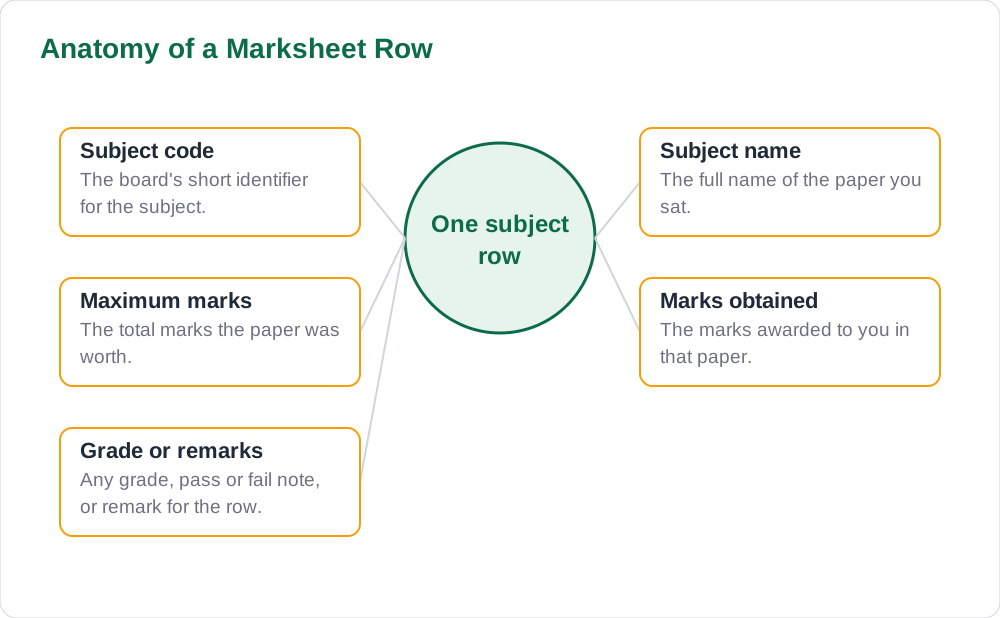
The main body of the marksheet lists each subject you took. Each row normally shows a subject code, the subject name, the maximum marks, and the marks you obtained. The subject code is simply a short number or letter combination the board uses to identify the subject in its system. It is not a secret grade — it just keeps records tidy and avoids confusion between subjects with similar names.
Some subjects are split into parts, such as a theory paper and a practical paper, and these may appear as separate rows or as combined totals. Read each row carefully and add the parts together if you want to check your subject total. If a row shows an abbreviation you do not recognise, such as absent, withheld, or compartment, do not guess its meaning — ask your school for an explanation before assuming the worst.
If you are unsure how your result compares with your expectations, it helps to revisit your preparation honestly. Guides like how to get an A-plus in Sindh board exams explain the study habits behind strong results, and how to avoid common exam mistakes covers the small errors that cost marks.
Total Marks, Percentages, and Grades
Below the subject rows you will usually find the total marks obtained out of the grand total, and sometimes a percentage. A percentage is simply your total marks divided by the maximum marks, multiplied by one hundred. Some boards also show a grade, a grade point, or a division, such as first division, based on ranges set by the board. These ranges can change, so never assume that a grade boundary from one year or board applies to another.
Grades describe bands of performance rather than exact marks. Two pupils with the same grade may have different totals, and that is normal. When a college or employer asks for your grade, they are usually interested in the band, but when they ask for marks, they want the numbers. Keep both in mind, and quote exactly what the marksheet says rather than converting one into the other yourself.
- Total marks: the sum of marks obtained across all subjects.
- Percentage: total obtained divided by total maximum, times one hundred.
- Grade or division: the band your total falls into, as defined by the board.
- Remarks: notes such as pass, compartment, or withheld, if any apply.
Common Marksheets Codes and Remarks
Marksheets sometimes carry remarks that confuse pupils. A remark such as compartment usually means you must clear one or more subjects in a later attempt. A withheld result means the board has not yet finalised that result, often because a document or verification is pending. An absent remark means the board recorded no appearance for that paper. Each of these has its own follow-up steps, so read the remark, stay calm, and ask your school what to do next.
Never rely on rumours about what a remark means. Boards publish their own explanations, and your school office deals with these cases every year. If a remark affects your admission plans, explain your situation to the school and ask for written guidance on the next steps and the timeline. You can also explore the solved notes and study resources on this site to keep your preparation moving while the paperwork is sorted.
What to Check Before You Put It Away
Before you file your marksheet, run through a short checklist. Confirm that your name, father's name, roll number, and school name are correct. Check that every subject you sat appears, that the marks look consistent with what you expected, and that the total adds up. If anything looks wrong, report it early — corrections are usually easier soon after results are issued.
Finally, remember that a marksheet is a record, not a verdict on your future. It tells you where you stood in one examination. Whether the result delights or disappoints you, the useful response is the same: understand it, learn from it, and plan the next step. If you need to improve a subject, start with a realistic plan — our guide on finishing the syllabus in 30 days shows how to organise a focused revision block.
AI Help: Muse AI
Muse AI is Meta's personal AI assistant. If a marksheet term confuses you, you can ask Muse AI to explain codes, grades, and remarks in simple words, or to help you draft a checklist of questions to ask your school. Muse AI does not give official Sindh Textbook Board answers — always verify against your Sindh Textbook Board book and your teacher.
Join Muse with invite code LTGSWD — in the Muse app, go to Settings > Redeem token and enter the code.
Disclosure: LTGSWD is the author's Muse invite code.
5 key points you must know
- A marksheet lists your subjects, marks, total, and result — the certificate confirms the pass itself.
- Subject codes are the board's identifiers for subjects, not hidden grades.
- Check your name, roll number, school, and every subject row as soon as you receive the marksheet.
- Grades describe bands of performance; quote exactly what the marksheet says.
- Report errors or unclear remarks to your school promptly rather than guessing.
Frequently asked questions
What is the difference between a marksheet and a certificate?
The marksheet shows your marks in each subject, while the certificate usually confirms that you passed the examination as a whole. Colleges may ask for either or both, so keep both documents safe.
What does a subject code on a marksheet mean?
A subject code is a short number or letter combination the board uses to identify a subject in its records. It helps avoid confusion between subjects with similar names and has nothing to do with your grade.
How is the percentage on a marksheet calculated?
In general, the percentage is your total marks obtained divided by the maximum marks, multiplied by one hundred. If your board shows a percentage, use the figure printed on the marksheet rather than recalculating it yourself.
What should I do if my name is spelled wrong on my marksheet?
Report it to your school as soon as possible and ask about the board's correction process. Confirm the current procedure, documents, and timeline with your school or the board's official notification.
What does a withheld result mean?
A withheld result generally means the board has not yet finalised that result, often because a document or verification is pending. Ask your school for the reason and the next steps instead of assuming the outcome.
Solved notes — preview free
These guides work best with the solved exercises. Preview the solved notes free on this website — 119 solved notes for Classes 6–10 in Sindhi, Urdu, English and Arabic medium. Or browse the full solved notes catalogue for your class and medium. New solved notes are added regularly — check the catalogue for coming-soon books.