What Air and Water Are Made Of: Composition Explained
Air and water are the two substances you use most and think about least. You breathe air every moment and drink water every day, yet most pupils cannot say what either one is actually made of. This guide answers both questions with simple, standard chemistry: air is a mixture of gases, mostly nitrogen and oxygen, and water is a compound of hydrogen and oxygen. Understanding the difference between a mixture and a compound is the key to the whole topic, because air and water look similar — both are colourless and everywhere — but they are chemically opposite kinds of substance. We explain the composition of air with percentages, show how scientists proved what air contains, and describe the composition of water with the famous electrolysis experiment that splits it back into hydrogen and oxygen. Along the way you will learn why pure water is rare, why air pollution matters, and how the composition of both substances connects to life itself.
Air Is a Mixture, Not a Compound
Air is a mixture of gases that are simply mixed together, not chemically bonded. The main gases are nitrogen, about 78 percent, and oxygen, about 21 percent, with the remaining 1 percent made up of argon, carbon dioxide, water vapour, and tiny amounts of other gases. Because air is a mixture, its composition varies slightly from place to place: humid air holds more water vapour, city air holds more carbon dioxide and pollutants, and the proportions can be separated by physical methods such as cooling and fractional distillation.
The mixture idea explains many observations. You can breathe air in and out all day without changing what air is, because your lungs do not split the mixture apart chemically — they simply take some oxygen from it and add carbon dioxide. The gases in air keep their own properties: oxygen still supports burning, nitrogen still dilutes it, carbon dioxide is still absorbed by plants. If air were a compound, its parts would lose those properties, and breathing would be a very different process.
Oxygen and Nitrogen: The Two Main Gases
Oxygen, about a fifth of air, is the gas that supports burning and breathing. A glowing splint relights in oxygen, a test that proves its presence. All animals, including humans, need oxygen to release energy from food, and all fires need it to burn. Nitrogen, about four-fifths of air, is much less reactive. It dilutes the oxygen, slowing burning so fires stay manageable, and it is the raw material plants need to build proteins — though plants cannot use nitrogen gas directly and rely on nitrogen-fixing bacteria and fertilisers to convert it into usable forms.
A useful way to remember the proportions is that air is roughly four parts nitrogen to one part oxygen. A simple school experiment proves that oxygen is about a fifth of air: burning a candle or a piece of phosphorus inside an inverted jar over water removes the oxygen, and water rises to fill about one-fifth of the jar. This experiment is a classroom classic because it turns an invisible gas into a visible measurement, and it is worth being able to describe it step by step in an exam.
- Nitrogen: about 78% of air, unreactive, dilutes oxygen, raw material for plant proteins.
- Oxygen: about 21% of air, supports burning and breathing, tested with a glowing splint.
- Argon and others: about 1%, including carbon dioxide and water vapour.
- Air is a mixture: gases keep their own properties and can be separated physically.
Carbon Dioxide, Water Vapour and Argon
Carbon dioxide is only a small fraction of air — roughly four hundredths of one percent — but it matters enormously. Plants absorb it for photosynthesis, and it is the gas we breathe out. Human activity, especially burning fossil fuels, has increased its concentration, which warms the planet. Water vapour is the gas form of water, and its amount varies with weather: humid days hold more, dry days less. It matters for clouds, rain, and how comfortable the air feels.
Argon, about 0.9 percent of air, is a noble gas that does almost nothing chemically. It is used in light bulbs, where its unreactive nature protects the filament, and in welding, where it shields hot metal from oxygen. The small gases in air are a good reminder that importance is not about quantity: carbon dioxide is tiny in proportion yet central to life and climate, while nitrogen is huge in proportion yet chemically quiet.
Water Is a Compound: H2O
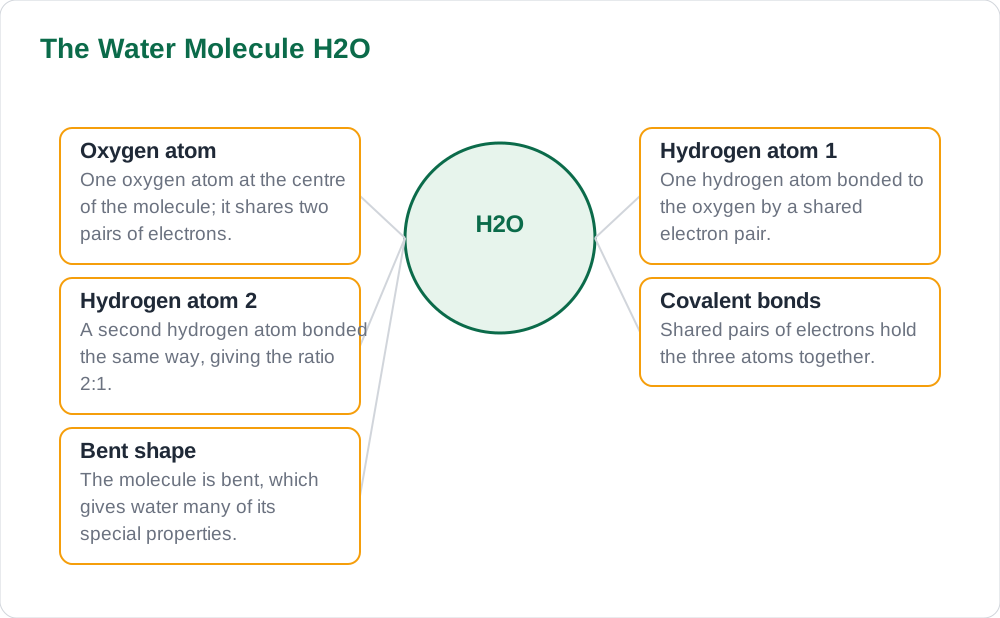
Water is not a mixture — it is a compound, a substance in which hydrogen and oxygen atoms are chemically bonded in a fixed ratio. Every water molecule is H2O: two hydrogen atoms bonded to one oxygen atom. Unlike the gases in air, hydrogen and oxygen in water have lost their individual properties: hydrogen alone burns explosively and oxygen alone supports burning, but water puts out fires. That change of properties is the signature of a compound, and it is the strongest contrast you can draw between air and water.
The fixed ratio matters too. A mixture can vary — air can hold more or less water vapour — but a compound cannot: every pure water molecule is H2O, always. This is why chemists call water a compound and air a mixture, and why the two substances are separated by different methods. You can separate air physically; you can only split water chemically, by giving it enough energy to break its bonds.
Proving It: Electrolysis of Water
Electrolysis splits water into hydrogen and oxygen using electricity, and it is the classic proof of water's composition. When an electric current passes through slightly acidified water, bubbles of hydrogen appear at the negative electrode and bubbles of oxygen at the positive electrode. The hydrogen collects twice as fast as the oxygen — two volumes of hydrogen for every one volume of oxygen — matching the H2O ratio. The gases can be identified by their tests: hydrogen pops with a lighted splint, oxygen relights a glowing splint.
The experiment also proves that water is a compound rather than a mixture, because only a chemical change — breaking bonds with electrical energy — can split it. Pure water conducts electricity poorly, so a little acid or salt is added to help the current flow. Being able to describe this experiment — apparatus, observation, gas tests, and the 2:1 conclusion — is a standard exam question, and the ratio is the fact examiners most often check. For related life-science context, see Photosynthesis Process Steps and Ecosystem Energy Flow.
AI Help: Muse AI
Muse AI is Meta's personal AI assistant, and it can help with this topic by quizzing you on the contrast between air and water: ask it to list mixture-versus-compound evidence and test whether you can classify each one. Muse AI does not give official Sindh Textbook Board answers — always verify against your Sindh Textbook Board book and your teacher.
Join Muse with invite code LTGSWD — in the Muse app, go to Settings > Redeem token and enter the code.
Disclosure: LTGSWD is the author's Muse invite code.
5 key points you must know
- Air is a mixture: about 78% nitrogen, 21% oxygen, 1% other gases.
- Water is a compound: every molecule is H2O, two hydrogen to one oxygen.
- Mixtures vary and keep their parts' properties; compounds are fixed and change them.
- Electrolysis splits water into hydrogen and oxygen in a 2:1 volume ratio.
- Small gases matter: carbon dioxide drives photosynthesis and climate.
Frequently asked questions
What is air made of?
Air is a mixture of gases: about 78% nitrogen, about 21% oxygen, and about 1% argon, carbon dioxide, water vapour, and other gases. The proportions vary slightly with place and weather.
What is water made of?
Water is a compound of hydrogen and oxygen with the formula H2O — two hydrogen atoms bonded to one oxygen atom in every molecule.
Why is air a mixture but water a compound?
In air the gases are only mixed, keep their own properties, and can vary in proportion. In water the hydrogen and oxygen are chemically bonded in a fixed ratio and have lost their individual properties.
How does electrolysis prove water is H2O?
Electrolysis splits water into hydrogen and oxygen gases in a 2:1 volume ratio — two volumes of hydrogen for every one volume of oxygen — matching the two hydrogen atoms and one oxygen atom in each molecule.
How can I show oxygen is about a fifth of air?
Burn a candle or phosphorus in an inverted jar over water: the oxygen is used up, and water rises to fill about one-fifth of the jar, showing oxygen is roughly 20% of air.
Solved notes — preview free
These guides work best with the solved exercises. Preview the solved notes free on this website — 119 solved notes for Classes 6–10 in Sindhi, Urdu, English and Arabic medium. Or browse the full solved notes catalogue for your class and medium. New solved notes are added regularly — check the catalogue for coming-soon books.