How to Read Nazm and Ghazal for Class 11 Urdu

The class 11 Urdu nazm ghazal reading method in this guide uses three calm passes: gist, imagery, then message. College-level Urdu poetry can feel dense on the first reading, because a few lines may carry a large idea, a picture, and a feeling at once. You do not need to understand everything in one pass. If you read slowly, notice the images, and then ask what the poet is saying, nazm and ghazal become much more readable and much easier to write about.
Why Urdu Poetry Feels Hard at First
Many students try to translate every word in a poem and then feel lost, because poetry does not work like a prose paragraph. A nazm builds one connected idea across its lines, while a ghazal often gives you separate couplets that each carry a complete thought. When you treat both forms the same way, or rush to find a hidden meaning in every line, the reading becomes confusing. The fix is to slow down and separate the jobs: first get the general sense, then look at the pictures, then think about the message.
Difficult vocabulary is only part of the challenge. Poets use images, comparisons, and feelings that need a moment to settle. A line may describe the evening, a journey, a memory, or a moral idea through a picture rather than a direct statement. If you pause and picture the image in your mind, the meaning often becomes clearer than if you keep hunting for a dictionary meaning. Your Sindh Textbook Board books give you the poems themselves; your job is to build a reading habit that lets those poems speak gradually.
Pass One: Get the Gist Without Stopping
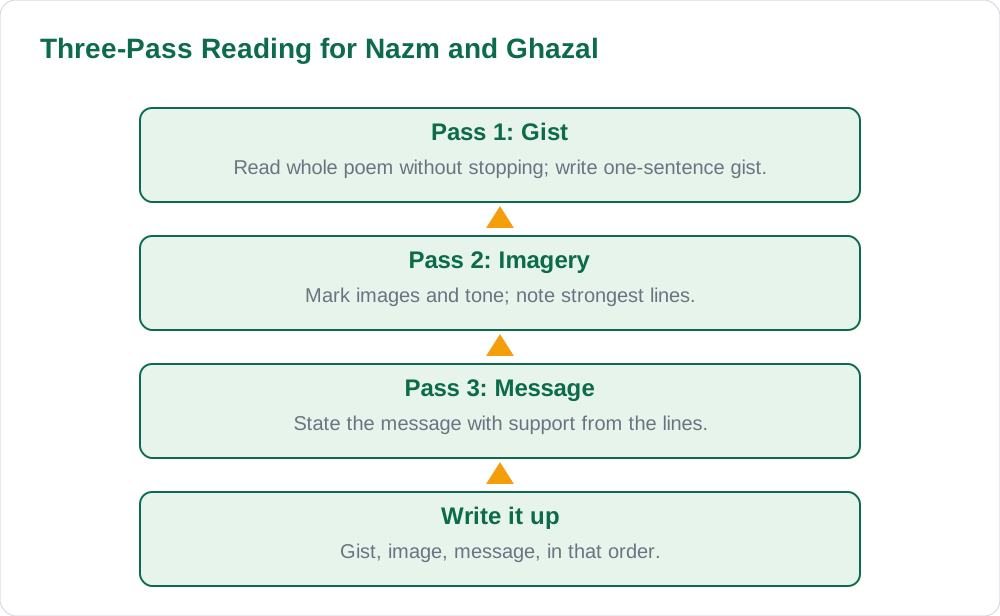
In the first pass, read the whole nazm or ghazal slowly from start to finish without stopping to analyse. Do not look up every word. Do not write notes yet. Just ask one question at the end: what is this poem broadly about? It may be about nature, love, time, hope, patience, homeland, learning, or a moral lesson. Write that gist in one simple sentence in your own words. This sentence becomes your anchor for the next passes, and it stops you from drifting into unrelated ideas.
If the gist is unclear after one reading, read the poem aloud once more, still without stopping. Hearing the rhythm often helps the sense fall into place. In a ghazal, treat each couplet as its own small unit during this pass, and note the feeling of each couplet separately. In a nazm, follow the flow from one part to the next and notice where the idea shifts. At this stage, a rough gist is enough; precision comes later.
- Read the whole poem once without stopping for meanings.
- Write the gist in one simple sentence in your own words.
- In a ghazal, note the feeling of each couplet separately.
- In a nazm, notice where the main idea shifts.
Pass Two: Notice Imagery and Feeling
In the second pass, read slowly and underline the images: words about light, night, garden, river, journey, mirror, lamp, season, or voice. Ask what picture each image creates and what feeling it carries. A garden image may suggest freshness or memory. A journey image may suggest effort or change. A night image may suggest silence, loneliness, or rest. You do not need fancy labels for these effects. You need to notice what the reader is meant to see and feel.
Also notice the tone. Is the poem hopeful, sad, thoughtful, questioning, or encouraging? Tone often comes from word choice and from the way lines rise or fall. Mark two or three lines where the feeling is strongest, and write a short note beside each one. These notes become the evidence for your later answers. For general answer-writing habits, the guide on how to write a perfect answer in Sindh board exams shows how short, supported points earn marks.
Pass Three: Find the Message and Support It
In the third pass, ask what the poet wants the reader to understand or feel. In a nazm, the message usually grows across the poem, so look at the beginning, the turning point, and the ending together. In a ghazal, each couplet may carry its own message, so state the message couplet by couplet rather than forcing one message onto the whole poem. Keep the message close to the words you actually read. If you cannot point to a line that supports your message, the message is probably a guess.
When you write about the poem, follow a simple order: state the gist, mention the strongest image, then state the message with a short reference to the lines. Avoid long retellings of every line. Examiners value a clear central idea supported by two or three well-chosen observations more than a long, vague summary. Keep your language simple and your points in order, so the reader can follow your thinking without effort.
A Weekly Practice Routine for Poetry
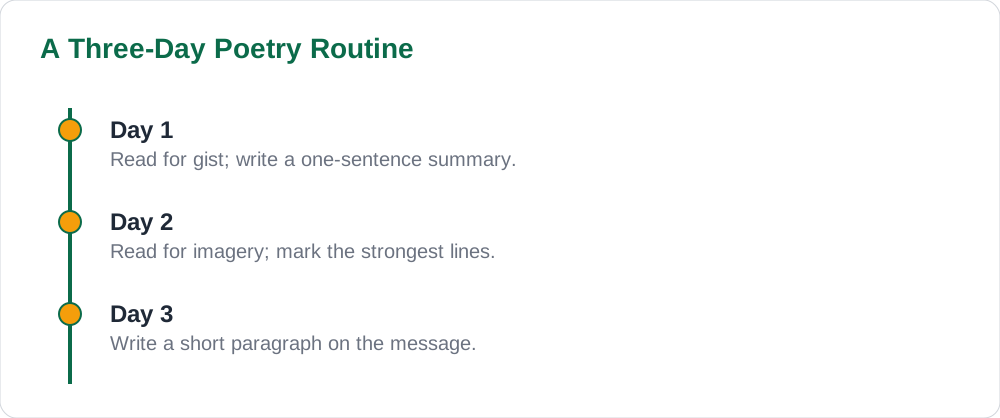
Poetry improves with short, regular practice rather than long, rare sessions. Choose two poems a week and give each one three readings on different days. On day one, read for gist and write your one-sentence summary. On day two, read for imagery and mark the strongest lines. On day three, write a short paragraph about the message, using your notes. This spaced routine keeps the poem fresh and builds the habit of reading carefully.
Read aloud whenever you can. Urdu poetry is written to be heard, and hearing the sound often reveals the feeling before the meaning is fully clear. Keep a small notebook for poetry notes: poem title, one-sentence gist, two strong images, and one message sentence. Over a term, that notebook becomes a compact revision record. You can also strengthen general study habits with the tips in how to revise before exam night, which show how short review sessions protect what you have learned.
AI Help: Muse AI
Muse AI is Meta's personal AI assistant. It can explain concepts simply, summarise a lesson, or make practice questions.
For this topic, you can paste a short couplet you find difficult and ask Muse AI to explain its image and feeling in plain words, then compare that explanation with your own reading before you write an answer.
Join Muse with invite code LTGSWD — in the Muse app, go to Settings > Redeem token and enter the code.
Disclosure: LTGSWD is the author's Muse invite code.
Muse AI does not give official Sindh Textbook Board answers — always verify against your Sindh Textbook Board book and your teacher.
5 key points you must know
- Read Urdu poetry in three passes: gist, imagery, then message.
- In a nazm, follow one connected idea; in a ghazal, treat each couplet as its own unit.
- Notice images and tone before you try to state a message.
- Support every message claim with a line from the poem itself.
- Practise two poems a week with short, spaced sessions.
Frequently asked questions
Should I translate every word before I understand a poem?
No. Word-by-word translation often breaks the flow and leaves you more confused. Read the whole poem first for gist, then return to the lines that matter most. Only then check the few words that block the sense.
How is reading a ghazal different from reading a nazm?
A nazm usually carries one connected idea across its lines, so you follow the flow and the turning point. A ghazal usually gives separate couplets, each with its own complete thought, so you read and explain each couplet on its own rather than forcing one message onto the whole poem.
How do I write about imagery without guessing?
Name the image, describe the picture it creates, and state the feeling it carries, then point to the line that shows it. If you cannot point to a line, the idea is probably a guess. Keep imagery notes short and tied to the text.
How can I remember poems for exams?
Do not try to memorise whole poems word for word at first. Remember the gist, two strong images, and one message sentence per poem, and keep them in a small notebook. Short review sessions, like those in how to make notes from Sindh Textbook Board books, help those points stay fresh.
Solved notes — preview free
These guides work best with the solved exercises. Preview the solved notes free on this website — 119 solved notes for Classes 6–10 in Sindhi, Urdu, English and Arabic medium. Or browse the full solved notes catalogue for your class and medium. New solved notes are added regularly — check the catalogue for coming-soon books.