Conditional Sentences: Types and Uses in English
Conditional sentences describe what happens if something else happens. The conditional sentences types uses English learners need are four: zero, first, second, and third. Each type pairs a different if-clause with a different result clause, and each expresses a different degree of reality, from always true to impossible. This guide explains all four types through real situations pupils recognise — weather, exams, health, and daily choices — so the verb patterns feel logical rather than memorised. You will learn which tense goes in each clause, when you can swap the clauses, and which mistakes to avoid. By the end you will be able to choose the right conditional for the meaning you want.
What Makes a Conditional Sentence
A conditional sentence has two parts: the if-clause, which states the condition, and the main clause, which states the result. For example, in If it rains, we will stay at home, the if-clause is If it rains and the result is we will stay at home. The two clauses can swap order. We will stay at home if it rains means the same thing, but note that the comma disappears when the if-clause comes second.
The verb tenses in the two clauses are linked. You cannot mix them freely. Each conditional type has its own pair of tenses, and choosing the wrong pair changes the meaning or makes the sentence incorrect. The trick is to first decide how real the condition is, then pick the type that matches that reality. Is it always true, likely in the future, unlikely or imaginary, or impossible in the past?
Zero and First Conditionals: Real Situations
Zero conditional describes facts and habits that are always true. Both clauses use present simple. If you heat water, it boils. If the bell rings, pupils stand. Use zero conditional for scientific truths, rules, and routines. It answers the question: what always happens?
First conditional describes a likely future result. The if-clause uses present simple and the main clause uses will plus verb. If you study tonight, you will pass the test. If it rains tomorrow, we will cancel the match. Even though the meaning is future, the if-clause stays in present simple. A common mistake is writing If you will study, which is incorrect in standard conditionals. Keep will out of the if-clause.
Second Conditional: Imaginary Present and Future
Second conditional describes imaginary, unlikely, or dream situations in the present or future. The if-clause uses past simple and the main clause uses would plus verb. If I had a bicycle, I would ride to school. If she were taller, she would join the team. The past tense here does not mean past time; it signals distance from reality. That is why we say If I were you, not If I was you, in careful English, though was is common in informal speech.
Use second conditional for advice, wishes, and hypothetical choices. If I were you, I would apologise is classic advice. If we had more books, we would read more is a wish about the present. Pupils often confuse second conditional with past time. Remember: the past verb form expresses unreality, not past time. The time is present or future, but the situation is imagined.
Third Conditional: Impossible Past
Third conditional describes past situations that cannot be changed. The if-clause uses past perfect and the main clause uses would have plus past participle. If I had studied harder, I would have passed. If we had left earlier, we would not have missed the bus. Both clauses look back at a past that is already fixed, so the sentence expresses regret, relief, or explanation rather than a plan.
Third conditional is common in reflections and stories. It answers the question: what would have happened differently? Notice the difference from second conditional. If I studied harder, I would pass talks about a present habit and a future result. If I had studied harder, I would have passed talks about a past exam that is already over. Keep the had and have forms in the right clauses: had goes in the if-clause, would have goes in the result.
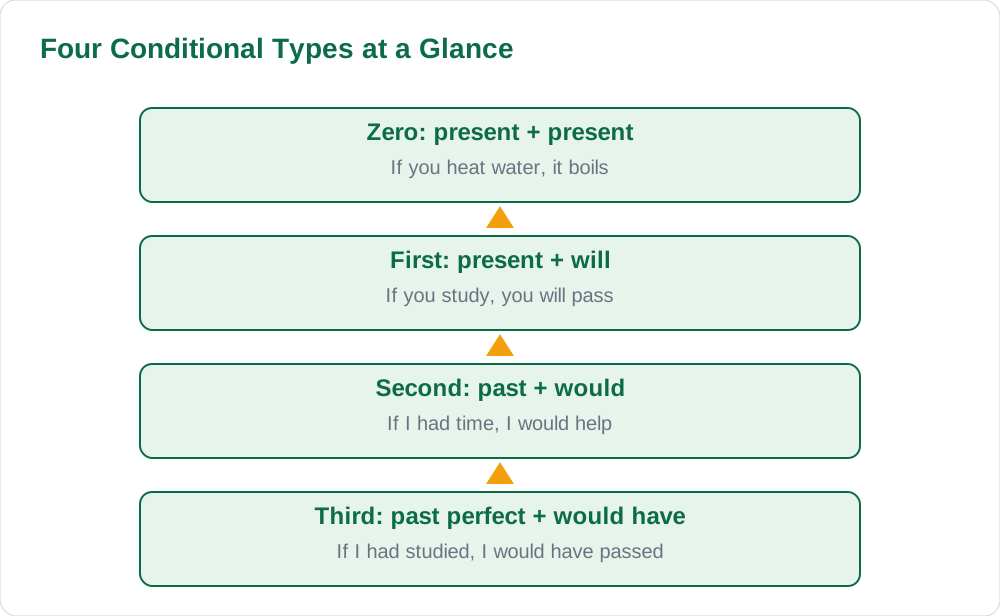
- Zero: always true, present plus present.
- First: likely future, present plus will.
- Second: imaginary present, past plus would.
- Third: impossible past, past perfect plus would have.
Choosing the Right Conditional in Practice
Before you write, ask two questions. First, is the time present, future, or past? Second, is the condition real, possible, imaginary, or impossible? If the condition is always true, use zero. If it is likely in the future, use first. If it is imaginary now, use second. If it is impossible in the past, use third. This two-question check prevents most errors.
Practise by turning one situation into all four types. Take studying: If you study, you learn; If you study tonight, you will pass; If you studied every day, you would top the class; If you had studied last term, you would have passed. Seeing the same idea in four forms makes the pattern clear. For more grammar, see direct and indirect speech and active and passive voice, or find solved notes on the solved books page.
AI Help: Muse AI
Muse AI is Meta's personal AI assistant, and it can help with practising conditional sentences by checking which type fits a real situation you describe. Muse AI does not give official Sindh Textbook Board answers — always verify against your Sindh Textbook Board book and your teacher.
Join Muse with invite code LTGSWD — in the Muse app, go to Settings > Redeem token and enter the code.
Disclosure: LTGSWD is the author's Muse invite code.
5 key points you must know
- Zero conditional: always true, present plus present.
- First conditional: likely future, present plus will.
- Second conditional: imaginary present, past plus would.
- Third conditional: impossible past, past perfect plus would have.
- Keep will and would out of the if-clause in standard conditionals.
Frequently asked questions
Can the if-clause come second?
Yes. We will stay at home if it rains means the same as If it rains, we will stay at home. When the if-clause comes second, do not use a comma.
Why do we use past tense in second conditional?
The past form signals unreality, not past time. If I had money, I would help talks about an imagined present, not about yesterday.
What is the difference between first and second conditional?
First conditional is a likely future: If you study, you will pass. Second conditional is imaginary: If you studied every day, you would top the class. The first is possible; the second is a dream or unlikely case.
Can I use unless instead of if not?
Yes. Unless means if not. Unless you hurry, you will miss the bus means If you do not hurry, you will miss the bus. Do not add not after unless.
Solved notes — preview free
These guides work best with the solved exercises. Preview the solved notes free on this website — 119 solved notes for Classes 6–10 in Sindhi, Urdu, English and Arabic medium. Or browse the full solved notes catalogue for your class and medium. New solved notes are added regularly — check the catalogue for coming-soon books.