English-Medium Comprehension: How to Make Inferences
Comprehension questions often ask pupils to find meaning that is not stated directly. The passage may say that Sara put on her coat, picked up her umbrella, and looked at the dark clouds, and then ask why Sara took an umbrella. The answer is not written in one sentence, but the clues point to it: dark clouds suggest rain. This skill is called inference. It means combining what the text says with what you already know to reach a reasonable conclusion. This guide shows English-medium pupils how to find textual clues, avoid guessing, and write inference answers that examiners can reward.
What an Inference Really Is
An inference is a conclusion drawn from evidence, not a guess. A guess comes from the question or from imagination. An inference comes from clues in the text plus sensible background knowledge. For example, if the text says that Ahmed arrived home late, left his bag by the door, and fell asleep without eating, a pupil can infer that Ahmed was tired. The text never says the word tired, but the clues point to it. A pupil who writes He was tired because he fell asleep without eating has made an inference. A pupil who writes He was tired because he likes sleeping has only guessed.
Examiners look for two things in an inference answer: a clear conclusion and a clue from the text. Pupils should always link the two with because. For example, Sara expected rain because she saw dark clouds and took her umbrella. The word because forces the pupil to show the evidence. Without because, the answer may sound like an opinion. With because, it sounds like reasoning. Teachers can train this habit by asking pupils to underline the clue before they write the answer. For more reading practice, pupils can use the books and the solved notes for their class.
- Inference equals text clue plus sensible background knowledge.
- A guess comes from imagination; an inference comes from evidence.
- Always link the conclusion to the clue with because.
Finding Clues in the Text
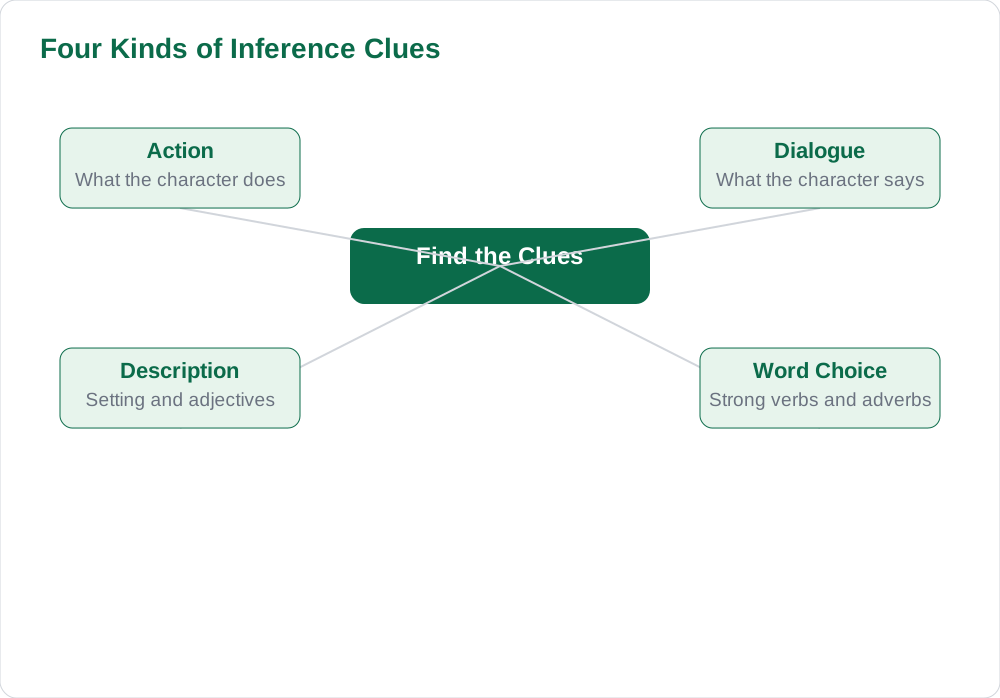
Clues come in several forms. Action clues describe what a character does, such as shivering, smiling, or running. Dialogue clues appear in what a character says, such as I cannot believe this happened. Description clues appear in adjectives and setting details, such as a silent room or a crowded market. Word choice clues appear in strong verbs and adverbs, such as whispered, hurried, or reluctantly. Pupils who look for all four kinds of clues find more evidence than pupils who read only for plot.
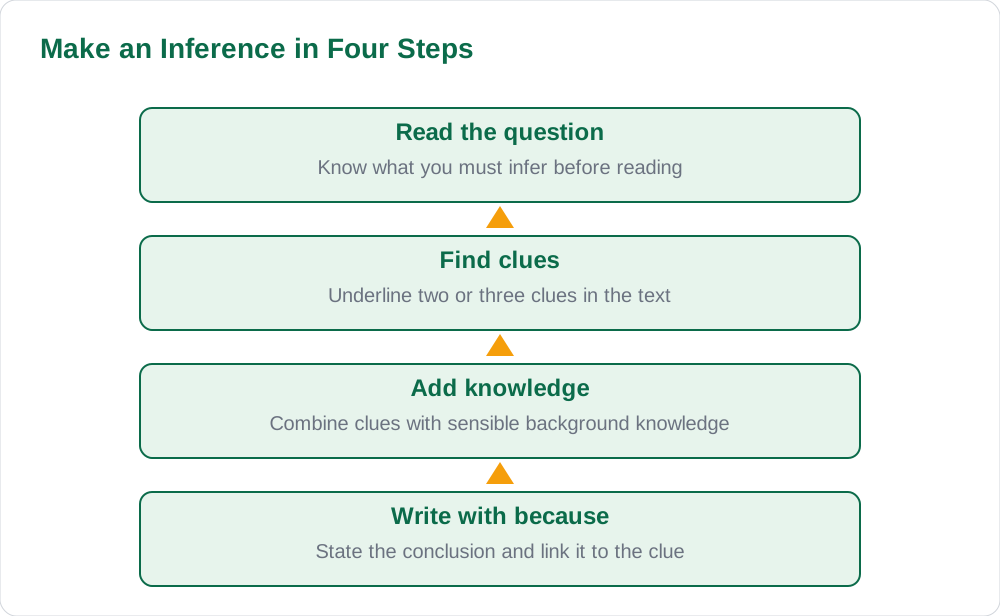
A practical method is to read the question first, then read the passage with the question in mind, and underline two or three clues that relate to the question. For example, if the question asks how the writer feels about the village, the pupil should underline adjectives and sentences that describe the village. If the question asks why a character acted in a certain way, the pupil should underline actions and dialogue near that moment. Underlining slows reading slightly, but it prevents the common error of answering from memory instead of from the text. Pupils can practise this method with passages in the blog and their textbook comprehension exercises.
- Action clues: what a character does, such as shivering or smiling.
- Dialogue clues: what a character says and how they say it.
- Description clues: adjectives, setting, and word choice.
- Underline two or three clues before writing the answer.
Combining Clues With What You Know
Background knowledge helps pupils make sense of clues, but it must stay connected to the text. For example, if the text says that the ground was wet and the leaves were dripping, a pupil who knows that rain makes things wet can infer that it had rained. That is a good use of background knowledge. If the same pupil writes that it rained because it always rains in that city, that is not an inference from the text. It is a general statement that could be true even if the passage said nothing about rain. Teachers should ask pupils to point to the exact sentence that supports each part of their answer.
Pupils should also be careful not to add details that the text does not support. If the text says that a boy was nervous before his speech, the pupil can infer that he wanted to do well, but cannot infer that he had never spoken before. The first inference is supported by the clue. The second adds a fact that the text never mentions. A good rule is to ask: could another pupil reach the same conclusion from the same sentences? If the answer is yes, the inference is reasonable. If the answer is no, the inference is probably a guess. This rule keeps answers fair and examinable.
Writing a Strong Inference Answer
A strong inference answer has three parts: the conclusion, the clue, and the link. For example, The writer feels proud of the school because he describes its students as hardworking and its teachers as caring. The conclusion is that the writer feels proud. The clue is the description of students and teachers. The link is the word because. Pupils who write all three parts earn full marks more often than pupils who write only the conclusion. Even a short answer can include all three parts in one sentence.
Pupils should also use the language of the question in their answer. If the question asks Why did the boy leave early, the answer should begin with The boy left early because. If the question asks What does the writer suggest, the answer should begin with The writer suggests that. Using the question language keeps the answer focused and shows the examiner that the pupil understood the question. Pupils should avoid copying long chunks of the passage. A short quotation of a few words is enough to show the clue. The rest of the answer should be in the pupil's own words. Model answers appear in the solved notes and the books.
- Part 1: State the conclusion clearly.
- Part 2: Name the clue from the text.
- Part 3: Link them with because.
Practice That Builds Inference Skill
Inference improves with short, regular practice. Pupils can practise with any paragraph, not only with exam passages. Read one paragraph, cover it, and ask: what does the writer suggest but not say directly? Then uncover the paragraph and underline the clues. Teachers can use newspaper paragraphs, textbook passages, or story extracts. Parents can ask inference questions about daily life: what does the cloudy sky suggest, or what does a friend's quiet voice suggest? These everyday questions train the same skill in a low-pressure way.
A useful classroom routine is think, pair, share. First, each pupil writes an inference alone. Then pupils compare inferences with a partner and discuss which clue is stronger. Finally, the teacher asks two or three pupils to share their answers and explains why one clue is stronger than another. This routine shows pupils that more than one inference can be reasonable, but some inferences have stronger evidence. Over time, pupils learn to choose the inference with the best evidence, not the first idea that comes to mind. More reading strategies are available in the blog and the solved notes.
- Read one paragraph and ask what it suggests but does not say directly.
- Underline the clues that support the inference.
- Compare answers with a partner and discuss which clue is stronger.
AI Help: Muse AI
Muse AI is Meta's personal AI assistant that can help pupils practise inference by explaining how a clue in a passage supports a conclusion.
Join Muse with invite code LTGSWD — in the Muse app, go to Settings > Redeem token and enter the code.
Disclosure: LTGSWD is the author's Muse invite code.
Muse AI does not give official STBB answers — always verify against your Sindh Textbook Board book and your teacher.
5 key points you must know
- An inference is a conclusion from text clues plus sensible knowledge, not a guess.
- Look for action, dialogue, description, and word choice clues.
- Always link the conclusion to the clue with because.
- Do not add facts the text never mentions.
- Short daily inference practice builds the skill faster than cramming.
Frequently asked questions
How is an inference different from a fact?
A fact is stated directly in the text. An inference is a reasonable conclusion drawn from clues in the text. Pupils should be able to point to the clue that supports every inference they write.
What if two inferences both seem possible?
Choose the one with stronger evidence from the text. Ask which conclusion another pupil could reach from the same sentences. The inference with the clearest clue is usually the better answer.
Should pupils quote the passage in an inference answer?
A short quotation of a few words is enough to show the clue. The rest of the answer should be in the pupil's own words, with the conclusion linked to the clue by because.
How can pupils practise inference at home?
Read one paragraph from any book or newspaper, ask what it suggests but does not say directly, and underline the clues. Discuss the answer with a parent or friend to check whether the evidence is strong.
Solved notes — preview free
These guides work best with the solved exercises. Preview the solved notes free on this website — 119 solved notes for Classes 6–10 in Sindhi, Urdu, English and Arabic medium. Or browse the full solved notes catalogue for your class and medium. New solved notes are added regularly — check the catalogue for coming-soon books.