Explaining Islamiat in Simple English: Tauheed, Risalat, Aakhirat
Islamiat in English medium can feel difficult because the most important ideas have Arabic names: Tauheed, Risalat, and Aakhirat. Pupils may memorise the Urdu or Arabic definitions but struggle to explain them in English. This guide explains the three beliefs in simple, respectful English, with clear examples and careful language. It is written for English-medium pupils in Sindh Textbook Board classes who need to understand the beliefs deeply and answer exam questions in English. It does not replace the textbook or the teacher. It helps pupils express what they already believe in clear English words.
Tauheed: The Oneness of Allah
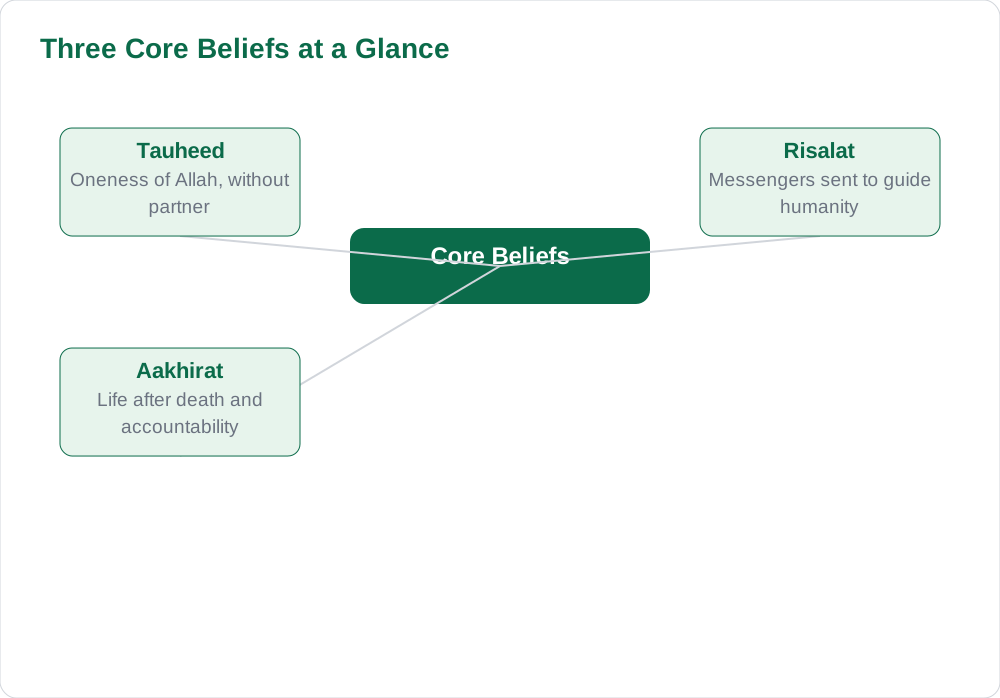
Tauheed means belief in the Oneness of Allah. It means that Allah is One, without partner, and that only Allah deserves worship. In simple English, Tauheed teaches that there is only one Creator, Sustainer, and Master of the universe. All power, knowledge, and mercy belong to Allah alone. This belief shapes how a Muslim thinks about life: a person turns to Allah in prayer, trusts Allah in difficulty, and thanks Allah for blessings. Tauheed also teaches that no created thing, whether a person, an idol, or a force of nature, shares in Allah's divinity.
In an exam answer, pupils can explain Tauheed in three short sentences. First, Tauheed is belief in the Oneness of Allah. Second, it means that Allah alone is worthy of worship and that Allah has no partner. Third, it guides a Muslim to pray only to Allah, to trust Allah, and to live with honesty and gratitude. Pupils should use respectful language and write Allah with care. They should avoid adding ideas that the textbook does not teach. The textbook and the teacher remain the authority for belief and practice. For textbook support, pupils can consult the books and the solved notes.
- Tauheed means belief in the Oneness of Allah, without partner.
- Only Allah deserves worship.
- Tauheed guides prayer, trust, gratitude, and honest living.
Risalat: The Messengers of Allah
Risalat means belief in the Messengers of Allah, who were sent to guide humanity. In simple English, Risalat teaches that Allah sent prophets and messengers to teach people how to worship Allah and how to live a good life. The messengers received revelation from Allah and shared it with their people. They taught truth, justice, kindness, and care for others. Muslims believe in all the messengers, and they believe that Hazrat Muhammad (peace be upon him) is the final Messenger, whose message completes the guidance.
Pupils can explain Risalat by naming its purpose and its result. Its purpose is guidance: messengers show people the right path. Its result is a life based on truth, justice, and compassion. In an exam answer, pupils should write with respect and use the full respectful form for the Prophet (peace be upon him). They should not guess at details that the textbook does not give. If the question asks for examples, pupils should use examples from the textbook and from the Seerah as taught by the teacher. The books and the solved notes can help pupils find the right chapter.
- Risalat means belief in the Messengers sent to guide humanity.
- Messengers taught worship of Allah and a good, just life.
- Hazrat Muhammad (peace be upon him) is the final Messenger.
Aakhirat: Life After Death
Aakhirat means belief in the life after death. In simple English, Aakhirat teaches that this worldly life is not the end. After death, people will be raised again and will answer for their deeds before Allah. Good deeds will be rewarded, and bad deeds will be judged with justice and mercy. This belief gives meaning to daily choices. A person who believes in Aakhirat tries to do good even when nobody is watching, avoids harming others, and seeks forgiveness for mistakes.
Pupils can explain Aakhirat by linking belief to behaviour. Belief in Aakhirat encourages honesty, kindness, patience, and care for others. It also teaches hope: even when life is difficult, a believer trusts that Allah sees every effort and that justice will prevail. In an exam answer, pupils should state the belief clearly, explain accountability, and give one example of how it shapes daily life. They should use respectful language and avoid describing details that the textbook does not teach. The teacher and the textbook remain the guide for this topic.
- Aakhirat means belief in life after death.
- People will answer for their deeds before Allah.
- Belief in Aakhirat encourages honesty, kindness, and patience.
How the Three Beliefs Connect
Tauheed, Risalat, and Aakhirat are connected. Tauheed tells a Muslim whom to worship: Allah alone. Risalat tells a Muslim how to follow guidance: through the Messengers. Aakhirat tells a Muslim why choices matter: because deeds will be judged. Together, the three beliefs give a complete picture of faith: belief in Allah, guidance through the Messengers, and accountability in the life after death. Teachers often ask pupils to explain this connection in one paragraph. Pupils who see the connection can answer such questions without memorising a separate paragraph for each combination.
A simple way to remember the connection is to use three short phrases: One Allah, True Guidance, and Final Accountability. Tauheed is One Allah. Risalat is True Guidance. Aakhirat is Final Accountability. Pupils can write these three phrases at the top of their revision page and then expand each one into two or three sentences. This method helps pupils write organised answers that show understanding. It also helps pupils in oral tests, because they can explain the connection in their own words without reading from notes. More Islamiat study help is in the blog and the solved notes.
Writing Clear Islamiat Answers in English
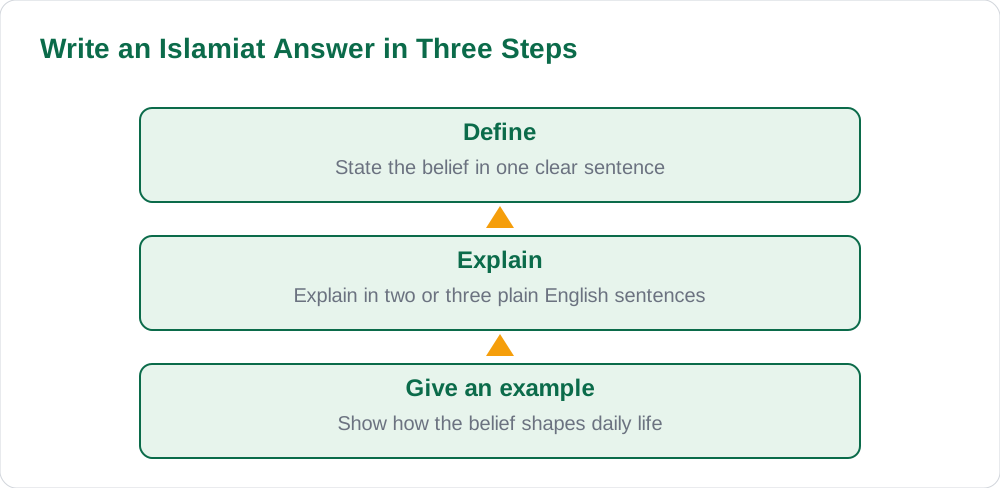
Clear Islamiat answers in English follow a simple structure. First, define the term in one sentence. Second, explain it in two or three sentences with plain English. Third, give one example of how the belief shapes daily life. For example, an answer on Tauheed might begin with Tauheed is belief in the Oneness of Allah. Then it explains that only Allah deserves worship and that Allah has no partner. Then it gives an example: a Muslim prays only to Allah and trusts Allah in difficulty. This structure works for Tauheed, Risalat, and Aakhirat, and for many other Islamiat topics.
Pupils should also use respectful language throughout. Write Allah with respect, use the full form (peace be upon him) for the Prophet, and avoid casual or joking language about sacred topics. Pupils should check their answers against the textbook before handing them in. If the textbook uses a particular Arabic term, pupils should use the same term and explain it, not replace it with a different word. Teachers can help by giving pupils a list of key terms with their English meanings and by marking one practice answer for each belief. The books page lists the textbooks for each class.
- Define the term in one sentence.
- Explain it in two or three plain English sentences.
- Give one example of how the belief shapes daily life.
AI Help: Muse AI
Muse AI is Meta's personal AI assistant that can help pupils explain Tauheed, Risalat, or Aakhirat in simple English and check whether an answer is clear and respectful.
Join Muse with invite code LTGSWD — in the Muse app, go to Settings > Redeem token and enter the code.
Disclosure: LTGSWD is the author's Muse invite code.
Muse AI does not give official STBB answers — always verify against your Sindh Textbook Board book and your teacher.
5 key points you must know
- Tauheed means belief in the Oneness of Allah, without partner.
- Risalat means belief in the Messengers sent to guide humanity.
- Aakhirat means belief in life after death and accountability.
- The three beliefs connect as One Allah, True Guidance, Final Accountability.
- Exam answers should define, explain, and give one daily-life example.
Frequently asked questions
How should pupils write Allah in English answers?
Write Allah with respect and care. Use respectful language throughout, avoid casual wording, and follow the style taught by the teacher and the textbook.
How should pupils mention the Prophet in English answers?
Use the full respectful form Hazrat Muhammad (peace be upon him). Keep the language respectful and avoid adding details that the textbook does not teach.
What is the best way to revise Tauheed, Risalat, and Aakhirat?
Write one definition, two or three explanation sentences, and one daily-life example for each belief. Then practise explaining the connection between the three beliefs in one paragraph.
Should pupils memorise answers for Islamiat?
Understanding comes first. Memorising a definition is useful, but pupils should also be able to explain each belief in their own words and give an example of how it shapes daily life.
Solved notes — preview free
These guides work best with the solved exercises. Preview the solved notes free on this website — 119 solved notes for Classes 6–10 in Sindhi, Urdu, English and Arabic medium. Or browse the full solved notes catalogue for your class and medium. New solved notes are added regularly — check the catalogue for coming-soon books.