English-Medium Lab Reports: Aim, Method, Observation, Conclusion

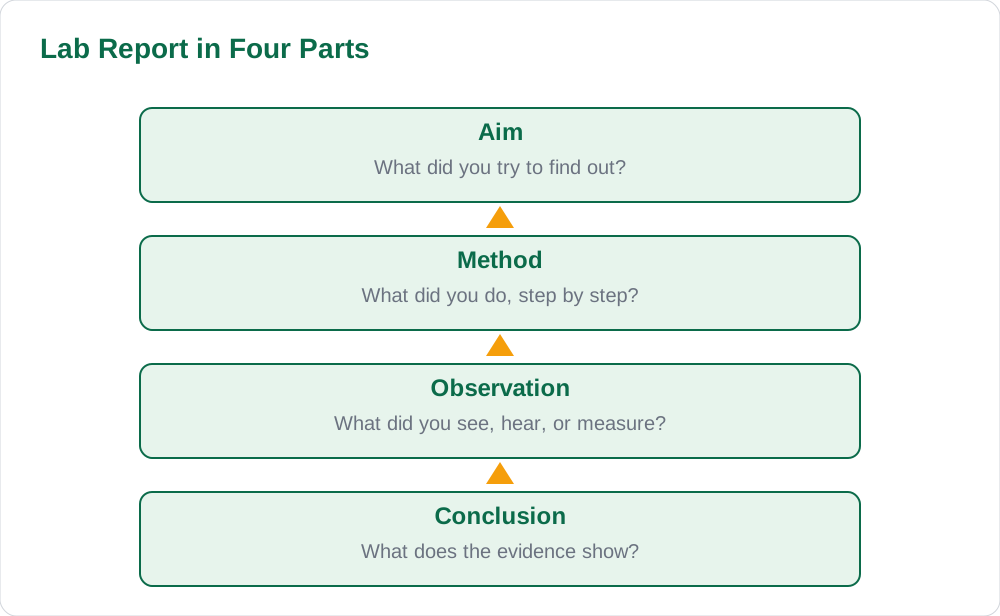
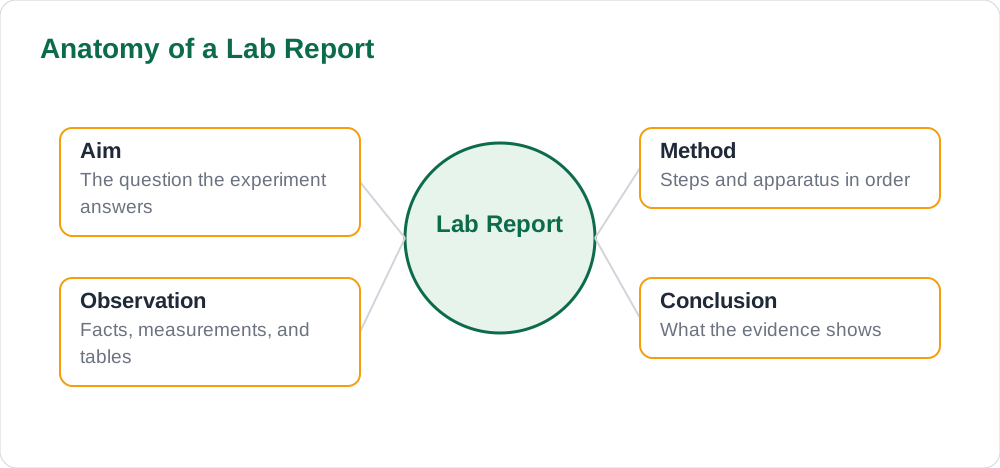
A lab report is not a story about what happened in class. It is a clear, organised record of a science experiment: what you wanted to find out, what you did, what you saw, and what you concluded. Many pupils lose marks not because their experiment failed, but because their report is disorganised, vague, or missing a section. This guide shows English-medium pupils in Sindh Textbook Board classes how to write a lab report in four parts: Aim, Method, Observation, and Conclusion. It gives sentence starters, a model report, and a checklist that keeps every report complete and easy to mark.
What a Lab Report Must Do
A lab report has one job: to let another person understand the experiment without being there. That person should be able to read the report and know what was tested, how it was tested, what happened, and what it means. A good report is short, honest, and precise. It does not exaggerate results, it does not hide mistakes, and it does not copy a textbook paragraph that has nothing to do with the experiment. Pupils should write in clear, simple English and use the past tense for what they did and what they saw.
Lab reports also teach scientific thinking. Writing the aim forces the pupil to state the question clearly. Writing the method forces the pupil to think in steps. Writing observations forces the pupil to separate what was seen from what was guessed. Writing the conclusion forces the pupil to decide what the evidence actually shows. Teachers value this thinking more than beautiful handwriting. Pupils who learn the four-part structure early find later science classes much easier. Examples and writing support appear in the books and the solved notes.
- A lab report lets another person understand the experiment without being there.
- Write in clear, simple English, in the past tense for what you did and saw.
- Separate what you observed from what you concluded.
Aim: State the Question Clearly
The aim is one or two sentences that state what the experiment was trying to find out. It should name the thing being tested and the result being measured. For example, To find out whether warm water dissolves salt faster than cold water is a good aim. It names the variable being changed, warm or cold water, and the result being measured, how fast salt dissolves. A weak aim such as To do an experiment with salt and water does not say what was tested or measured. Pupils should write the aim before the experiment begins, not after it ends.
A useful sentence starter is To find out whether or To see how. Pupils can also use To test whether or To compare. Teachers can check the aim quickly: if a pupil can read the aim aloud and another pupil can guess what the experiment was about, the aim is clear. If the aim is vague, the pupil should rewrite it before starting. Writing a clear aim saves time later, because the method, observation, and conclusion all follow from it. More planning help is in the blog and the solved notes.
- Aim starter: To find out whether ...
- Name what you changed and what you measured.
- Write the aim before the experiment begins.
Method: Steps Another Pupil Could Follow
The method describes what the pupil did, in numbered steps, in the order it happened. Each step should be short and specific. For example, Pour 100 millilitres of warm water into a beaker is better than Take some warm water. A good method also lists the apparatus at the start: beaker, measuring cylinder, thermometer, salt, spoon, and stopwatch. Pupils should include amounts, times, and safety steps, such as wearing safety glasses or handling hot water with care. The test of a good method is simple: could another pupil follow it and repeat the experiment?
Pupils should write the method in the past tense and avoid personal pronouns when possible. Instead of I poured water, write Water was poured into the beaker, or Pour water into the beaker. Both forms are acceptable in school reports, but pupils should follow the teacher's preference. Pupils should not write results in the method section. Results belong in the observation section. Keeping the sections separate makes the report easier to read and easier to mark. Teachers can model one method on the board and ask pupils to number the steps before they begin.
- List apparatus first, then numbered steps in order.
- Include amounts, times, and safety steps.
- Keep results out of the method section.
Observation: What You Saw and Measured
The observation section records what actually happened, without interpretation. It includes what the pupil saw, heard, smelled, or measured. For example, The salt dissolved in 40 seconds in warm water and in 90 seconds in cold water is an observation. It states numbers and facts. The salt dissolved faster because the water was warm is not an observation; it is an explanation. Explanations belong in the conclusion. Pupils should record observations in a table whenever possible, because tables are clear and easy to compare.
Honesty matters more than perfect results. If the experiment did not work as expected, the pupil should write what actually happened, not what the textbook says should have happened. Teachers respect honest observations and can help pupils explain why results differed. Pupils should also record any problem, such as spilling water or misreading the stopwatch, because that problem may explain the result. A good observation section is factual, complete, and organised. It never invents numbers. If a measurement was missed, the pupil should say so rather than guessing. The books show how textbook experiments present observations.
- Record facts and measurements, not explanations.
- Use a table for results whenever possible.
- Record what actually happened, including problems, honestly.
Conclusion and a Model Report
The conclusion answers the aim in one or two sentences. It states what the evidence shows and whether the aim was answered. For example, The results show that salt dissolves faster in warm water than in cold water is a good conclusion for the salt experiment. It directly answers the aim. A good conclusion does not introduce new results or new ideas. It may add one sentence about what could be improved, such as repeating the experiment twice to check the times. Pupils should avoid writing I think or In my opinion in the conclusion. Instead, they should write The results show that, which sounds scientific and evidence-based.
Here is a short model report. Aim: To find out whether warm water dissolves salt faster than cold water. Method: Pour 100 millilitres of warm water into one beaker and 100 millilitres of cold water into another beaker. Add one spoon of salt to each beaker and stir. Record the time taken for the salt to dissolve. Observation: The salt dissolved in 40 seconds in warm water and in 90 seconds in cold water. Conclusion: The results show that salt dissolves faster in warm water than in cold water. Pupils can follow this model for any simple experiment. A checklist for every report is available in the solved notes and the blog.
- Conclusion starter: The results show that ...
- Answer the aim directly, without new results.
- Add one improvement idea if the teacher asks for it.
AI Help: Muse AI
Muse AI is Meta's personal AI assistant that can help pupils turn rough lab notes into a clear aim, method, observation, and conclusion draft.
Join Muse with invite code LTGSWD — in the Muse app, go to Settings > Redeem token and enter the code.
Disclosure: LTGSWD is the author's Muse invite code.
Muse AI does not give official STBB answers — always verify against your Sindh Textbook Board book and your teacher.
5 key points you must know
- A lab report has four parts: Aim, Method, Observation, Conclusion.
- The aim states what was tested and what was measured.
- The method lists apparatus and numbered steps another pupil could follow.
- Observations record facts and measurements honestly, without explanations.
- The conclusion answers the aim with The results show that.
Frequently asked questions
How long should a school lab report be?
One page is usually enough for a simple experiment: two sentences for the aim, five to seven steps for the method, a small table for observations, and two sentences for the conclusion. Longer reports are needed only for longer experiments.
Should pupils write lab reports in past tense?
Yes for the method and observation, because those sections describe what was done and what happened. The aim and conclusion can use present tense for general statements, such as The results show that.
What if the experiment did not work?
Write what actually happened, note the problem honestly, and explain in the conclusion what the evidence shows. Teachers value honest reporting and can help pupils explain unexpected results.
Can pupils draw diagrams in a lab report?
Yes. A labelled diagram of the apparatus or setup makes the method clearer. Keep the diagram simple, label the parts, and give it a short title.
Solved notes — preview free
These guides work best with the solved exercises. Preview the solved notes free on this website — 119 solved notes for Classes 6–10 in Sindhi, Urdu, English and Arabic medium. Or browse the full solved notes catalogue for your class and medium. New solved notes are added regularly — check the catalogue for coming-soon books.