Cornell Notes for Sindh Textbook Board Chapters
Many pupils copy whole textbook paragraphs into their notebooks and call it note-taking. The result is long, hard to revise, and easy to forget. Cornell Notes solve this problem with a simple page layout: a narrow cue column on the left, a wide notes column on the right, and a short summary at the bottom. Pupils take notes during reading or class, then write questions in the cue column and a summary at the bottom. This guide shows English-medium pupils in Sindh Textbook Board classes how to adapt Cornell Notes to STBB chapters, with examples, a weekly routine, and tips for every subject.
The Cornell Page in Three Parts
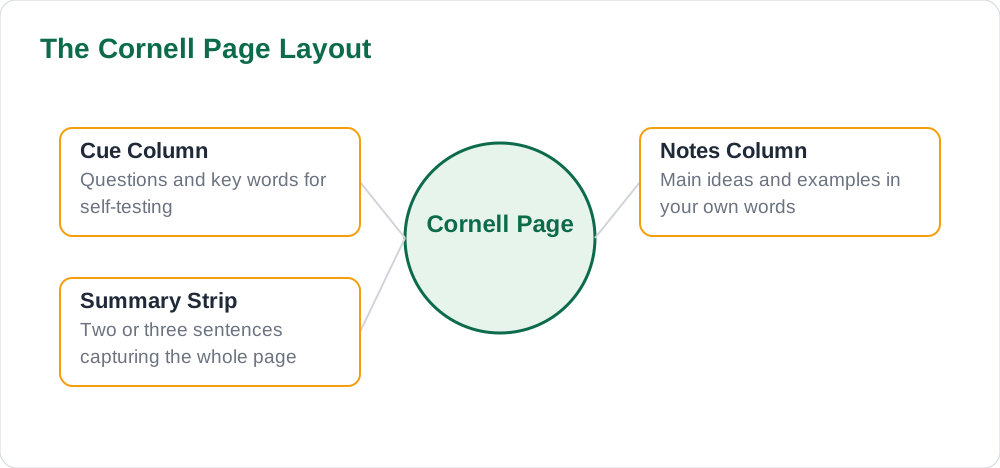
A Cornell page has three parts. The notes column on the right is the widest part. Pupils write main ideas, key terms, and short examples there in their own words. The cue column on the left is narrow. Pupils write questions, key words, or prompts there after reading, such as What is photosynthesis? The summary strip at the bottom holds two or three sentences that capture the whole page. Pupils write the summary after finishing the notes, not during reading, so it reflects the main ideas.
Pupils can draw the layout by hand in any notebook. Draw a vertical line about one third from the left edge, from the top to near the bottom. Draw a horizontal line near the bottom to make the summary strip. Write the chapter title and date at the top. That is all the preparation needed. No special notebook is required. Teachers can show one finished Cornell page on the board so pupils see what good notes look like. A clear example is more useful than a long explanation. More note-taking help is in the blog and the solved notes.
- Notes column on the right: main ideas, key terms, short examples.
- Cue column on the left: questions, key words, prompts.
- Summary strip at the bottom: two or three sentences for the whole page.
Taking Notes in Your Own Words
Good notes are short and in the pupil's own words. Copying whole sentences from the textbook feels productive, but it does not force the brain to understand. A better method is to read one paragraph, close the book, and write one or two lines that capture the main idea. For example, after reading a paragraph on photosynthesis, a pupil might write Plants use sunlight, water, and air to make food. This sentence is shorter than the textbook paragraph, but it shows understanding. Pupils who write in their own words remember more and revise faster.
Pupils should also use abbreviations, arrows, and lists to keep notes short. Use w for with, bcz for because, or imp for important, as long as the pupil can read the abbreviations later. Use bullets for lists and arrows to show cause and effect. Leave blank space between ideas so that extra notes can be added later. Teachers can model this by reading a paragraph aloud, closing the book, and writing two lines on the board. Pupils who see the method once can use it for any chapter. The books list the textbooks for each class.
- Read one paragraph, close the book, write one or two lines in your own words.
- Use abbreviations, bullets, and arrows to keep notes short.
- Leave blank space between ideas for later additions.
Writing Cues That Make Revision Easy
Cues are the secret of Cornell Notes. After finishing the notes column, the pupil writes questions or key words in the cue column. Good cues look like exam questions. For example, if the notes say that a federation shares power between central and provincial governments, the cue might be What is a federation? If the notes list three causes of pollution, the cue might be List three causes of pollution. Pupils who write good cues can revise by covering the notes column and answering the cues aloud.
Cues should be specific, not vague. What is photosynthesis? is a good cue. Chapter 3 is not a cue. Key words can also work as cues, such as Photosynthesis, Federation, or Past perfect. Pupils should write cues in a different colour if possible, so they stand out. Teachers can check cues quickly: if the cues look like exam questions, the pupil has understood the chapter. If the cues are vague, the pupil needs to reread the notes and rewrite them. More revision methods appear in the solved notes and the blog.
- Write cues that look like exam questions.
- Be specific: What is a federation? beats Chapter 3.
- Revise by covering the notes and answering the cues aloud.
The Summary: Two Sentences That Capture the Page
The summary strip at the bottom forces the pupil to decide what matters most. After finishing the notes and cues, the pupil writes two or three sentences that capture the whole page. For example, This page explains photosynthesis. Plants use sunlight, water, and air to make food and release oxygen. This process is important for life on earth. That summary is short, but it covers the main idea. Pupils who write summaries after every page build a set of mini-revisions that make exam preparation much faster.
Summaries should be written the same day as the notes, while the ideas are still fresh. If the pupil waits a week, the summary becomes harder to write and less accurate. Teachers can ask pupils to read one summary aloud at the start of the next lesson. This quick routine revises the previous lesson and shows the teacher whether pupils understood it. Parents can ask the pupil to explain one summary at dinner. Explaining aloud is one of the best ways to check understanding. The summary habit takes only three minutes per page and pays off in every exam.
Cornell Notes for Every STBB Subject
Cornell Notes work in every subject, with small adjustments. In science, the notes column can hold definitions, diagrams, and one worked example. The cues can ask for the definition or the steps of a process. In maths, the notes column can hold one worked problem with steps, and the cues can ask When do I use this method? In Islamiat, the notes column can hold a definition, an explanation, and one daily-life example. In Pakistan Studies, the notes column can hold a term, a definition, and one example. The layout stays the same; only the content changes.
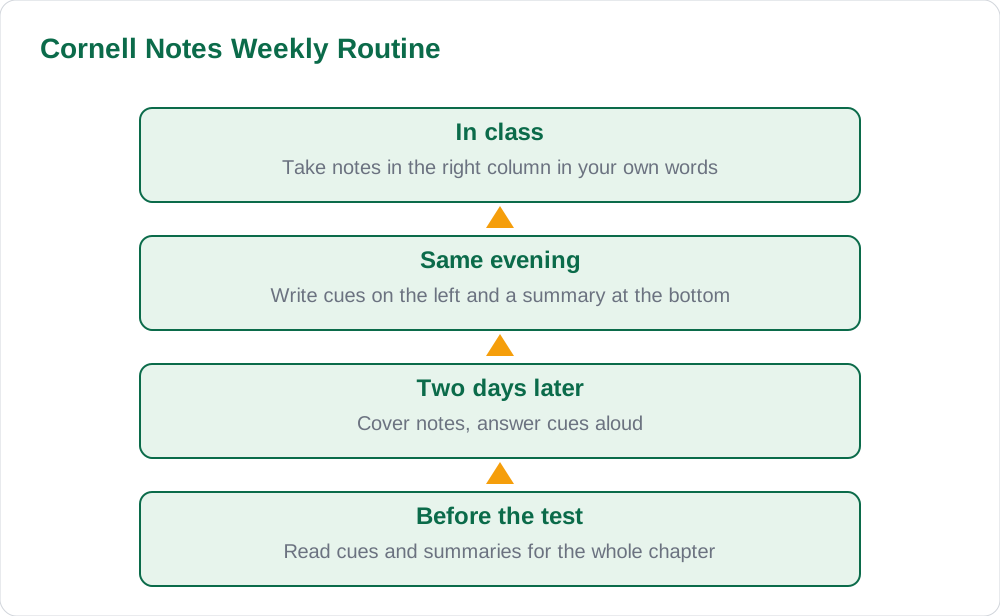
A simple weekly routine keeps Cornell Notes working. On the day of the lesson, pupils take notes in the right column. The same evening, they write cues and a summary. Two days later, they cover the notes and answer the cues aloud. Before the test, they read only the cues and summaries for all pages in the chapter. This routine turns notes into a self-testing system, not just a copy of the textbook. Pupils who follow it revise faster and remember more. For subject-specific examples, pupils can check the solved notes and the books for their class.
- Science: definitions, diagrams, one worked example.
- Maths: one worked problem with steps, plus when to use it.
- Islamiat: definition, explanation, one daily-life example.
AI Help: Muse AI
Muse AI is Meta's personal AI assistant that can help pupils turn a textbook paragraph into short Cornell Notes and suggest cue questions for self-testing.
Join Muse with invite code LTGSWD — in the Muse app, go to Settings > Redeem token and enter the code.
Disclosure: LTGSWD is the author's Muse invite code.
Muse AI does not give official STBB answers — always verify against your Sindh Textbook Board book and your teacher.
5 key points you must know
- Cornell Notes use a cue column, a notes column, and a summary strip.
- Write notes in your own words, not by copying whole paragraphs.
- Write cues that look like exam questions for easy self-testing.
- Write a two-sentence summary on the same day as the notes.
- Revise by covering the notes and answering the cues aloud.
Frequently asked questions
How much time does Cornell Notes take?
Taking notes takes the same time as normal notes. Writing cues and a summary takes about five minutes per page. That small extra time saves much more time during exam revision.
Can Cornell Notes work for maths?
Yes. Put one worked problem with steps in the notes column, and write a cue such as When do I use this method? Then practise by covering the solution and solving the problem from the cue.
What if I miss a point during class?
Leave blank space and fill it later from the textbook or by asking the teacher. The cue column can hold a question mark as a reminder to check the missing point.
Should summaries be written in full sentences?
Yes. Two or three full sentences work best because they force you to express the main idea clearly. Short phrases are less useful for revision than a clear summary sentence.
Solved notes — preview free
These guides work best with the solved exercises. Preview the solved notes free on this website — 119 solved notes for Classes 6–10 in Sindhi, Urdu, English and Arabic medium. Or browse the full solved notes catalogue for your class and medium. New solved notes are added regularly — check the catalogue for coming-soon books.