English-Medium Pakistan Studies: Key Terms in Plain English
Pakistan Studies has many important terms that sound formal and difficult: constitution, federation, census, referendum, and manifesto. Pupils often memorise definitions without understanding them, and then struggle to use the terms in exam answers. The solution is to learn each term in plain English first, then add the formal definition. This guide explains key Pakistan Studies terms in simple language, with examples from everyday life and from the textbook. It helps English-medium pupils in Sindh Textbook Board classes understand what each term means, why it matters, and how to use it correctly in an answer.
Why Plain English Comes First
A formal definition is useful, but it is not the best starting point. If a pupil reads that a constitution is the supreme law of the state, the words supreme and state may themselves need explaining. A plain English start works better: a constitution is the book of rules for how a country is run. Once the pupil understands that idea, the formal definition makes sense. Teachers should always give the plain meaning first, then the textbook definition, then one example. Pupils should do the same in their notes: plain meaning, formal definition, example.
Plain English also helps pupils answer questions that ask them to explain a term in their own words. Examiners reward answers that show understanding, not only memorisation. A pupil who writes that a federation is a system in which power is shared between a central government and provincial governments shows understanding. A pupil who only repeats a memorised sentence without an example may still earn marks, but the answer is weaker. Pupils can build a term bank with three columns: term, plain meaning, example. More study methods appear in the blog and the solved notes.
- Start with a plain English meaning, then add the formal definition.
- Every term needs one example that shows it in real life.
- Understanding earns more marks than memorisation alone.
Constitution, Federation, and Government
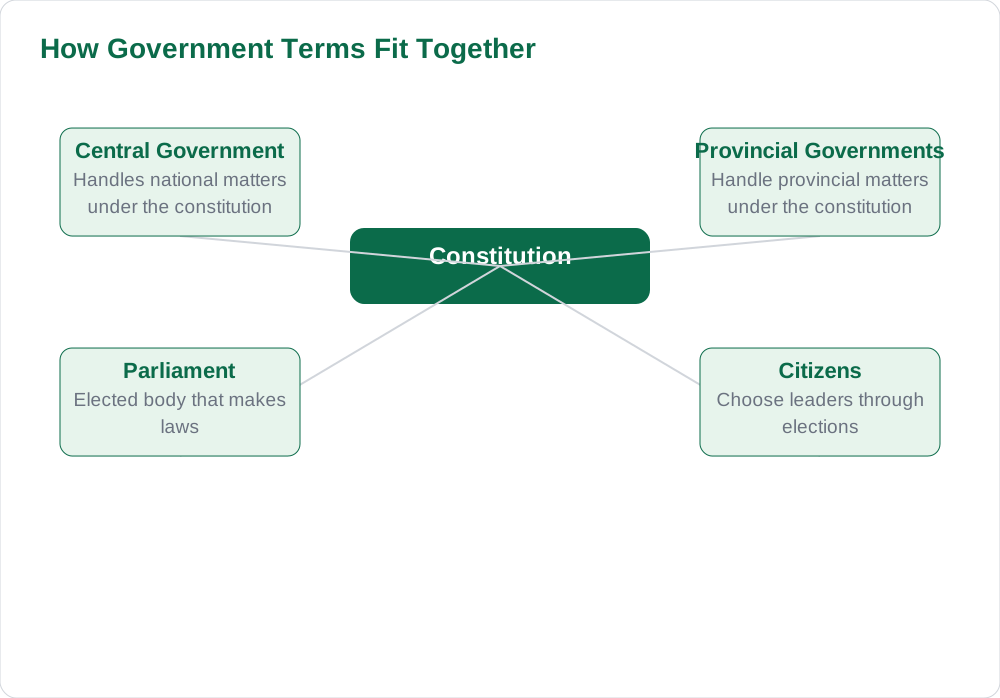
A constitution is the set of rules that explains how a country is governed, what the government can and cannot do, and what rights citizens have. It is the highest law. Other laws must follow it. A federation is a system in which power is shared between a central government and the governments of provinces or states. In a federation, some matters are handled by the central government and others by provincial governments. A democracy is a system in which citizens choose their leaders through elections. A parliament is the body of elected representatives that makes laws.
Pupils often confuse federation and confederation, or constitution and law. A constitution is the whole framework of rules, while a law is a single rule made within that framework. A federation shares power through a constitution, while a confederation is a looser union of independent states. Teachers can use a simple diagram: the constitution at the top, then the central and provincial governments below it, then laws made by each level. Pupils who draw this diagram once remember the relationship far better than pupils who only read about it. Definitions and examples also appear in the books for each class.
- Constitution: the book of rules for how a country is run.
- Federation: power shared between central and provincial governments.
- Democracy: citizens choose leaders through elections.
- Parliament: the elected body that makes laws.
Census, Referendum, and Elections
A census is an official count of the population. It records how many people live in a country, where they live, and basic information such as age and household size. Governments use census data to plan schools, hospitals, roads, and services. A referendum is a direct vote in which citizens answer a single question, such as whether to accept a new law. An election is a vote to choose leaders or representatives. A manifesto is a written statement in which a party or candidate explains its plans and promises before an election.
Pupils can remember the difference by asking what the vote does. In an election, citizens choose people. In a referendum, citizens decide a question. In a census, nobody votes; officials count people. Teachers can give pupils three short news-style examples and ask them to label each one as a census, referendum, or election. This sorting exercise is quick and effective. Pupils should also note that census data is used for planning, not for choosing leaders. That distinction appears in many exam questions. More worked examples are in the solved notes and the blog.
- Census: an official count of the population for planning.
- Referendum: a direct vote on a single question.
- Election: a vote to choose leaders or representatives.
- Manifesto: a written statement of plans and promises.
Economy and Society Terms
Pakistan Studies also uses economy and society terms that pupils must define clearly. Gross domestic product, often called GDP, is the total value of goods and services produced in a country in a year. Inflation means a general rise in prices, so the same amount of money buys less than before. Literacy rate means the percentage of people who can read and write. Urbanisation means the growth of towns and cities as people move from rural areas. Each of these terms appears in textbook chapters on population, economy, and development.
Pupils should learn these terms with a real example, not only with a definition. For example, if prices of food and transport rise over a year, that is inflation. If more families move from villages to a nearby city for jobs, that is urbanisation. Teachers can ask pupils to find one example from their own district for each term. That local example makes the term memorable and gives the pupil something concrete to write in an exam answer. Pupils should avoid inventing numbers or dates. They should use general examples unless the textbook gives a specific figure. Guidance on accuracy is in the books and the solved notes.
How to Use Terms in Exam Answers
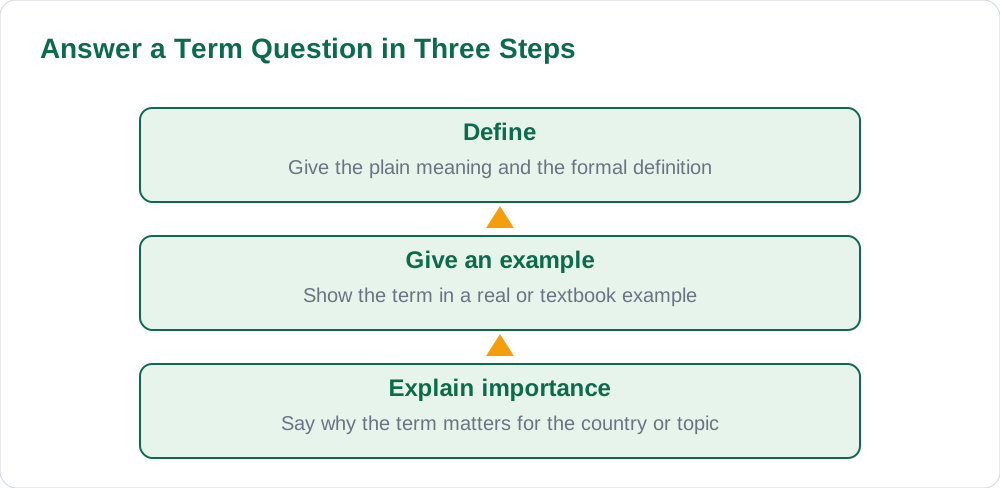
In an exam, a term should appear in the first sentence of the answer when the question asks for a definition. For example, if the question asks What is a federation, the answer should begin with A federation is a system in which power is shared between a central government and provincial governments. Then the pupil should add one example and one reason why the term matters. This structure, definition plus example plus importance, earns marks for knowledge and understanding. Pupils who only write an example without a definition may lose marks for the definition part.
Pupils should also use terms consistently. If the question uses the word constitution, the answer should use the same word, not a vague word such as rules book. Consistency shows that the pupil knows the correct term. Before handing in the paper, pupils should reread each answer and check that every key term is used correctly. Teachers can give pupils a checklist of five terms for each chapter and ask them to tick each term they used correctly in a practice answer. Over time, pupils build a habit of using terms precisely and confidently.
- Definition plus example plus importance is a strong answer structure.
- Use the exact term from the question, not a vague replacement.
- Reread answers to check that each term is used correctly.
AI Help: Muse AI
Muse AI is Meta's personal AI assistant that can help pupils explain a Pakistan Studies term in plain English and suggest a simple example for it.
Join Muse with invite code LTGSWD — in the Muse app, go to Settings > Redeem token and enter the code.
Disclosure: LTGSWD is the author's Muse invite code.
Muse AI does not give official STBB answers — always verify against your Sindh Textbook Board book and your teacher.
5 key points you must know
- Learn each term in plain English first, then add the formal definition.
- Every term needs one example that shows it in real life.
- Federation means shared power; constitution means the book of rules.
- Census counts people, referendum decides a question, election chooses leaders.
- Exam answers should give definition plus example plus importance.
Frequently asked questions
What is the difference between a constitution and a law?
A constitution is the whole framework of rules for how a country is run. A law is a single rule made within that framework. All laws must follow the constitution.
What is the difference between a federation and a confederation?
In a federation, power is shared between central and provincial governments under one constitution. A confederation is a looser union of independent states that keep more of their own power.
Why is census data important?
Governments use census data to plan schools, hospitals, roads, and services. It shows how many people live where, which helps in fair planning and budgeting.
How should pupils revise Pakistan Studies terms?
Keep a term bank with three columns: term, plain meaning, and example. Review five terms each day, cover the meanings, and try to recall them before checking.
Solved notes — preview free
These guides work best with the solved exercises. Preview the solved notes free on this website — 119 solved notes for Classes 6–10 in Sindhi, Urdu, English and Arabic medium. Or browse the full solved notes catalogue for your class and medium. New solved notes are added regularly — check the catalogue for coming-soon books.