Exam Answer Layout: Headings, Margins and White Space
An examiner reads dozens of answer sheets in one sitting. When your answer is a single dense block of writing with no headings, no gaps, and no margins, finding your good points becomes hard work — and tired readers miss things. When your answer is laid out with clear headings, a margin, and breathing space between points, every point is easy to find and easy to credit. Exam answer layout with headings and margins is not decoration; it is how you make your knowledge visible. This guide shows you a simple, repeatable layout for long and short answers: where headings go, how wide a margin to leave, how much space to leave between points, and how to underline key terms so they stand out. It works in every subject and every medium, and it costs you almost no extra time once it becomes a habit.
Why Layout Changes Your Marks
Marks are given for points the examiner can find. A well-laid-out answer puts each point where it can be seen: under its own heading, at the start of its own paragraph, or as its own bullet. A badly laid-out answer buries the same points in the middle of long paragraphs, where they are easy to skip. Two pupils can write the same knowledge and score differently, simply because one made the knowledge easy to find.
Good layout also helps you. Headings force you to organise your thinking before you write, so your answer follows a plan instead of wandering. White space gives your hand a rest and your mind a moment to think about the next point. Pupils who lay out their answers well usually write more complete answers, because the layout itself reminds them when a section is thin or missing.
- Headings make each point easy to find, so nothing good gets missed.
- Short paragraphs and gaps keep long answers readable from start to finish.
- A clean layout signals care, which helps the examiner read generously.
The Basic Layout: Margin, Headings, Paragraphs
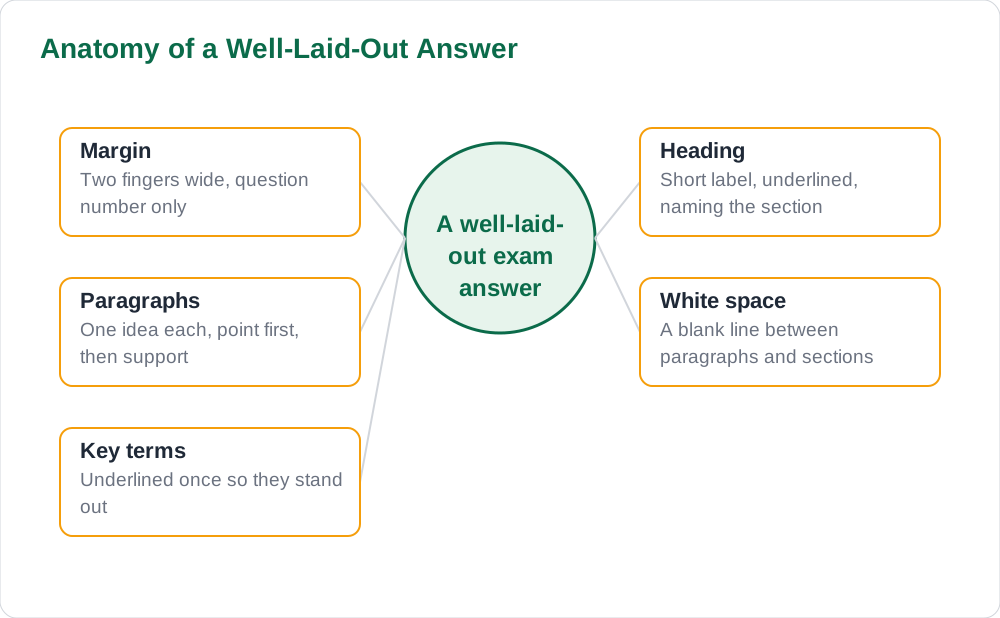
Start every answer by leaving a margin of about two fingers' width on the left side of the page. Write nothing in the margin except the question number — it is breathing room that keeps the page tidy and gives the examiner space to tick marks. Begin each answer on a fresh line, write the question number clearly, and if the answer is long, add a short title or heading line for the answer as a whole.
Break the answer into paragraphs, one idea per paragraph. Start each paragraph with the point in the first sentence, then support it in the next one or two sentences. Leave a line of white space between paragraphs. This one habit — one idea, one paragraph, one line of space — transforms a wall of writing into a readable answer.
Headings: Small, Clear and Honest
Headings are short labels that tell the reader what the next section says. For a question asking for causes and effects, headings like Causes and Effects do the job perfectly. For a describe question, headings can name the parts: Introduction, Main Features, Example, Conclusion. Keep headings short — two to four words — and underline them or write them slightly larger so they stand out.
Do not invent headings that promise more than the paragraph delivers. A heading that says Three Causes must be followed by three causes, or the examiner notices the gap. If you only have two causes, write the heading as Causes and give two. Honest headings build trust; exaggerated headings draw attention to what is missing.
For short answers of three to five marks, one heading is often unnecessary — a short paragraph or a few bullets is enough. Save headings for answers where they genuinely help: long answers, multi-part answers, and compare questions.
Bullets, Numbers and Tables: When to Use Them
Bullets are excellent for lists: causes, features, steps, examples, differences. Use them when the question asks you to list or give points. Numbered lists are better for steps in order, such as the steps of a process or the stages of a method. Tables are best for compare questions: one column for each side, one row for each point of comparison. A table makes similarities and differences visible at a glance.
Do not use bullets for everything. An essay or explanation question usually wants connected sentences, because the examiner wants to see how your ideas link together. A good rule is: bullets for lists, paragraphs for explanations, tables for comparisons. Mixing the three where each fits shows real writing control.
White Space Is Not Wasted Space
Many pupils fear white space, as if a page with gaps looks empty. The opposite is true: a page with gaps looks organised, and it is far easier to mark. White space also gives you room to add a forgotten point later. If you remember an extra point after finishing an answer, you can add it neatly in a gap with a clear label, instead of squeezing it into a margin where it may be missed.
White space also protects you against running out of room. If you pack every line, a long answer can spill awkwardly onto the next page mid-sentence. Leaving a line between paragraphs naturally spreads the answer and makes page breaks fall at sensible places. Leave a line or two between answers as well, so the examiner can see clearly where one answer ends and the next begins.
Handwriting, Underlining and Final Checks
Layout works best with steady, readable handwriting. You do not need beautiful writing — just consistent letter size, words on the line, and a pen you have practised with. Underline key terms and headings once, with a ruler if you have one, but do not underline whole sentences; over-underlining makes nothing stand out. Avoid heavy crossing out: a single neat line through a wrong word is cleaner than a scribbled block.
Before moving on, glance over each answer: is the question number right, is there a heading where one helps, are the paragraphs separated, and is anything squeezed into the margin that belongs in the main text? That ten-second layout check catches the errors that cost marks. For handwriting practice see how to improve handwriting for board exams, and for answer content see how to write a perfect answer and Sindhi-medium answer structure.
AI Help: Muse AI
Muse AI is Meta's personal AI assistant, and it can help you plan answer layouts: ask it to suggest headings for a practice question, then write the answer yourself under those headings and check the layout against this guide. Muse AI does not give official Sindh Textbook Board answers — always verify against your Sindh Textbook Board book and your teacher.
Join Muse with invite code LTGSWD — in the Muse app, go to Settings > Redeem token and enter the code.
Disclosure: LTGSWD is the author's Muse invite code.
5 key points you must know
- Leave a margin and write the question number clearly at the start of each answer.
- Use short, honest headings to divide long and multi-part answers.
- Write one idea per paragraph with a line of white space between paragraphs.
- Use bullets for lists, numbers for steps in order, and tables for comparisons.
- Underline headings and key terms once — never whole sentences.
Frequently asked questions
Does layout really affect marks, or only the content?
Content earns the marks, but layout decides whether the content is found. A well-laid-out answer makes every point visible, so the examiner can credit all of it.
How wide should the margin be?
About two fingers' width on the left side is enough. Keep it empty except for the question number, and never write answers in the margin.
Should I use headings in short answers?
Usually not. For answers of three to five marks, a short paragraph or a few bullets is enough. Save headings for longer, multi-part answers.
Are bullets acceptable in board exams?
Yes, for lists and points. For explanation and essay questions, use connected paragraphs so the examiner can see how your ideas link.
What if I run out of space on a page?
Continue on the next page at a paragraph break, not mid-sentence. Leaving white space between paragraphs makes clean page breaks much easier.
Solved notes — preview free
These guides work best with the solved exercises. Preview the solved notes free on this website — 119 solved notes for Classes 6–10 in Sindhi, Urdu, English and Arabic medium. Or browse the full solved notes catalogue for your class and medium. New solved notes are added regularly — check the catalogue for coming-soon books.