The Five-Minute Plan: How to Start Every Exam Paper
Most pupils open an exam paper and start writing immediately. That feels brave, but it is usually wasteful. The first answer gets far more time than it deserves, a hard question eats the clock, and the last questions are rushed or left blank. A short plan at the start fixes all three problems at once. Exam answer planning in the first five minutes is not lost time; it is the highest-value five minutes of the whole paper. In this guide you will learn a simple five-minute routine: scan the whole paper, rank the questions, divide your time, and note your first ideas. It works for Islamiat, science, English, mathematics and every other subject, and it needs no special materials — just your question paper, your answer sheet, and a calm start. Practise it on a past paper at home first, so it feels natural on exam day.
Why the First Five Minutes Decide the Paper
An exam paper is a map, not a race. When you read the whole paper first, you see where the easy marks are, where the long questions sit, and which questions connect to each other. Sometimes a later question reminds you of a fact you need for an earlier one. Sometimes you spot that two questions cover the same topic, so one good revision idea can serve both. None of this is visible if you dive into question one with your head down.
Planning also protects your confidence. Pupils who start writing without a plan often hit a hard question early and panic. Pupils who have scanned the paper already know that easier questions are waiting, so a hard start feels like a small delay, not a disaster. That calm alone is worth several marks, because a calm mind remembers more and writes more clearly.
- Scanning the paper shows you the full mark spread before you commit any time.
- Ranking questions lets you collect the easiest marks first and build momentum.
- A time plan stops one long answer from stealing time from the rest of the paper.
Minute 1: Read the Instructions and Scan the Whole Paper
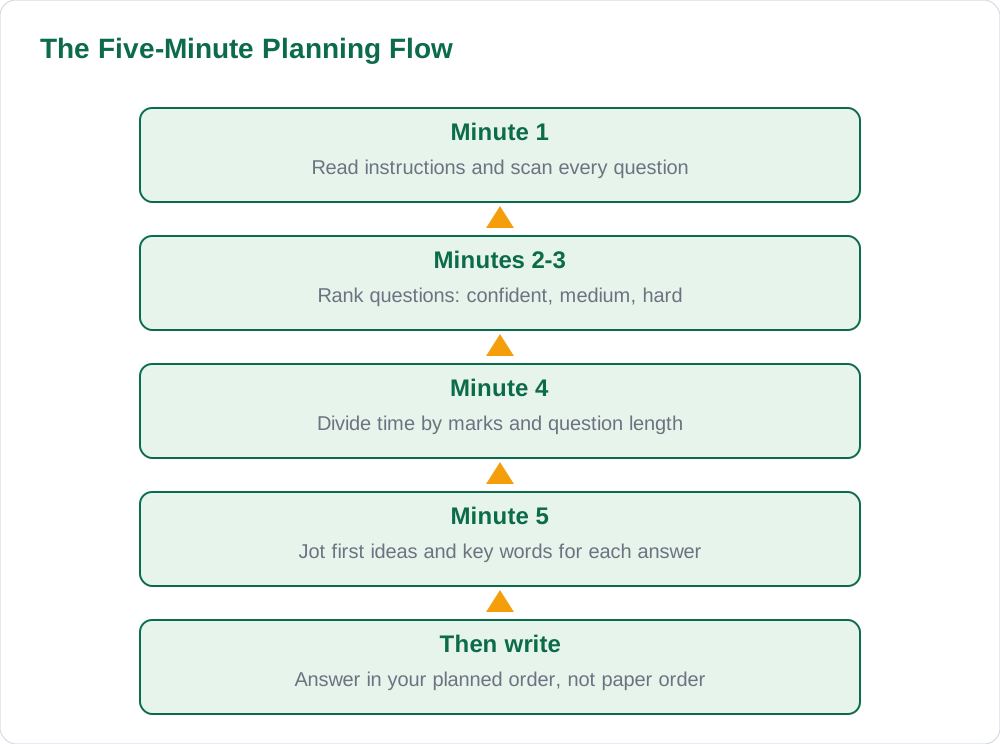
Use the first minute to read the instructions slowly: how many questions must be answered, whether any section is compulsory, and how the paper is divided. Then scan every question, reading each one fully but not trying to solve it yet. Put a small tick beside questions you feel sure about, a circle beside questions you can attempt, and a cross beside the ones that look hard. This gives you a fast, honest picture of the paper.
Do not write any answers in this minute. Your only job is orientation. If the paper allows it, underline the command words as you scan — explain, describe, compare, list — because these tell you what kind of answer each question wants. You are building the map you will follow for the rest of the exam.
Minutes 2-3: Rank the Questions and Set Your Order
Now decide the order in which you will answer. A good rule is: confident questions first, medium questions next, hard questions last. This is not about being lazy; it is about banking marks while your mind is fresh and your confidence is growing. Every completed answer makes the next one easier, because success calms the nerves and warms up your recall.
Write your order as small numbers in the margin of the question paper — for example 1, 2, 3 beside the questions you will attempt in that sequence. Number your answers clearly in the answer sheet to match the question numbers, even if you answer out of order. Examiners mark the question number you write, not the order you wrote in, so a clear numbering habit keeps your paper easy to follow.
Minute 4: Divide Your Time by Marks and Length
Take your total exam time, subtract the five planning minutes and a few minutes for a final check, and split what remains across the questions. A simple method is to divide the remaining minutes by the total marks, which tells you roughly how many minutes each mark is worth. A ten-mark question then gets about twice the time of a five-mark question. This rough guide stops you from spending twenty minutes on a two-mark question.
Write your time targets beside each question on the question paper — for example, 12 minutes for a long answer, 4 minutes for a short one. These are targets, not chains. If an answer is flowing well, you may use a minute or two extra, but the targets should keep you honest. When a target runs out, finish the point you are on and move on; you can return later if time remains.
Minute 5: Jot First Ideas Before They Fade
In the last planning minute, jot two or three key words beside each question — the definition you will open with, the example you will use, or the steps you will follow. These tiny notes act like anchors. When you reach a question later, you will not face a blank page; you will face a starting point. That is a big difference under pressure, and it keeps your answers structured instead of wandering.
Keep these notes short. A full draft in the margin wastes the time you just saved. Two or three words per question is enough: for example, beside a question on a lesson you studied, note the heading, one key point, and one example. If an idea does not come for a hard question, leave it blank and move on — your mind will keep working on it in the background while you answer easier questions.
Common Planning Mistakes to Avoid
The most common mistake is planning for too long. Five minutes is enough; ten minutes of planning is ten minutes stolen from writing. Set a quiet internal limit and stick to it. Another mistake is planning in your head only. A plan you do not write down disappears the moment the first hard question appears, so always put your order, time targets, and key words on the paper.
A third mistake is ignoring the plan once you start. If you planned to answer a confident question first, do it, even if question one looks tempting. The plan exists because your calm self at minute one makes better decisions than your stressed self at minute forty. Trust it, and review common exam mistakes so you know which traps the plan protects you from. For more on using your time well once you start writing, see how to manage time during exams, and for answer structure see how to write a perfect answer.
Finally, remember that planning is a skill, and skills improve with practice. Run the five-minute plan on every practice paper at home until it feels automatic. On exam day it should feel like a habit, not an experiment.
AI Help: Muse AI
Muse AI is Meta's personal AI assistant, and it can help you rehearse this routine before exam day: ask it to turn a revision topic into a timed practice set so you can practise scanning, ranking and planning under realistic conditions. Muse AI does not give official Sindh Textbook Board answers — always verify against your Sindh Textbook Board book and your teacher.
Join Muse with invite code LTGSWD — in the Muse app, go to Settings > Redeem token and enter the code.
Disclosure: LTGSWD is the author's Muse invite code.
5 key points you must know
- Spend the first five minutes scanning, ranking and planning before writing any answer.
- Answer confident questions first to bank marks and build calm momentum.
- Divide remaining time by marks so long answers get more time and short ones less.
- Jot two or three key words per question as anchors for when you reach them.
- Practise the five-minute plan on past papers at home until it becomes automatic.
Frequently asked questions
Does the five-minute plan waste writing time?
No. Five minutes of planning usually saves far more than five minutes of wandering, over-long answers and rushed endings. Pupils who plan finish more questions and leave fewer blanks.
What if I cannot rank the questions because they all look hard?
Rank them anyway, best to worst. Even a rough ranking helps. Start with the question where you know even one good point, and your memory will often warm up as you write.
Should I answer in paper order or my planned order?
Your planned order. Just number each answer clearly with its real question number so the examiner can follow your paper without confusion.
Can I use this plan for mathematics papers too?
Yes. In mathematics, scanning helps you spot the questions whose methods you know, and jotting the first step or formula beside each question gives you a running start.
What if I run out of time on a question?
Finish the sentence you are on, leave the question, and move to the next one. You can return at the end if time remains — a half-finished long answer rarely beats two completed short ones.
Solved notes — preview free
These guides work best with the solved exercises. Preview the solved notes free on this website — 119 solved notes for Classes 6–10 in Sindhi, Urdu, English and Arabic medium. Or browse the full solved notes catalogue for your class and medium. New solved notes are added regularly — check the catalogue for coming-soon books.