The Rough-Work Box Method for Clean Exam Answers

Every pupil does rough work in an exam: multiplying, sketching, testing an idea, jotting a plan. The problem is where that rough work goes. Scattered across the answer sheet, it clutters the final answers, confuses the examiner, and sometimes gets marked by mistake. Scribbled in the margin, it is hard to read and easy to lose. The rough-work box method solves this with one simple rule: all rough work goes inside a labelled box, in one place. This guide shows you how to draw a rough-work box, what belongs inside it, and how to keep it separate from your final answers. It works best in mathematics and science, but it helps in any subject where you plan, calculate, or draft before writing the final answer.
Why Rough Work Needs Its Own Place
Rough work is thinking on paper. It is where you test a calculation, try a formula, or work out which points to include. It is valuable — but it is not the answer. When rough work and final answers mix, two problems follow. First, the examiner cannot tell which version is your real answer, and may mark the rough version by mistake. Second, you cannot check your own work, because the steps are scattered and hard to follow.
A labelled box fixes both problems. The examiner sees at a glance that the box is rough work and reads only your final answer for marks. You see your own thinking in one place, so checking becomes a quick scan instead of a hunt. The box also keeps your answer sheet tidy, which makes the whole paper easier to read and mark.
How to Draw the Rough-Work Box
The box is simple. At the end of your answer sheet, or on a page the paper sets aside for rough work, draw a large rectangle with your ruler. Write ROUGH WORK across the top of the box, and underline it. Everything inside the rectangle is rough work; everything outside it is final answer. If you need more than one box, draw a second one and label it the same way.
If your paper already provides a rough-work space, use that space and still label it clearly. If the paper does not provide one, ask yourself whether rough work belongs on the answer sheet at all — in most papers it is accepted, but keep it at the end, clearly labelled, and never mixed into your answers. Draw the box before the exam starts if the rules allow, so you do not waste time during the paper.
What Goes Inside the Box — and What Stays Out
Inside the box belongs everything that is thinking, not answering: trial calculations, checking a multiplication, testing which formula fits, sketching a diagram before drawing it neatly, jotting the points you will include in a long answer, and working out an outline. Treat the box as your workshop: messy is fine inside, because the box itself is the boundary.
Outside the box belongs your final answer only: the clean calculation with steps in order, the neat diagram with labels, the structured paragraph, the final result with units. Never copy rough work into the answer and never leave a final step only inside the box. If a step matters, it must appear in the final answer, in the right order, where the examiner will read it.
- Inside the box: trial calculations, formula tests, sketches, plans, outlines.
- Outside the box: final steps in order, neat diagrams, structured answers, final results.
- If a step matters for marks, it must appear in the final answer — not only in the box.
The Box Method in Mathematics
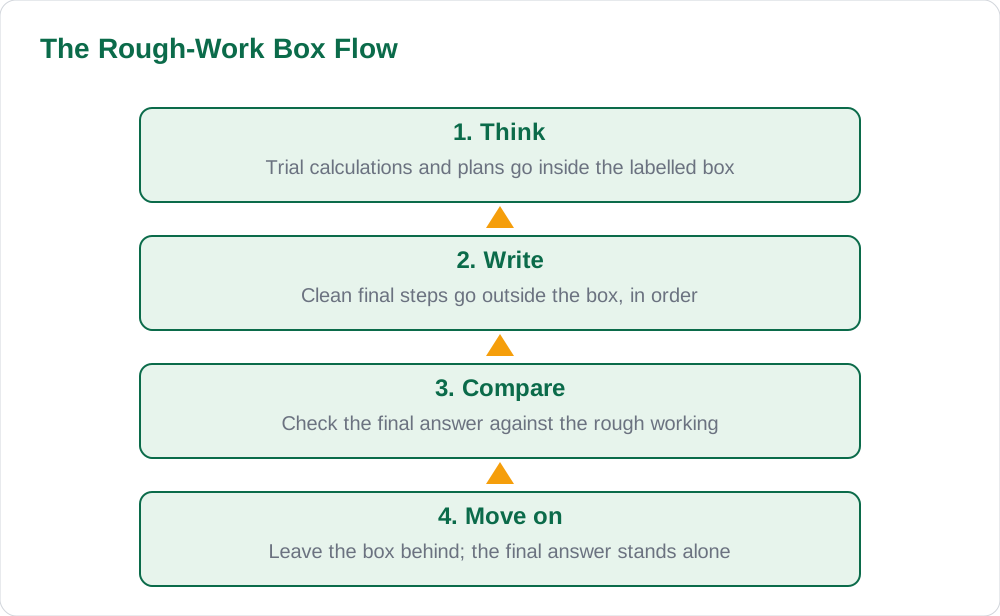
In mathematics, the box method is at its most useful. Work out the messy arithmetic inside the box — long multiplication, checking a division, trying a substitution — then write the clean solution outside: formula, substitution, steps, answer with units. This keeps your solution readable and makes method marks easy to award, because the examiner follows a tidy chain of steps instead of hunting through crossed-out numbers.
The box also helps you check. When you finish a question, compare your final answer with your rough calculation: do they match? If they differ, you have caught a copying error, which is one of the most common ways pupils lose mathematics marks. A quick comparison takes seconds and saves marks.
The Box Method in Science and Other Subjects
In science, use the box for trial diagrams, unit conversions, and working out which points to include in an explanation. Draw the neat, labelled diagram in your final answer and keep the sketch in the box. In subjects with long written answers, use the box for your plan: jot the heading, two or three points, and one example, then write the full answer outside the box following that plan.
The box also helps when you change your mind. If a planned point turns out to be wrong, you cross it out inside the box — where crossing out does not matter — and write the correct version in your final answer. Without a box, pupils often cross out large parts of a final answer and rewrite them, leaving a messy page that is hard to mark.
Checking and Finishing With the Box
At the end of the exam, use the box for a final check. Re-read each final answer, and where you have time, rework one or two key calculations inside the box and compare them with the final answers. If you spot a copying error, correct the final answer neatly with a single line through the wrong figure and the correction beside it. For presentation habits that keep final answers readable, see Urdu-medium answer presentation.
Before you hand in, make sure every final answer is complete outside the box and that nothing important exists only inside it. The examiner marks the final answers, so a brilliant calculation that only appears in the rough-work box earns nothing. For more checking habits see checking with estimation, and for time habits see how to manage time during exams. Keep the box labelled until the last minute — it is your safety net, not your answer.
AI Help: Muse AI
Muse AI is Meta's personal AI assistant, and it can help you practise this method: ask it to give you a calculation or a planning task, then practise doing the rough work in a box and writing the clean final version beside it. Muse AI does not give official Sindh Textbook Board answers — always verify against your Sindh Textbook Board book and your teacher.
Join Muse with invite code LTGSWD — in the Muse app, go to Settings > Redeem token and enter the code.
Disclosure: LTGSWD is the author's Muse invite code.
5 key points you must know
- Keep all rough work inside one clearly labelled ROUGH WORK box.
- Write only final steps, neat diagrams and structured answers outside the box.
- Use the box for trial calculations, sketches, plans and outlines.
- Compare each final answer with your rough working to catch copying errors.
- Before handing in, check that nothing important exists only inside the box.
Frequently asked questions
Will the examiner mark my rough work?
If it is clearly labelled as rough work in a box, the examiner will mark your final answers. Keep the label clear and keep final steps outside the box.
Where should I draw the rough-work box?
At the end of your answer sheet, or in the space the paper provides for rough work. Keep it in one place, not scattered through your answers.
Can I use the box in subjects without calculations?
Yes. Use it to plan long answers: jot headings, points and an example in the box, then write the full answer outside it.
What if I run out of box space?
Draw a second box and label it the same way. Two labelled boxes are still far tidier than rough work scattered across the paper.
Should I cross out the rough-work box at the end?
There is no need if it is clearly labelled. Leave it readable — it shows your thinking — but make sure every final answer stands complete outside the box.
Solved notes — preview free
These guides work best with the solved exercises. Preview the solved notes free on this website — 119 solved notes for Classes 6–10 in Sindhi, Urdu, English and Arabic medium. Or browse the full solved notes catalogue for your class and medium. New solved notes are added regularly — check the catalogue for coming-soon books.