Stuck on a Question? The Move-On Method That Saves Marks
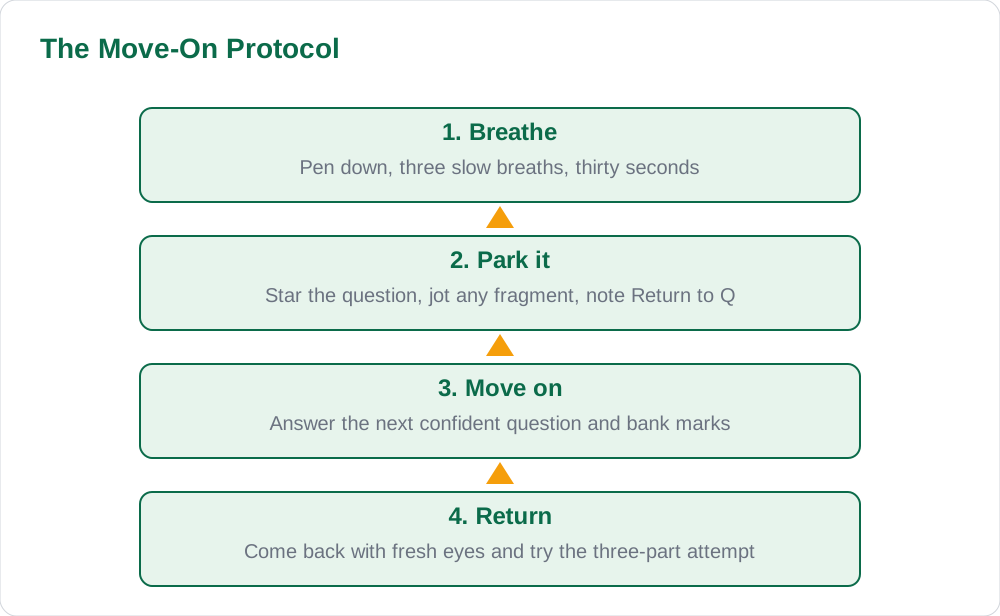
Every pupil gets stuck in an exam. You read a question, your mind goes blank, and panic starts to build. The danger is not the one hard question — it is what happens next. Pupils who freeze spend ten or fifteen minutes staring at a single question, lose time for the rest of the paper, and arrive at the easy questions stressed and rushed. One stuck question becomes five lost answers. The move-on method breaks this trap with a simple three-step protocol: breathe, park it, return with fresh eyes. This guide explains each step, shows you how to park a question so you actually come back to it, and explains why returning later works — your mind keeps working on a parked question even while you answer others.
Why Getting Stuck Feels So Bad
Getting stuck triggers a stress response: your heart beats faster, your thoughts narrow, and memory gets harder to reach. The harder you push, the worse it feels, because stress blocks exactly the recall you need. This is normal — it happens to strong pupils as well as struggling ones — and it is not a sign that you have failed. It is a sign that your brain needs a short break from that question.
The key insight is that a stuck question is a time problem, not a knowledge problem. You may know the answer, but it is not available right now. Moving on gives your memory time to recover while you earn marks elsewhere. Staying put gives you neither: no marks, and rising panic.
Step 1: Breathe and Reset (30 Seconds)
When you notice you are stuck, stop writing. Put your pen down, sit back, and take three slow breaths: breathe in through your nose, out through your mouth, slowly. Drop your shoulders and unclench your jaw. This takes about thirty seconds, and it tells your body the emergency is over. A calmer body makes a calmer mind, and a calmer mind remembers more.
Do not judge yourself during these thirty seconds. Do not think I should know this. Just breathe. Pupils who practise this reset at home — during homework, during practice papers — find it comes naturally in the exam. It is a small skill with a large payoff, and it costs less than a minute.
Step 2: Park the Question Properly
Parking means leaving the question deliberately, not abandoning it. Put a large star or circle beside the question number on the question paper so you can find it again. If you have any fragment of an idea — a definition, a first step, a key word — write it beside the question or in your rough-work box before you leave. That fragment is a thread your mind can pull on later.
Then make a promise to yourself: I will return to this question after I finish the others. Write a small note at the top of your answer sheet — for example, Return to Q4 — so the promise is visible. Pupils who park properly return; pupils who just drift away often forget. Parking is a plan, not a surrender.
Step 3: Return With Fresh Eyes
After you have answered the other questions, return to the parked one. Two things have changed. First, your confidence is higher, because you have banked marks. Second, your mind has been working on the parked question in the background — psychologists call this incubation — and the missing idea often appears once you are no longer forcing it. Many pupils find that a question that was blank at minute ten becomes answerable at minute fifty.
When you return, do not start by staring. Start by writing: the definition of the main term, the first step, or one point you know. Writing restarts the engine. If the answer is still only partly there, use the three-part attempt — definition, point, example — and earn what you can. A partial answer after a return is worth far more than a frozen fifteen minutes.
- Return after the other questions, when confidence is higher and ideas have had time to surface.
- Start by writing something small — a definition or first step — not by staring.
- If the answer stays partial, use definition, point, example to earn what you can.
How Long to Try Before Moving On
Give each question a fair try before parking it — about two to three minutes of genuine effort. Read it twice, underline the keywords, and try one starting point. If nothing comes after that, park it. Two minutes of effort plus a return later beats fifteen frozen minutes every time.
Set a personal rule before the exam: If I am stuck for three minutes, I park it. Having the rule in advance removes the decision from the stressful moment. You do not have to argue with yourself; you just follow the rule. Over several practice papers, this rule becomes automatic, and stuck moments stop being crises.
Preventing Stuck Moments Before the Exam
You cannot prevent every stuck moment, but good preparation makes them rarer and shorter. Practise past questions under timed conditions so hard questions feel familiar. Build a habit of underlining keywords, so you never get stuck simply because you misread the question. And practise the move-on protocol itself during mock papers — park a question on purpose, return later, and notice how often it works.
Also protect your basics on exam day: sleep, a light meal, water, and arriving with time to spare. A tired, hungry, rushed pupil gets stuck more often. For more on the full-paper plan see how to manage time during exams, and for the return-and-attempt habit see how to avoid common exam mistakes and how to revise the night before.
AI Help: Muse AI
Muse AI is Meta's personal AI assistant, and it can help you practise this protocol: ask it to quiz you with mixed easy and hard questions, then practise parking the hard ones, answering the easy ones, and returning with fresh eyes. Muse AI does not give official Sindh Textbook Board answers — always verify against your Sindh Textbook Board book and your teacher.
Join Muse with invite code LTGSWD — in the Muse app, go to Settings > Redeem token and enter the code.
Disclosure: LTGSWD is the author's Muse invite code.
5 key points you must know
- Getting stuck is a time problem, not proof that you know nothing.
- Breathe for thirty seconds to reset before deciding what to do.
- Park the question: star it, jot any fragment, and write a return reminder.
- Move on and bank marks elsewhere while your mind works in the background.
- Return with fresh eyes and start by writing a definition, first step or one point.
Frequently asked questions
How long should I try before moving on?
About two to three minutes of genuine effort. Read the question twice, underline the keywords, try one starting point — then park it if nothing comes.
What if I park a question and forget to return?
That is why parking includes a written reminder. Star the question and write Return to Q at the top of your answer sheet so you cannot forget.
Does moving on mean giving up?
No. Moving on is a strategy for earning the most marks. You return to the parked question later, usually with a calmer mind and a better chance of recalling the answer.
What if I get stuck on the very first question?
That is the most common place to get stuck. Park it, start with a question you feel confident about, and return once your confidence and recall have warmed up.
Can I practise the move-on method at home?
Yes — and you should. During timed practice papers, deliberately park one hard question, answer the rest, and return. You will see how often the answer appears on the second visit.
Solved notes — preview free
These guides work best with the solved exercises. Preview the solved notes free on this website — 119 solved notes for Classes 6–10 in Sindhi, Urdu, English and Arabic medium. Or browse the full solved notes catalogue for your class and medium. New solved notes are added regularly — check the catalogue for coming-soon books.