Writing Answer Outlines for Long Questions Before Drafting
Writing answer outlines long questions drafting is the habit that separates calm exam writers from rushed ones. An outline is a short plan — roughly five lines — that lists the points of your answer in order before you write a single full sentence. Without it, students discover their structure while writing, which means mid-answer changes of direction, repeated points, and conclusions that do not match introductions. With it, drafting becomes a straightforward job: expand each line into a paragraph, in order, and stop. This guide shows how to build a five-line outline in about five minutes, what each line should contain, and how to use it while drafting.
What a five-line outline looks like
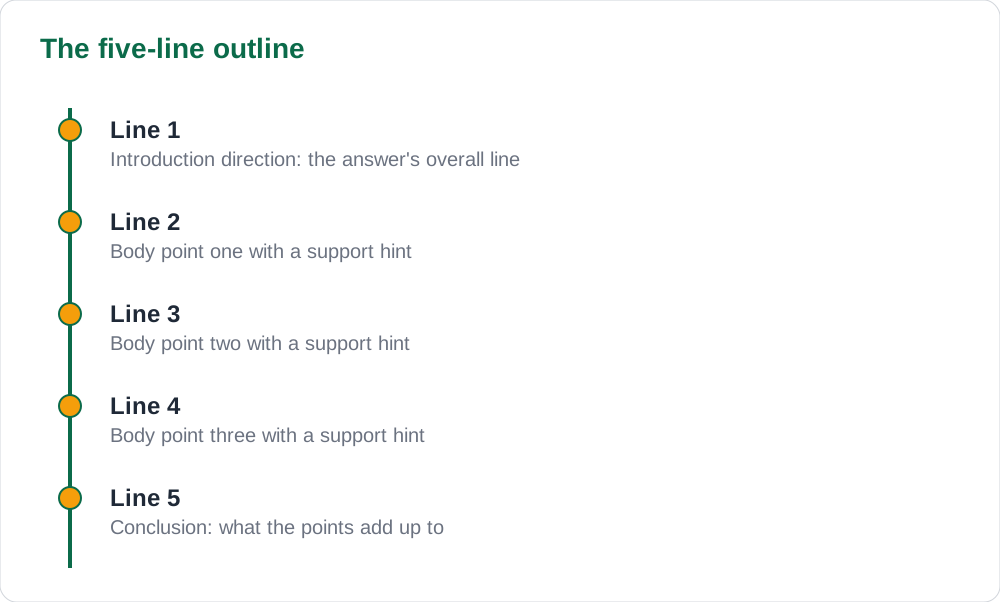
A five-line outline has one line for the introduction's direction, three lines for the body points, and one line for the conclusion's landing point. Each body line contains a point and a hint of its support — a reason, an example, or a piece of evidence — in just a few words. The whole outline fits in the margin or at the top of your answer space, and it should take no more than five minutes to write. Its brevity is its strength: a long plan is a first draft in disguise, while a five-line plan is a map you can actually follow.
Here is the shape in words: line one states the answer's overall direction in a phrase; lines two, three, and four name the three body points in order, each with a support hint; line five states what the conclusion will conclude. That is all. If you cannot fit the plan into five lines, your answer is probably trying to do too much — cut the weakest point before drafting rather than during it. The outline is a promise to yourself about the answer's shape, and keeping it short makes the promise keepable.
Building the outline: read, think, then list
Build the outline in three quick stages. First, read the question twice and underline its key words: the topic, the instruction, and any limit or angle it sets. Second, think for a minute or two: what are the three strongest points that answer this exact question, and in what order do they make sense? Third, list them as five lines, with the introduction direction first and the conclusion last. Do not write sentences at this stage — phrases and keywords are enough, and they keep the planning fast.
Order the points deliberately. A natural order might run from cause to effect, from general to specific, or from the most important point to the least. Whatever order you choose, note it in the outline, because drafting in a different order from the one you planned is a common source of confusion. If two points seem equally strong, put the clearer one first — a strong opening paragraph builds momentum for the rest of the answer. This planning step pairs naturally with budgeting length, covered in Planning a Long Answer Within the Word Limit.
Drafting from the outline, line by line
Drafting from an outline is deliberately mechanical: take line two and expand it into a paragraph, then line three, then line four, in order. Each paragraph starts with the point named in the outline line, develops it with the support hinted there, and ends with a sentence linking it to the question. Because the order is already decided, you never pause to wonder what comes next — and that saved thinking time is what makes outlined answers faster, not slower, despite the planning time spent.
Write the introduction from line one and the conclusion from line five, but write them after drafting the body if that feels easier. An introduction written after the body matches the body exactly, because you know what you actually argued. A conclusion written from line five stays on track, because the landing point was decided before drafting began. Either way, check the finished answer against the outline: every line should have become a paragraph, and no paragraph should have appeared from nowhere. A paragraph with no outline line is usually a digression.
- Expand one outline line into one paragraph, in order.
- Start each paragraph with the point named in its outline line.
- Develop the point with the support hinted in the outline.
- Write introduction and conclusion from lines one and five.
- Check the finished answer against the outline for stray paragraphs.
When the outline needs to change mid-answer
Sometimes, while drafting, you realise a point is weaker than you thought or a better point occurs to you. Changing the outline mid-answer is allowed — but change it deliberately, not by drifting. Cross out the old line, write the new line in its place, and check that the introduction and conclusion lines still fit. A deliberate change keeps the answer coherent; a silent drift, where you simply start writing about something else, breaks the structure the outline was meant to protect.
The most common mid-answer problem is discovering that a point needs far more explanation than its paragraph allows. In that case, do not let the paragraph swallow the answer: give the point its paragraph, note its importance briefly, and move on. If the point genuinely deserves more room, borrow space from the weakest remaining point rather than from the conclusion. Keeping the conclusion intact matters more than giving any single point extra length, because an unfinished answer loses marks across the board.
Practising outlines until they are fast
Practise outlining as its own exercise, separate from full writing. Take a question, spend five minutes on the outline, and stop — do not draft the answer. Then judge the outline: are the points relevant, in a sensible order, and supported by hints? Repeat this for several questions, and you will find that outlines get faster and sharper without any full answers being written. This drill is efficient revision, because it forces you to think about structure and content together.
Once outlines feel fast, practise the full sequence — outline, then draft — under timed conditions, and compare outlined answers with unoutlined ones you wrote earlier. Most students find the outlined answers clearer, better balanced, and no slower overall, because drafting time falls by more than planning time rises. Keep your best outlines as revision notes: they summarise topics in exactly the form an exam answer needs. For the frame the outline feeds into, see Introduction, Body, Conclusion: A Frame for Long Questions, and browse books for topic organisation.
AI Help: Muse AI
Muse AI is Meta's personal AI assistant. You can ask it to explain a concept in simple words, summarise a lesson, or make practice questions for revision.
For this topic, ask Muse AI to suggest three body points for a practice question, so you can practise turning them into a five-line outline.
Join Muse with invite code LTGSWD — in the Muse app, go to Settings > Redeem token and enter the code.
Disclosure: LTGSWD is the author's Muse invite code.
Muse AI does not give official STBB answers — always verify against your Sindh Textbook Board book and your teacher.
5 key points you must know
- A five-line outline lists direction, three body points, and conclusion before drafting.
- Each body line holds a point plus a short support hint, in phrases not sentences.
- Drafting means expanding one line into one paragraph, in order.
- Change the outline deliberately mid-answer, never by silent drift.
- Practise outlining alone until a good outline takes about five minutes.
Frequently asked questions
Does outlining waste exam time?
No — it saves time overall. Five minutes of planning prevents mid-answer rethinking, repeated points, and restructuring, so drafting becomes faster. Most students find outlined answers are completed in the same time or less, and to a higher standard.
What if I can only think of two good points?
Two strong points, well developed, beat three points where one is weak. Outline two body points and give each a fuller paragraph, or split one broad point into two related ones. Never invent a weak third point just to fill the outline.
Should the outline be written in the answer booklet?
If your exam allows rough work in the margin or a planning space, write it there. If not, keep the five lines in your head in the same shape: direction, three points, conclusion. Check your exam's rules about rough work beforehand.
Can I change my outline while writing?
Yes, deliberately: cross out the old line, write the new one, and check the introduction and conclusion still fit. What harms an answer is drifting to a new point without updating the plan, not a conscious, checked change.
Solved notes — preview free
These guides work best with the solved exercises. Preview the solved notes free on this website — 119 solved notes for Classes 6–10 in Sindhi, Urdu, English and Arabic medium. Or browse the full solved notes catalogue for your class and medium. New solved notes are added regularly — check the catalogue for coming-soon books.