Fractions Made Visible: Paper Strips, Circles and Number Lines
Fractions are one of the first places where many pupils start to feel that maths has stopped making sense. A whole number can be counted on fingers, but one half of what, and why is one quarter smaller than one third even though four is bigger than three? The confusion is normal, because a fraction is a relationship between two numbers, not a single count. Visual models fix this by giving the relationship something pupils can see, touch and compare. Paper strips, circles and number lines each show the same idea from a different angle, and together they build a picture that symbols alone rarely give. This article shows how to use all three models in a classroom, with worked examples that are clearly illustrative, so pupils learn what a fraction means before they practise the rules for working with one.
Why Fractions Need Something to See
When pupils only meet fractions as numbers written one above the other, the top and bottom numbers often feel like two separate whole numbers. That is why a common mistake is to add one half and one quarter by adding the tops and the bottoms, giving two sixths, which is wrong. A visual model makes the error obvious: a half strip is clearly longer than a quarter strip, so their sum must be longer than a half, and two sixths is smaller than a half. Seeing beats memorising here, because the picture carries the meaning that the symbols only summarise. Teachers who start with models find that pupils argue less about rules and ask better questions about what the fraction actually describes.
Visual models also give pupils a shared language. Instead of saying that the denominator is the bottom number, a teacher can point to the number of equal parts the whole was cut into, and the numerator becomes the number of those parts being considered. That language stays useful for years: equivalence, comparison, addition, subtraction and even percentages all rest on the same picture of a whole divided into equal parts. Pupils who can draw a fraction can usually explain it, and pupils who can explain it rarely forget it. The solved notes on this site use the same see-first approach, and the books page lists the official texts pupils should check their work against.
- Always cut the whole into EQUAL parts — unequal parts are the most common source of confusion.
- Keep the whole the same size when comparing two fractions, or the comparison means nothing.
- Let pupils fold, shade and label the models themselves instead of only watching the teacher.
- Move from the model to the symbol only after pupils can explain the model in words.
Paper Strips: Folding Halves, Quarters and Eighths
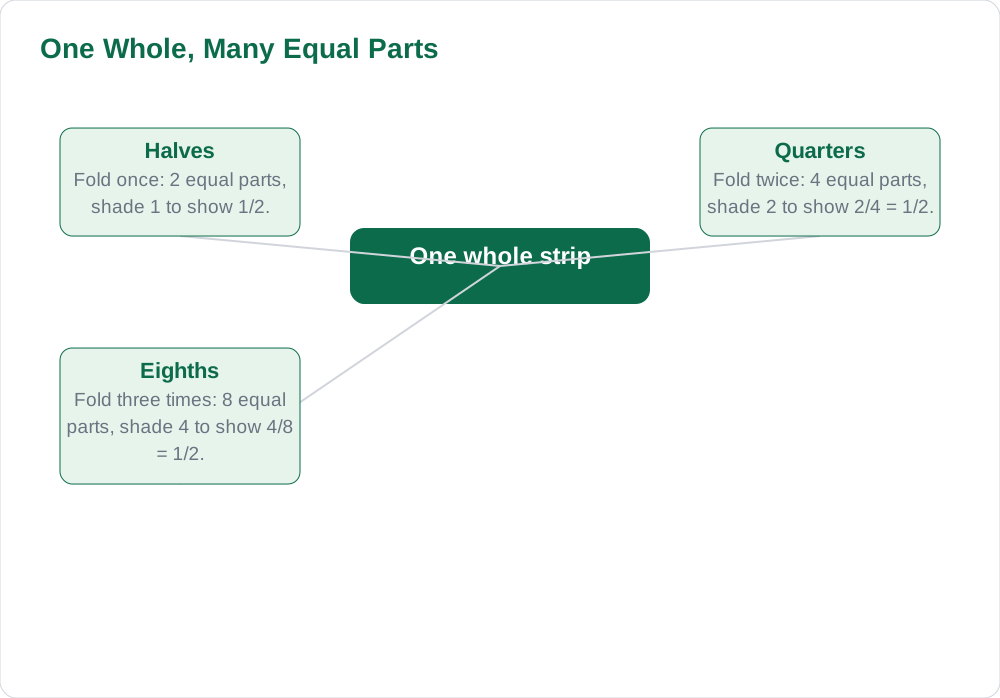
Paper strips are the cheapest and most reliable fraction model in any classroom. Give every pupil a strip of paper of the same length, fold it in half, and shade one half. Then take a second identical strip, fold it into quarters, and shade two quarters. Placed side by side, the two shaded lengths match exactly, so pupils discover for themselves that one half equals two quarters. No rule needs to be announced; the strips announce it. Repeating the fold to eighths shows that four eighths is the same length again, and the pattern of equivalent fractions begins to feel like something pupils found rather than something they were told.
Strips also make addition concrete. Take one half plus one quarter as an example: lay a half strip next to a quarter strip and the total shaded length is three quarters of a strip, because the half strip is the same length as two quarter strips. Pupils can then write the addition as one half plus one quarter equals three quarters, and the symbols now describe a length they have already seen. Subtraction works the same way: three quarters take away one quarter leaves two quarters, which is one half. When pupils later meet unlike denominators, the strip habit of finding a common size for the parts is already in place, and the rule about common denominators feels like common sense.
Circles: Sharing Pizzas, Rotis and Clocks
Circles suit sharing stories, because food and clocks are round in everyday life. A roti shared fairly among four people gives each person one quarter; among eight people, one eighth each. Drawing the circle and shading the slices shows at once that one quarter is bigger than one eighth, even though eight is the bigger number. That single picture corrects one of the most stubborn fraction misunderstandings: a bigger denominator means smaller pieces, because the same whole is being shared among more people. Pupils who have shaded both circles rarely make that mistake again.
Circles are also good for fractions greater than one. Two whole circles with one quarter of a third shaded show two and one quarter far more clearly than the symbol 9/4 does on its own. A clock face adds another familiar circle: a quarter of an hour is fifteen minutes, and half an hour is thirty. Linking fractions to time, food and money keeps the idea grounded in things pupils already know. Teachers can ask pupils to draw their own sharing circles for their family at dinner, which turns homework into a conversation and gives parents a window into what the class is learning.
Number Lines: Placing Fractions Between Whole Numbers
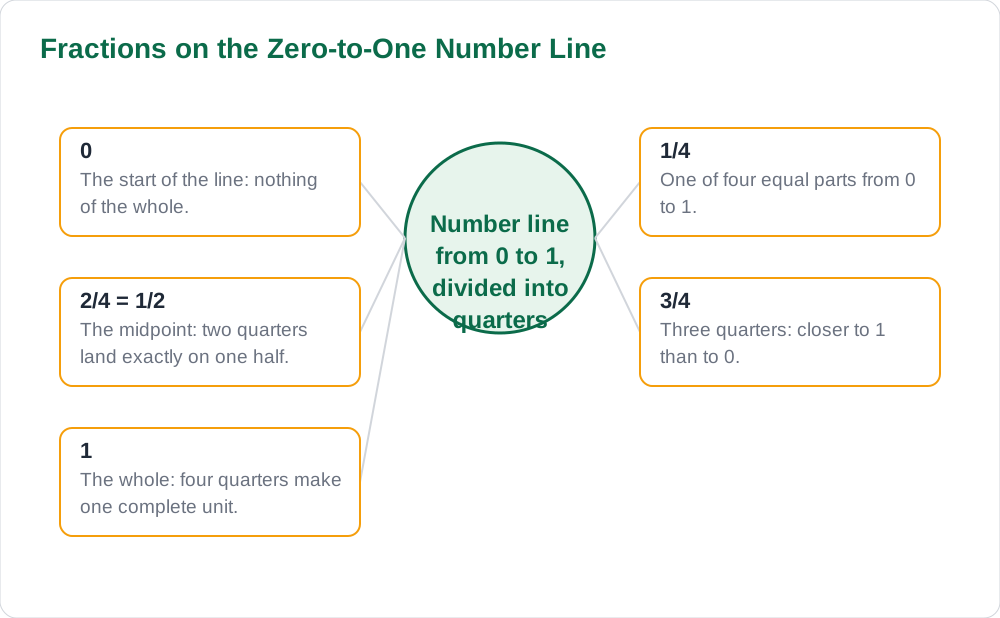
The number line is the model that connects fractions to everything else in maths. Draw a line from zero to one, divide it into four equal parts, and the marks are one quarter, two quarters, three quarters and one. Pupils can see that two quarters lands exactly on one half, and that three quarters sits closer to one than to zero. Extending the line past one shows improper fractions as ordinary points: five quarters is one quarter past one, which is the same point as one and one quarter. This picture prepares pupils for decimals, percentages and negative numbers later, because all of them live on the same line.
Number lines also settle comparison questions that circles and strips leave arguable. Which is bigger, two thirds or three quarters? Mark both on the same zero-to-one line and the answer is visible: three quarters is further to the right. Pupils can also use the line to estimate: seven eighths is close to one, one eighth is close to zero. That sense of size matters in exams, because it lets pupils check whether an answer is plausible before moving on. A pupil who knows that one half plus one third must be between one half and one is unlikely to accept an answer of two fifths without noticing something is wrong.
From Pictures to Equivalence and Simple Addition
The goal of visual work is not to keep pupils drawing forever; it is to build a mental picture strong enough that the symbols start to carry meaning on their own. A good sequence is: fold and shade, then sketch quickly, then imagine the sketch, then work with numbers while checking against the imagined picture. Equivalence comes first: pupils who can show that three sixths equals one half with strips can then explain why multiplying numerator and denominator by the same number leaves the value unchanged. The rule is no longer a trick; it is a description of cutting each piece into smaller equal pieces.
Simple addition follows the same path. When the denominators match, pupils add the shaded parts: two fifths plus one fifth is three fifths. When they do not match, pupils redraw one fraction in smaller pieces until the parts match, which is exactly what a common denominator does. Take one half plus one quarter as an example once more: redraw the half as two quarters, and the sum is three quarters. Teachers should celebrate pupils who still sketch a quick strip in an exam, because a thirty-second sketch that prevents a careless error is time well spent. For more practice ideas, see the blog and the guide to checking maths answers in exams.
- Teach equivalence before addition of unlike fractions — the second needs the first.
- Ask pupils to estimate before calculating: is the answer more or less than one half?
- Use the same whole size across all three models so pupils transfer the idea, not just the picture.
- Keep one wall display of strips, circles and a number line for the whole fractions unit.
AI Help: Muse AI
Muse AI is Meta's personal AI assistant, and it can help with this topic by explaining a fraction idea in a different way when the first explanation does not click — for example, by describing equivalence with a fresh sharing example or by making extra practice questions with paper-strip sketches.
Join Muse with invite code LTGSWD — in the Muse app, go to Settings > Redeem token and enter the code.
Disclosure: LTGSWD is the author's Muse invite code.
Muse AI does not give official STBB answers — always verify against your Sindh Textbook Board book and your teacher.
5 key points you must know
- A fraction is a relationship: the denominator counts the equal parts, the numerator counts the parts taken.
- Paper strips make equivalence visible: 1/2, 2/4 and 4/8 are the same length.
- Circles suit sharing stories and show why a bigger denominator means smaller pieces.
- Number lines place fractions between whole numbers and make comparisons exact.
- Move from model to sketch to mental picture before relying on symbols alone.
Frequently asked questions
Why do pupils think 1/4 is bigger than 1/3?
Because they compare the denominators as whole numbers, and four is bigger than three. A visual model corrects this: cut the same whole into three parts and into four parts, and the thirds are clearly larger pieces. The bigger the denominator, the more pieces the whole is split into, so each piece is smaller.
Which visual model should a teacher introduce first?
Paper strips usually work best first, because folding is physical and the equal parts are easy to check. Circles come next for sharing stories, and number lines come third, once pupils are comfortable with equivalence. All three stay useful throughout the fractions unit, and pupils benefit from seeing the same fraction in each model.
How do visual models help with adding fractions?
They show what is actually being added. Take 1/2 + 1/4 as an example: the strips show that the half is worth two quarters, so the sum is three quarters. Pupils who see this first understand why a common denominator is needed, instead of memorising a rule they do not believe.
Should pupils still draw models in exams?
Yes, a quick sketch is a legitimate checking tool. A small strip or number line drawn in the margin takes seconds and catches the most common fraction errors, such as adding denominators. The sketch does not replace the written working, but it makes the written working far more reliable.
How can parents help with fractions at home?
Use sharing at mealtimes: cut a roti or fruit into equal parts and ask who gets which fraction. Folding a strip of newspaper into halves, quarters and eighths takes two minutes and gives pupils the same model they use in class. Keep it playful and concrete, and let the child do the folding and shading.
Solved notes — preview free
These guides work best with the solved exercises. Preview the solved notes free on this website — 119 solved notes for Classes 6–10 in Sindhi, Urdu, English and Arabic medium. Or browse the full solved notes catalogue for your class and medium. New solved notes are added regularly — check the catalogue for coming-soon books.