Understanding Namaz Step by Step for Class 6
Namaz is the most important daily act of worship in Islam. Muslims pray five times a day, and each prayer is a meeting with Allah. For Class 6 pupils, Namaz should not feel like a race through movements. It should feel like a calm conversation, where every step has a meaning. This guide walks through Namaz step by step in simple English: preparation, wudu, intention, the standing, bowing, prostration, and sitting positions, and the short duas and meanings that give each step its heart. Pupils who understand what they are doing will find it easier to pray with focus, respect, and joy.
Before Namaz: Cleanliness, Place, and Time
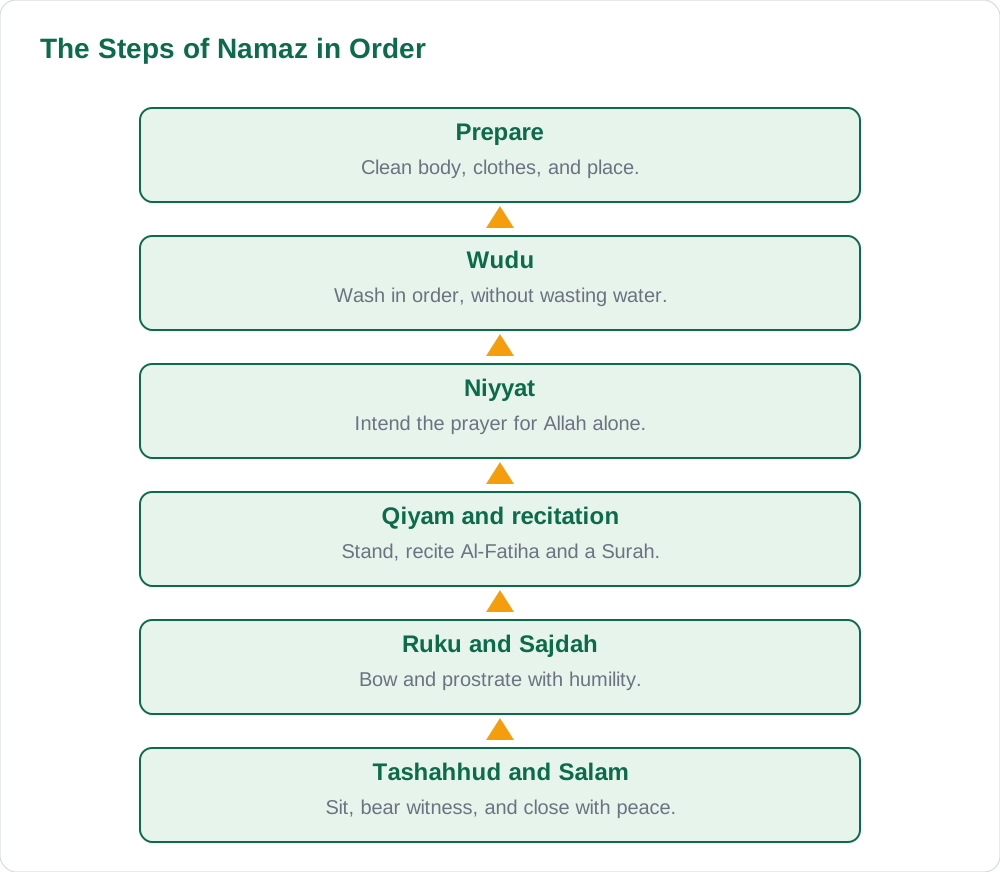
Good Namaz begins before the first Allahu Akbar. The body, the clothes, and the place of prayer should be clean. This is Taharat, the cleanliness that Islam teaches as part of faith. Pupils should check that their clothes are clean, that their hands and face are washed, and that the prayer mat or floor is clean. They should also check the time. Each of the five prayers has its own time, and praying on time is part of the discipline of Namaz. A pupil who prepares early never needs to rush.
The place of prayer should be quiet and free from distraction. A television left on, a game half-finished, or a noisy room all pull the mind away from Allah. Pupils can build a simple habit: when the Azan sounds, switch off distractions, lay out the prayer mat, and take a breath before beginning. This short pause helps the heart settle. Parents can help by keeping one clean, quiet corner for prayer and by treating prayer time as protected time in the home.
- Body, clothes, and place of prayer should be clean.
- Pray each prayer in its proper time, without delay.
- Switch off distractions before beginning.
- A short pause before Namaz helps the heart settle.
Wudu: Washing With Care and Intention
Wudu is the washing performed before Namaz. It includes washing the hands, the mouth, the nose, the face, the arms up to the elbows, wiping the head, and washing the feet. Each part is washed with care, not in a hurry. Wudu is both physical and spiritual cleanliness. The water cleans the skin, and the intention cleans the heart. Pupils should learn the order of wudu step by step from their teacher or parent, and practise it slowly until it becomes a smooth habit.
Wudu also teaches responsibility with water. Islam teaches that water is a blessing, and pupils should not waste it by leaving the tap running. A calm, careful wudu with a moderate amount of water is better than a hurried wudu that floods the floor. Teachers can demonstrate wudu once, then let pupils practise in pairs, checking each other kindly. A useful revision question is: why do we perform wudu before standing before Allah, and what does it teach us about cleanliness in daily life?
Niyyat and Qiyam: Intention and Standing Before Allah
Namaz begins with Niyyat, the intention in the heart. Niyyat means knowing which prayer you are about to offer and offering it for Allah alone. It does not need to be spoken loudly. It is the quiet decision of the heart. After Niyyat, the pupil says Allahu Akbar and raises the hands, entering the prayer. This moment is called Takbeer-e-Tahreema. From this point, the pupil speaks only the words of prayer and keeps the mind on Allah.
In Qiyam, the standing position, the pupil stands with respect, hands folded, eyes lowered, and heart calm. The opening supplication and Surah Al-Fatiha are recited, followed by another short Surah or verses. Pupils should learn the meanings of what they recite, even in simple English, so that the words are not empty sounds. For example, Surah Al-Fatiha praises Allah, asks for His guidance, and asks to be kept on the straight path. When pupils know this, standing in prayer feels like speaking to Allah, not only repeating words.
- Niyyat is the quiet intention in the heart to pray for Allah alone.
- Takbeer-e-Tahreema opens the prayer: Allahu Akbar.
- In Qiyam, stand with respect, hands folded, eyes lowered.
- Learn the meanings of Surah Al-Fatiha and short Surahs in simple words.
Ruku and Sajdah: Bowing and Prostration With Meaning
After recitation, the pupil bows in Ruku, placing the hands on the knees with a straight back, and glorifies Allah. Ruku teaches humility. The body bends low before Allah, and the heart remembers that all strength comes from Him. Pupils should hold the position calmly, not rush through it. A short pause in Ruku, with the mind on the words being said, is better than a hurried movement that means nothing.
Sajdah is the prostration, where the forehead, nose, palms, knees, and toes touch the ground. It is the closest a person comes to Allah in prayer, and it is the most humble position of all. In Sajdah, the believer is low before Allah and high in honour before Him at the same time. Pupils can use Sajdah to make dua from the heart, asking Allah for help with studies, family, and personal worries. Teachers should remind pupils that Sajdah is not a race. Each Sajdah deserves calm, care, and sincerity.
Tashahhud, Salam, and Praying With Focus Every Day
After the Sajdahs of a rakah, the pupil sits for Tashahhud, bearing witness that Allah is One and that Muhammad (peace be upon him) is His Messenger and servant. In the final sitting, the pupil sends blessings on the Holy Prophet (peace be upon him) and makes dua. Namaz closes with Salam, turning the head to the right and then to the left, greeting the angels and the people on each side with peace. The prayer ends, but its effect should stay: a calm heart, a clean tongue, and a wish to do good.
Praying with focus, or Khushu, grows with practice. Pupils can improve by learning meanings, by praying in a quiet place, by slowing down, and by making a short dua after each prayer. If the mind wanders, the pupil gently brings it back without giving up. Parents and teachers should praise steady effort, not only perfect focus. For more help with daily worship and study, see the blog, the solved notes page, and the companion guide The Azan, Line by Line.
- Tashahhud bears witness to Tauheed and Risalat.
- Salam closes the prayer with peace to both sides.
- Khushu grows by learning meanings, slowing down, and practising daily.
- If the mind wanders, gently bring it back and keep going.
AI Help: Muse AI
Muse AI is Meta's personal AI assistant, and it can help with this topic by explaining the steps of Namaz in simple words, testing pupils on the order of the positions, or making short practice questions about the meanings of the recitations.
Join Muse with invite code LTGSWD — in the Muse app, go to Settings > Redeem token and enter the code.
Disclosure: LTGSWD is the author's Muse invite code.
Muse AI does not give official STBB answers — always verify against your Sindh Textbook Board book and your teacher.
5 key points you must know
- Namaz begins with cleanliness, a clean place, and praying on time.
- Wudu is careful washing with intention, without wasting water.
- Niyyat is the quiet intention to pray for Allah alone.
- Ruku and Sajdah teach humility; Sajdah is the closest moment to Allah.
- Khushu grows by learning meanings, slowing down, and practising daily.
Frequently asked questions
How many times a day do Muslims pray?
Muslims pray five times a day: Fajr, Zuhr, Asr, Maghrib, and Isha. Each prayer has its own time, and praying on time is part of the discipline of Namaz.
What is Niyyat in Namaz?
Niyyat is the intention in the heart. It means knowing which prayer you are offering and offering it for Allah alone. It is a quiet decision of the heart, not a loud announcement.
Why is Sajdah so important?
Sajdah is the most humble position in prayer, with the forehead on the ground before Allah. It is described as the closest a person comes to Allah in prayer, and a special moment for sincere dua.
How can a pupil improve focus in Namaz?
Learn the meanings of what is recited, pray in a quiet place, slow down each movement, and gently bring the mind back when it wanders. Focus grows with steady practice.
What does Salam at the end of Namaz mean?
Salam closes the prayer by turning to the right and then the left with a greeting of peace. It marks the end of the prayer and a return to daily life with a calm and peaceful heart.
Solved notes — preview free
These guides work best with the solved exercises. Preview the solved notes free on this website — 119 solved notes for Classes 6–10 in Sindhi, Urdu, English and Arabic medium. Or browse the full solved notes catalogue for your class and medium. New solved notes are added regularly — check the catalogue for coming-soon books.