Newton's Laws of Motion with Everyday Examples
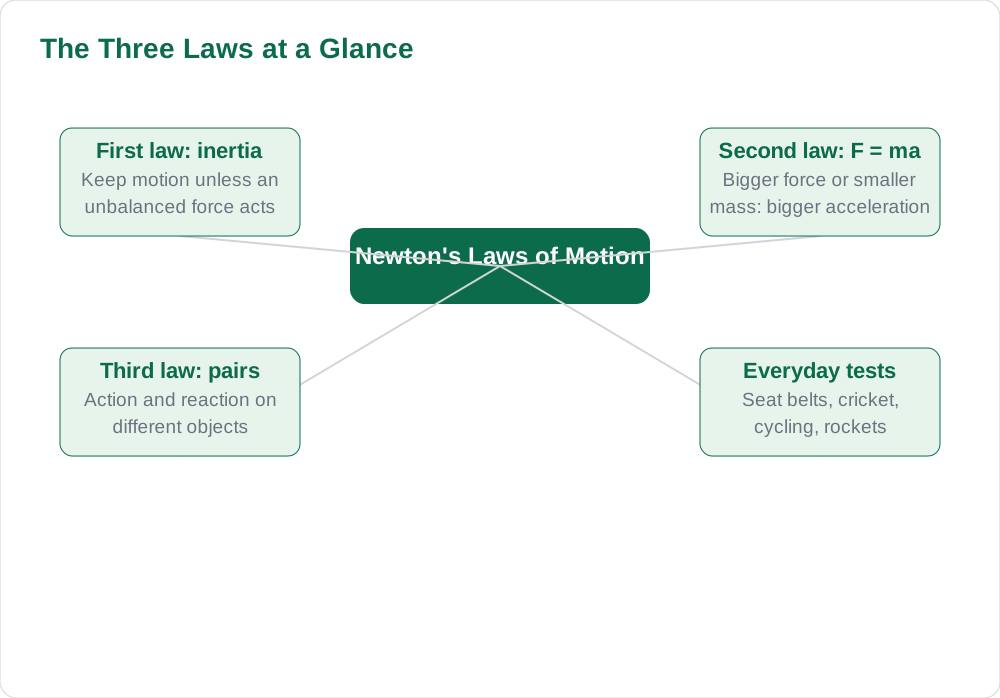
When a batsman hits a cricket ball, when a cyclist stops pedalling, and when a car brakes suddenly, the same three rules are at work. Newton's laws of motion describe how forces change the motion of objects, and they explain things you see every day. The first law says that an object keeps its state of motion unless a force acts on it. The second law says that a force produces acceleration, and that a bigger force or a smaller mass gives a bigger acceleration. The third law says that forces always come in pairs: for every action there is an equal and opposite reaction. These laws sound abstract when they are written in one line, but they become obvious once you attach them to things you already know. This article takes each law in turn and explains it with cricket, cycling, seat belts, and other everyday scenes from life in Pakistan. You will also learn the common mistakes pupils make with each law, and how to answer exam questions that ask you to identify which law is acting in a given situation. By the end, you will be able to watch any moving object and name the law behind what it does.
What Is a Force?
A force is a push or a pull that can change the motion of an object. It can start a stationary object moving, stop a moving object, change its speed, change its direction, or change its shape. Forces are measured in newtons (N), named after Isaac Newton. When you push a desk, kick a ball, or stretch a rubber band, you apply a force. Some forces need contact, like friction and the push of your hand. Others act at a distance, like gravity pulling an apple down and magnetism pulling a nail toward a magnet.
Forces are vectors: they have size and direction. Two forces can add up or cancel out depending on their directions. If two pupils push a desk in the same direction, the pushes add. If they push in opposite directions with equal strength, the desk does not move, because the forces balance. This idea of balanced and unbalanced forces is the key to the first law. When the forces on an object are balanced, its motion does not change; when they are unbalanced, its motion changes. Many pupils think a force is needed to keep an object moving, but as the first law shows, that is not true. Class physics material is listed on the books page.
First Law: Objects Keep Their Motion
Newton's first law, the law of inertia, says that an object remains at rest or in uniform motion in a straight line unless an unbalanced force acts on it. Inertia is the resistance of an object to a change in its motion. A heavy object has more inertia than a light one, which is why a loaded school bag is harder to start moving and harder to stop than an empty one. On a perfectly smooth surface with no friction, a sliding object would keep sliding forever, because nothing would act to slow it down.
Everyday life is full of inertia. When a bus starts suddenly, passengers lurch backward, because their bodies tend to stay at rest while the bus moves forward. When the bus brakes suddenly, passengers lurch forward, because their bodies tend to keep moving while the bus slows down. That is why seat belts matter: the belt provides the unbalanced force that stops your body with the car instead of letting it continue forward. A cricket ball rolling on the ground slows down because friction provides an unbalanced force, not because motion needs a force to continue. The dusting of a carpet by beating it, the way a coin drops into a glass when a card is flicked away, and the way a tablecloth can be pulled from under dishes are all first-law demonstrations. If a question describes something continuing as it was until something forces a change, it is testing the first law.
The first law also explains why you should wear a helmet on a bicycle. If the bicycle stops suddenly against an obstacle, your body keeps moving forward, and the helmet protects the part of you most at risk. Inertia is not a force pushing you; it is your body's tendency to keep its motion. Remembering that distinction will save you from one of the most common wrong answers in physics.
Second Law: Force, Mass and Acceleration
Newton's second law says that the acceleration of an object is directly proportional to the net force acting on it and inversely proportional to its mass. In symbols: F = ma, force equals mass times acceleration. The same force gives a small acceleration to a heavy object and a large acceleration to a light one. Push an empty shopping cart and a full one with the same effort, and the empty one speeds up much faster. That is the second law in action.
Cricket gives a clear example. A fast bowler's delivery reaches the batsman with a certain speed. If the batsman stops the ball quickly, in a short time, the force on the bat is large. If the batsman lets the ball travel with the bat, slowing it over a longer time, the force is smaller. Fielders use the same idea when they pull their hands back as they catch a fast ball: lengthening the time of the catch reduces the force on their hands. The law can also be read the other way: to give a heavy object the same acceleration as a light one, you need a bigger force. That is why pushing a loaded truck takes far more effort than pushing a bicycle.
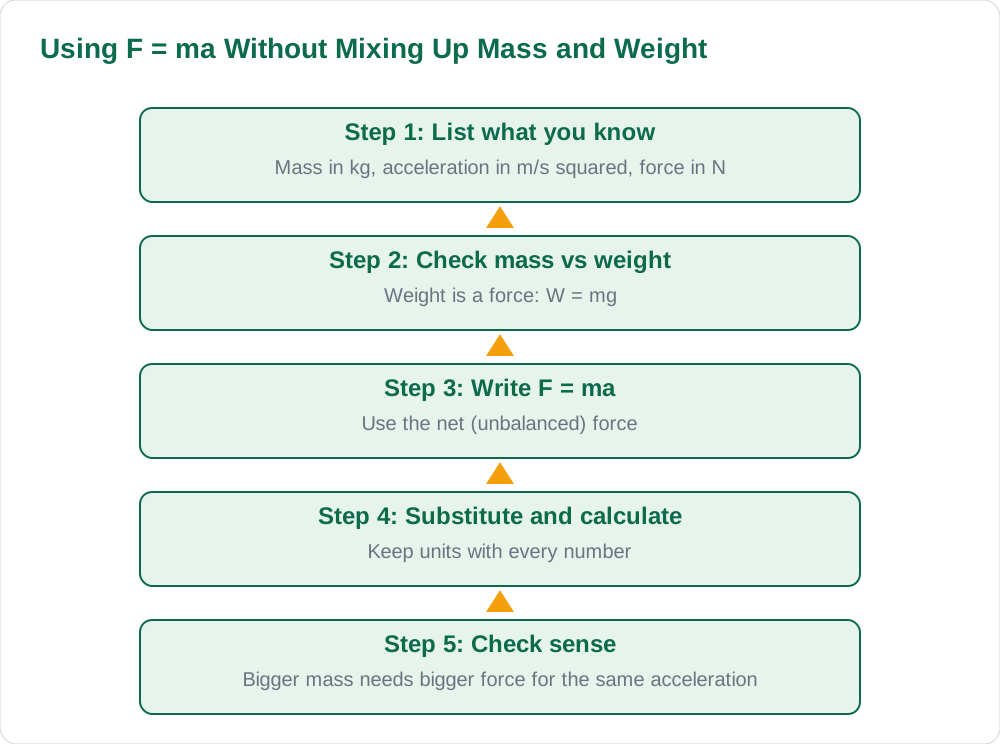
When you solve second-law problems, follow this routine: list the mass in kilograms, the acceleration in metres per second squared, and the net force in newtons. Write F = ma, substitute the numbers with units, and calculate. Watch out for weight, which is a force: weight equals mass times the acceleration due to gravity (W = mg). A 10 kg bag has a weight of about 98 N, but its mass is still 10 kg. Mixing up mass and weight is the most common second-law mistake, so always check which one the question gives you. The method of working carefully through numbers also helps with physics numerical problems.
Third Law: Every Action Has a Reaction
Newton's third law says that for every action there is an equal and opposite reaction. When one object exerts a force on a second object, the second object exerts an equal force in the opposite direction on the first. The two forces act on different objects, which is the detail most pupils forget. If the two forces acted on the same object, they would cancel and nothing would ever move, but they act on different objects, so motion happens.
Walking is a third-law act. Your foot pushes backward on the ground, and the ground pushes forward on your foot, moving you ahead. A swimmer pushes water backward and the water pushes the swimmer forward. A rocket pushes hot gases downward and the gases push the rocket upward. A cricket bat hits a ball forward, and the ball pushes back on the bat, which is why a hard hit stings the hands. A bird flies because its wings push air downward and the air pushes the wings upward. In each case, the pair of forces is equal in size and opposite in direction, but they act on different bodies.
A famous trap question asks: if the action and reaction are equal and opposite, why does anything move? The answer is that the two forces act on different objects. The action of the horse on the cart and the reaction of the cart on the horse are equal, but the cart still moves because the net force on the cart is forward. When you answer third-law questions, always name both objects and both forces: object A pushes object B, and object B pushes object A. Naming the pair in full is what earns full marks.
Which Law Is This? A Quick Test
Exam questions often describe a situation and ask which law it shows. Use these clues. If something keeps its motion until a force changes it, or if the question mentions inertia, a seat belt, or a sudden stop, it is the first law. If the question gives a force, a mass, and an acceleration, or asks how one of them changes when another changes, it is the second law. If the question describes two objects pushing each other, or a pair of forces in opposite directions, it is the third law. Many questions combine laws, so read carefully: a rocket accelerating uses the third law to produce thrust and the second law to relate that thrust to its acceleration.
Try this test on three scenes. A cyclist stops pedalling and slowly comes to rest: the first law, because friction is the unbalanced force that changes the motion. A batsman hits a ball and it accelerates off the bat: the second law, because the force of the bat produces the ball's acceleration, and the third law, because the ball pushes back on the bat. A balloon flies when its air escapes: the third law, because the air rushes one way and the balloon moves the other. Practise naming the law for ten scenes a day for a week, and the identification skill becomes automatic. Related everyday physics is covered in force and motion in daily life.
AI Help: Muse AI
Muse AI is Meta's personal AI assistant, and it can help with this topic by turning any everyday scene you describe, like a cricket catch or a sudden bus stop, into a clear explanation of which of Newton's laws is at work. You can ask it to quiz you with new situations or to explain F = ma using objects from your own home. Muse AI does not give official Sindh Textbook Board answers — always verify against your Sindh Textbook Board book and your teacher.
Join Muse with invite code LTGSWD — in the Muse app, go to Settings > Redeem token and enter the code.
Disclosure: LTGSWD is the author's Muse invite code.
5 key points you must know
- First law: an object keeps its motion unless an unbalanced force acts on it; this resistance is inertia.
- Second law: F = ma — acceleration grows with force and shrinks with mass.
- Third law: forces come in equal, opposite pairs acting on different objects.
- Seat belts work by providing the unbalanced force that stops your body with the car.
- Name both objects and both forces when answering third-law questions.
Frequently asked questions
Why do passengers lurch forward when a bus brakes suddenly?
Because of inertia, from the first law. The passengers' bodies tend to keep moving forward while the bus slows down. The seat or a seat belt provides the unbalanced force that slows the passengers with the bus.
What is the difference between mass and weight in F = ma?
Mass is the amount of matter in an object, measured in kilograms, and it does not change with location. Weight is the force of gravity on that mass, W = mg, measured in newtons. In F = ma, m is the mass, never the weight.
If action and reaction are equal, why does anything move?
Because the two forces act on different objects. When you walk, your foot pushes the ground backward and the ground pushes you forward. The force on you is unbalanced, so you move, even though the pair of forces is equal and opposite.
Why do fielders pull their hands back when catching a fast ball?
Pulling the hands back lengthens the time over which the ball slows down, which reduces the force on the hands. This follows from the second law: the same change in motion spread over more time needs a smaller force.
How can I tell which law a question is testing?
Keeping motion or inertia points to the first law; force, mass, and acceleration point to the second; two objects pushing each other points to the third. Name the clue words in the question before you choose.
Solved notes — preview free
These guides work best with the solved exercises. Preview the solved notes free on this website — 119 solved notes for Classes 6–10 in Sindhi, Urdu, English and Arabic medium. Or browse the full solved notes catalogue for your class and medium. New solved notes are added regularly — check the catalogue for coming-soon books.