Light: Reflection and Refraction with Ray Diagrams

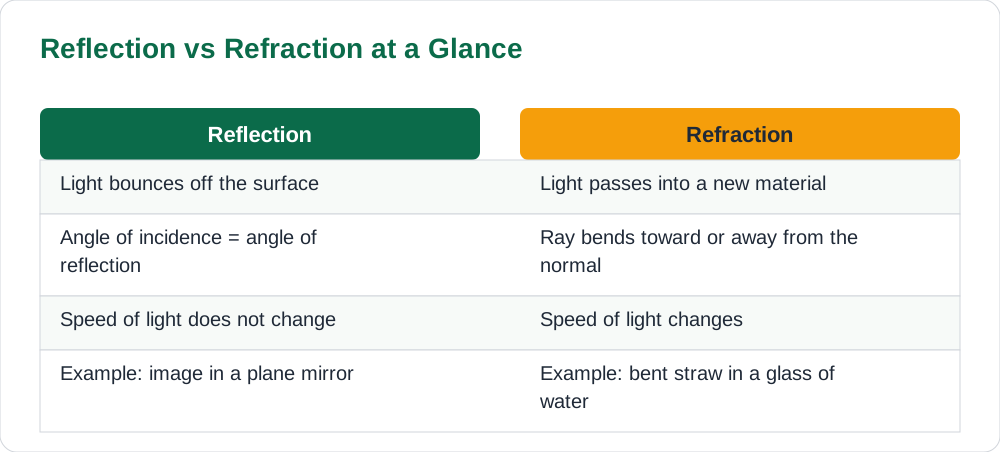
Light travels in straight lines, and that single fact explains mirrors, lenses, rainbows, and why a straw in a glass of water looks bent. When light meets a surface, it can bounce back, which is reflection, or it can pass into a new material and change direction, which is refraction. Both behaviours follow simple rules, and both are best learned by drawing ray diagrams: straight lines with arrowheads showing where the light goes. A pupil who can draw the ray diagram can answer almost any question about light. This article teaches you to draw those diagrams yourself. You will learn the law of reflection with a plane mirror, how images form in mirrors, and why a spoon in water looks broken at the surface. You will practise with mirrors and a glass of water at home, using safe, simple observations. By the end, you will be able to trace rays through a mirror and through water, label the angles, and explain what you see in your own words. The [solved notes page](/solved.html) lists class material where these diagrams appear. More science material is on the [books page](/books.html) and the [blog index](/blog/).
Light Travels in Straight Lines
A ray is a straight line showing the path of light, and a beam is a group of rays. Shadows are the simplest proof that light travels straight: an object blocks the rays, and the shadow is the region the rays cannot reach. A pinhole camera works the same way: light from each point of an object passes through a tiny hole in a straight line and forms an upside-down image on the screen. The image is upside down because rays from the top of the object travel downward through the hole, and rays from the bottom travel upward.
This straight-line rule is the foundation of every ray diagram. When you draw a diagram, use a ruler for every ray, add an arrowhead to show the direction of travel, and label the important lines: the incident ray coming in, the reflected or refracted ray going out, and the normal, a line drawn at right angles to the surface at the point where the ray meets it. Angles in optics are always measured from the normal, never from the surface. That one rule, angles from the normal, prevents more mistakes than any other single habit in this topic.
Reflection: The Law of the Mirror
When light hits a smooth surface like a mirror, it reflects. The law of reflection says that the angle of incidence equals the angle of reflection, and that the incident ray, the reflected ray, and the normal all lie in the same plane. The angle of incidence is the angle between the incoming ray and the normal; the angle of reflection is the angle between the outgoing ray and the normal. If a ray strikes a mirror at 30 degrees to the normal, it leaves at 30 degrees to the normal, on the other side.
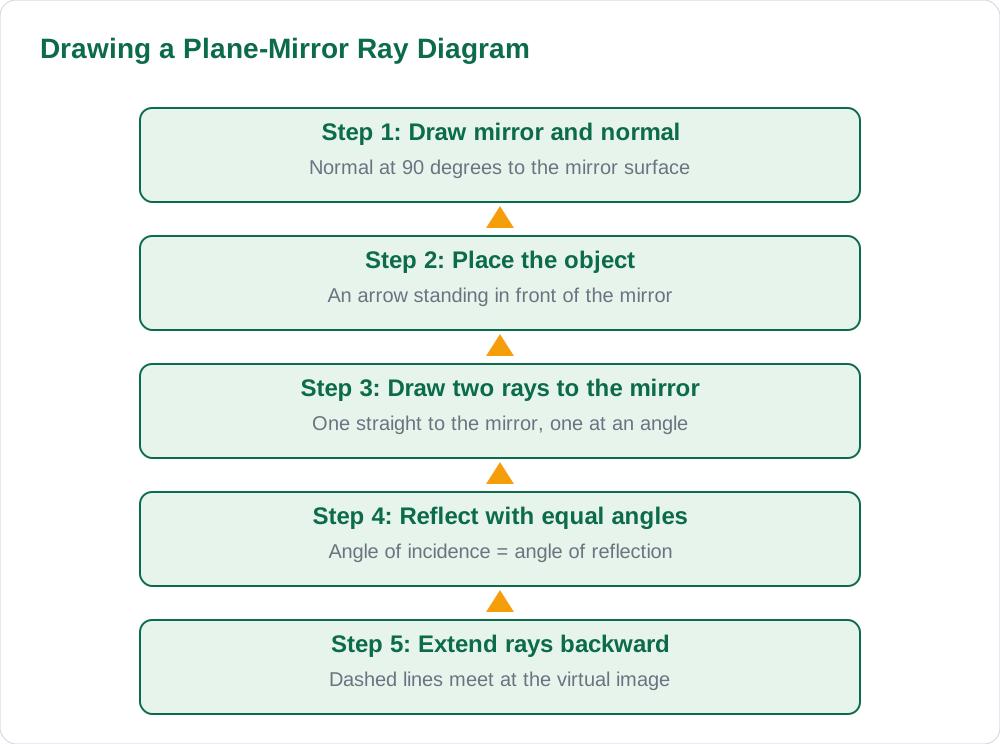
A plane mirror forms an image that is upright, the same size as the object, and as far behind the mirror as the object is in front of it. The image is virtual, which means the light rays do not actually meet behind the mirror; your brain follows the reflected rays backward and sees the image there. It is also laterally inverted, so writing appears back to front. A periscope uses two mirrors at 45 degrees to let you see over an obstacle, and the mirrors in a barber's shop use two reflections to show the back of your head. To draw a plane-mirror diagram, draw the mirror, place the object, draw two rays from one point of the object to the mirror, reflect each with equal angles, and extend the reflected rays backward with dashed lines to find the image point.
Refraction: Why Light Bends
When light passes from one transparent material into another, it changes speed, and that change of speed makes it change direction. This bending is called refraction. Light travels fastest in a vacuum and slower in water and glass. When light enters a denser material, like going from air into water, it slows down and bends toward the normal. When it leaves a denser material and goes back into a rarer one, it speeds up and bends away from the normal. If the ray enters exactly along the normal, straight on, it does not bend at all, although it still slows down.
The bent straw in a glass of water is the classic example. Light from the underwater part of the straw refracts as it leaves the water, bending away from the normal. Your eye follows the outgoing rays backward in a straight line, so the straw appears to be in a different place from where it really is, and it looks broken at the surface. A swimming pool looks shallower than it really is for the same reason: the light from the bottom bends as it leaves the water, and your brain places the bottom higher than it is. Never judge the depth of water by looking at it, because refraction always makes it look shallower.
Ray Diagrams for Refraction
To draw a refraction diagram, draw the boundary between the two materials as a straight line and the normal at right angles to it. Draw the incident ray in the first material with an arrowhead pointing toward the boundary. At the boundary, draw the refracted ray in the second material: toward the normal if the light is entering a denser material, away from the normal if it is entering a rarer material. Label the angle of incidence in the first material and the angle of refraction in the second material, both measured from the normal.
A glass block shows refraction twice: once when the light enters the glass, bending toward the normal, and once when it leaves, bending away from the normal. The ray that comes out is parallel to the ray that went in, but shifted sideways. This sideways shift is called lateral displacement, and it grows with the thickness of the block. You can observe it safely at home with a glass of water and a pencil: look at the pencil from the side and then move your head, and the apparent shift changes with the viewing angle. Drawing the two bends on paper makes the shift obvious and easy to explain in an exam.
Total Internal Reflection and Everyday Uses
When light travels inside a denser material toward a rarer one, and the angle of incidence is large enough, the light does not leave at all: it reflects back inside. This is called total internal reflection. It happens only when light goes from denser to rarer, and only beyond a certain critical angle. Diamonds sparkle because their shape makes light reflect internally many times before it escapes. Fibre-optic cables carry internet and phone signals as pulses of light bouncing inside a thin glass fibre by total internal reflection, with almost no loss over long distances.
Mirages are another example. On a hot day, the air just above a road is hotter and rarer than the air above it. Light from the sky bends as it passes through layers of air of different density, and at a large enough angle it reflects totally, so you see a shimmering patch that looks like water. It is not water; it is the sky, reflected by hot air. Rainbows are different: they form when sunlight refracts as it enters a raindrop, reflects once inside the drop, and refracts again as it leaves, splitting white light into colours. The same splitting happens in a glass prism, because different colours bend by different amounts.
AI Help: Muse AI
Muse AI is Meta's personal AI assistant, and it can help with this topic by describing a ray diagram in words for any mirror or water setup you name, so you can check your drawing against it. You can ask it to explain why a pool looks shallower than it is, or to quiz you on reflection versus refraction. Muse AI does not give official Sindh Textbook Board answers — always verify against your Sindh Textbook Board book and your teacher.
Join Muse with invite code LTGSWD — in the Muse app, go to Settings > Redeem token and enter the code.
Disclosure: LTGSWD is the author's Muse invite code.
5 key points you must know
- Light travels in straight lines; angles in optics are measured from the normal.
- Law of reflection: angle of incidence equals angle of reflection.
- A plane mirror gives an upright, same-size, virtual, laterally inverted image.
- Refraction is bending caused by a change of speed when light enters a new material.
- Total internal reflection happens when light in a denser material hits the boundary beyond the critical angle.
Frequently asked questions
Why does a straw in water look bent?
Light from the underwater part of the straw bends away from the normal as it leaves the water. Your eye follows the outgoing rays backward in a straight line, so the straw appears in a different position above the surface, and it looks broken at the water line.
What is a virtual image?
A virtual image is one where the light rays only appear to meet. In a plane mirror, the rays do not actually meet behind the mirror; your brain follows the reflected rays backward and sees the image there. A virtual image cannot be caught on a screen.
Why does a pool look shallower than it really is?
Because of refraction. Light from the bottom bends away from the normal as it leaves the water, and your brain places the bottom higher than its true position. Never judge water depth by looking at it.
Does light bend when it enters glass straight on?
No. A ray that enters along the normal, at zero angle of incidence, does not change direction, although it slows down. Bending happens only when the ray enters at an angle.
What is total internal reflection used for?
It is used in fibre-optic cables, which carry signals as light bouncing inside thin glass fibres, and it explains the sparkle of a diamond and the mirage on a hot road.
Solved notes — preview free
These guides work best with the solved exercises. Preview the solved notes free on this website — 119 solved notes for Classes 6–10 in Sindhi, Urdu, English and Arabic medium. Or browse the full solved notes catalogue for your class and medium. New solved notes are added regularly — check the catalogue for coming-soon books.