Lab Safety Rules Every Pupil Must Follow
Laboratory safety rules exist because school laboratories contain real hazards: chemicals that can burn or stain, glassware that can break into sharp pieces, and flames that can catch clothing or hair alight. Most lab accidents are preventable, and they usually happen when a simple rule is ignored, such as running in the lab, tasting a chemical, or heating a closed container. Knowing the rules is not enough; you must follow them every time, even when the experiment seems simple, because habits formed in easy practicals protect you in harder ones. This guide covers the essential safety rules for chemicals, glassware, and flames, and what to do first when something goes wrong.
General Behaviour in the Laboratory
Enter the laboratory calmly, go to your assigned place, and listen to the teacher's instructions before touching any apparatus or chemical, since many accidents happen in the first minutes when pupils handle equipment before the method is explained. Do not run, push, or play around in the lab, and keep bags and coats away from benches and walkways where they cause trips or knock apparatus over. Wear the eye protection your teacher provides whenever it is required, and tie back long hair and tuck in loose clothing or sleeves before starting work, because hair and cloth catch fire far more easily than pupils expect. If you are unsure about any instruction, ask before acting rather than guessing, since a question asked early prevents an accident later.
Keep your bench tidy throughout the practical, with only the apparatus and materials for the current step in front of you, and put stoppers back on bottles immediately after use so chemicals cannot be knocked over or mixed up. Never eat, drink, or chew in the laboratory, and never taste or smell a chemical directly to identify it, since even familiar-looking substances can be harmful. Wash your hands at the end of the practical and after handling any chemical, and report any accident, spill, or breakage to the teacher at once, however small it seems. A calm, tidy, attentive pupil is the safest person in any laboratory.
Chemicals: Handling and Spills
Handle chemicals exactly as your teacher instructs, using the amounts and concentrations given, and never mix chemicals together to see what happens, since unexpected reactions can produce heat, gas, or splashes. Read the label on every bottle before you use it, checking the name and any hazard warning, and take only what you need, returning nothing to a stock bottle once it has been poured out, because returned chemical may be contaminated. Carry bottles with one hand under the base and the other around the neck or side, keeping them low over the bench, and pour slowly with the label facing your hand so drips do not hide the name. If a chemical contacts your skin or eyes, tell the teacher immediately and follow their instructions, which usually include washing with plenty of water.
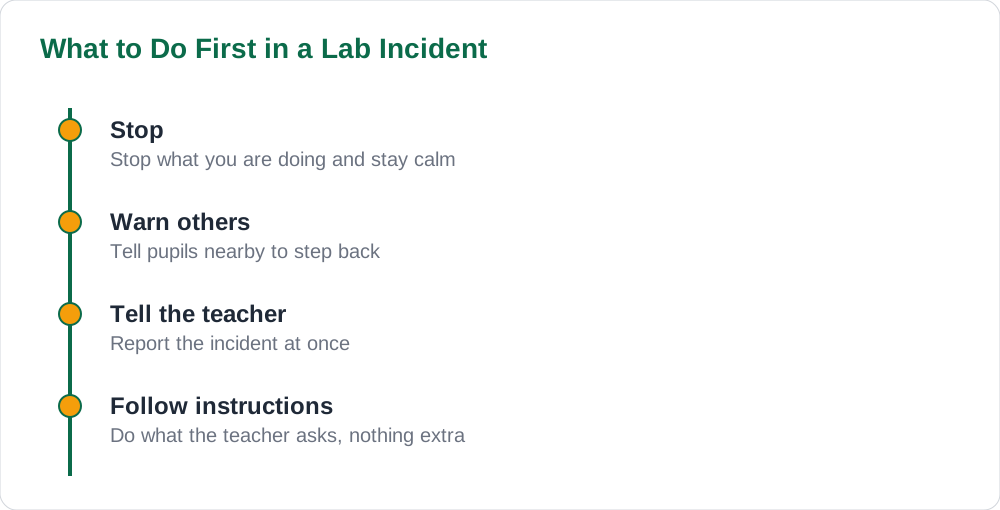
If a chemical spills, do not try to clean it up on your own with paper towels or by wiping it towards yourself; step back, warn pupils nearby, and tell the teacher straight away, since the right response depends on the chemical spilled. Keep the spill contained by not walking through it, and do not pour water on a spill unless the teacher tells you to, because water makes some spills worse. Learn where the safety equipment in your laboratory is, such as the eye wash, the first aid box, and the spill kit, before you need it, by asking your teacher to point them out at the start of the year. Knowing what to do first, which is to tell the teacher and step back, turns a frightening spill into a managed incident. For more study material, see the solved notes and the book collection.
Glassware: Breakage and Sharp Edges
Treat all glassware as fragile, even thick-looking beakers and flasks, and place it gently on the bench rather than sliding or dropping it into place. Check glassware before use for chips or cracks, especially around rims and joints, and hand any damaged piece to the teacher instead of using it, since a cracked vessel can break under heat or pressure. Carry glassware with both hands where it is large, keep it away from the edge of the bench, and never use a glass item as a hammer, stirrer, or lever unless it is designed for that purpose. Hot glass looks exactly like cold glass, so never pick up glassware that has been heated without checking with your teacher or using the proper holder.
If glass breaks, stop work, warn pupils nearby, and tell the teacher immediately, and do not pick up broken pieces with your bare hands, since even tiny shards cut easily. Your teacher will show you the safe way to clear breakage, usually with a brush and dustpan into a special container, not the ordinary bin, and the area should be checked for small pieces before work resumes. If you cut yourself, however small the cut seems, tell the teacher at once so it can be cleaned and covered properly, and do not continue handling chemicals with an uncovered cut. Respect for glassware, and a calm response to breakage, prevents most laboratory cuts entirely.
Flames, Heating, and Hot Equipment
Treat every flame as a burn risk, light burners only as your teacher instructs, and never leave a lit burner unattended or point a heated test tube towards yourself or another pupil. When heating a liquid in a test tube, warm it gently, move the tube through the flame rather than holding it in one spot, and angle the mouth away from everyone, since heated liquid can bubble up suddenly and spit out. Never heat a closed container, because trapped gas or vapour builds pressure and can burst the container, and never look directly into a vessel you are heating. Turn burners off as soon as heating is finished, and check that the flame is truly out before moving on.
Handle hot equipment only with the proper holders, tongs, or heat-resistant mats, and place hot items on a heat-resistant surface, never directly on a bench or near paper. Remember that metal and glass stay hot long after heating, so warn others if an item is hot and wait for it to cool before putting it away. If clothing catches fire, the rule is to stop, drop, and roll, and to call for the teacher immediately, rather than running, which fans the flames. If a small fire starts in a container, do not try to fight it yourself with water unless your teacher directs you; step back, tell the teacher, and let them use the correct extinguisher or cover. Calm, prompt reporting is the safest response to any fire.
Safety as a Habit, Not a List
Safety rules only protect you when they become habits, followed without thinking in every practical, not rules remembered for a test and forgotten in the lab. Build a personal start-of-practical routine: hair tied back, sleeves secure, eye protection on where required, bench tidy, and instructions heard before touching anything, and run through it every time until it is automatic. During the practical, keep checking your own behaviour: are you pouring slowly, is the burner off when not needed, is the glassware away from the edge? These small self-checks take seconds and prevent most accidents, and they are exactly the habits examiners and teachers notice when they judge a pupil's laboratory manner.
Finally, take responsibility for the safety of others as well as yourself, by warning a classmate who is about to make a mistake, reporting hazards you spot, and never distracting someone who is handling a flame or a chemical. If you see a spill, a cracked flask, or a burner left on, tell the teacher even if it is not your bench, because a hazard ignored becomes someone's accident. Laboratories are safe places when everyone follows the same rules, and your own steady example helps the whole class stay safe. A pupil who works safely every time is a pupil teachers trust with harder, more interesting practical work. More guides are on the blog and the [home page](/).
AI Help: Muse AI
Muse AI is Meta's personal AI assistant, and it can help you learn lab safety by explaining why a rule matters, such as why long hair must be tied back or why a closed container must never be heated. Try asking it to explain the reason behind one safety rule, then remember the reason rather than just the rule.
Join Muse with invite code LTGSWD — in the Muse app, go to Settings > Redeem token and enter the code.
Disclosure: LTGSWD is the author's Muse invite code.
Muse AI does not give official STBB answers — always verify against your Sindh Textbook Board book and your teacher.
5 key points you must know
- Listen to instructions before touching any apparatus or chemical.
- Wear eye protection where required and tie back hair and loose clothing.
- Never taste, smell directly, eat, or drink in the laboratory.
- Report every spill, breakage, or accident to the teacher at once.
- Never heat a closed container or point a heated tube at anyone.
Frequently asked questions
What should I do first if a chemical spills?
Step back, warn pupils nearby, and tell the teacher immediately. Do not try to clean it up alone and do not pour water on it unless the teacher tells you to, since the right response depends on the chemical.
What should I do if glassware breaks?
Stop work, warn others, and tell the teacher at once. Do not pick up broken pieces with bare hands; your teacher will clear them safely with a brush and dustpan into a special container.
Why must long hair be tied back in the laboratory?
Because hair catches fire easily and can dip into chemicals or flames when you lean over a bench. Tying it back and tucking in loose sleeves removes a common and preventable burn risk.
Can I look into a test tube while heating it?
No, never look into a vessel you are heating, and always angle the mouth away from yourself and others. Heated liquid can bubble up suddenly and spit out of the tube.
Solved notes — preview free
These guides work best with the solved exercises. Preview the solved notes free on this website — 119 solved notes for Classes 6–10 in Sindhi, Urdu, English and Arabic medium. Or browse the full solved notes catalogue for your class and medium. New solved notes are added regularly — check the catalogue for coming-soon books.