A Playground-Scale Model of the Solar System
Textbook pictures of the solar system can be misleading. They show the planets as neat, evenly spaced balls, but in reality the distances between planets are enormous compared with the sizes of the planets themselves. A playground-scale model fixes that misunderstanding by turning the school ground into a map of the solar system. Pupils walk the distances, place the planets, and feel how far apart they really are. This article explains how to plan, build, and explain a playground-scale model, what pupils learn from it, and how to keep the activity safe and organised. For more study support, see the [solved notes](/books.html) and the [books page](/books.html).
Why Scale Models Change How You See Space
A scale model keeps proportions honest. If you make the Sun a ball and the planets small beads, you must also keep the distances in the same proportion, or the model will lie about space. That honesty is the point. When pupils walk from Mercury to Neptune in a playground model, they discover that the inner planets are close together while the outer planets are far apart. They also discover that the Sun, even as a small ball, dominates the model, while the planets are tiny by comparison. Those two ideas are hard to learn from a picture, but easy to feel when you walk them.
Scale models also teach estimation and measurement. Pupils must choose a scale, measure distances with a tape or counted steps, and place markers carefully. If the scale is too large, the outer planets will run past the school gate. If it is too small, the inner planets will crowd together. Choosing a workable scale is itself a science and maths skill. Teachers can start with a simple rule: pick a scale that fits the playground, then calculate where each planet goes. The study blog has more examples of turning textbook ideas into outdoor learning.
- A scale model keeps sizes and distances in the same proportion.
- Walking the distances shows how far apart the outer planets are.
- Choosing a scale that fits the playground is a maths and science skill.
- The Sun dominates the model while planets are tiny by comparison.
Choosing a Scale That Fits Your Playground
Start by measuring the longest straight line your playground allows, such as from one corner to the opposite gate. That length is your limit for the distance to the farthest planet in the model. Next, choose a simple scale, such as one step equals a fixed number of million kilometres, or one metre equals a fixed distance in space. Keep the maths simple enough for pupils to calculate with a table. The teacher can prepare a table with each planet, its real distance from the Sun in simple rounded numbers, and its model distance in steps or metres. Pupils then use the table to place markers without needing to calculate huge numbers on the spot.
For planet sizes, use a different scale if needed, and say so openly. Real planet sizes are so small compared with real distances that using one scale for both would make the planets invisible. Many school models use one scale for distances and a larger, clearly labelled scale for sizes, so pupils can still see the planets. That is honest as long as the teacher explains it. A model that pretends one scale does everything can confuse pupils more than it helps. Write both scales on the display board so every visitor knows what the model shows.
- Measure the longest straight line the playground allows first.
- Choose a simple scale pupils can use with a table.
- Use a separate, clearly labelled scale for planet sizes if needed.
- Write both scales on the display board so the model stays honest.
Building the Model: Markers, Labels, and Roles
Build the model with simple, cheap materials. The Sun can be a large ball, a painted circle, or a flag on a pole. Planets can be labelled stones, bottle caps, paper circles, or small balls in different colours. Each marker needs a clear label with the planet name and one fact, such as its position from the Sun. Cones, chalk marks, or paper arrows on the ground can show the path from the Sun outward. Keep the path clear of play equipment so pupils can walk it safely without tripping.
Give pupils roles so the activity stays organised. One group measures and places markers, one group checks distances with a tape, one group writes labels, and one group guides visitors along the walk. Each group should have a simple checklist: planet name, distance from the Sun, marker placed, label checked. When the model is complete, walk it together slowly, stopping at each planet to read its label and compare its distance from the Sun with the previous planet. That guided walk is where the learning happens, not in the building alone.
- Use simple markers: labelled stones, caps, paper circles, or small balls.
- Label each planet with its name and one clear fact.
- Keep the walking path clear of equipment and tripping hazards.
- Give groups roles: measuring, checking, labelling, and guiding.
What the Walk Teaches About Planets
The walk teaches several ideas at once. First, the inner planets are rocky and close together, while the outer planets are much further apart. Second, Jupiter and Saturn are much larger than the inner planets, even when sizes use a separate scale. Third, the Sun is the centre that all planets orbit, and the model shows that centre clearly. Fourth, distance from the Sun affects how much sunlight a planet receives, which helps explain why outer planets are colder. Pupils can discuss these ideas at each stop, rather than memorising a list at a desk.
The walk also corrects common misunderstandings. Pupils often think planets are evenly spaced, or that the Moon is a planet, or that the Sun moves around Earth. A scale model makes the first error visible, and the teacher can address the others at the Earth stop by showing the Moon as a tiny marker near Earth. Encourage pupils to ask questions as they walk: why is Mars red, why does Saturn have rings, why is Mercury so hot in the day and cold at night. Short, honest answers at the right stop are more memorable than a long lecture. For more on asking and testing ideas, see observation and hypothesis.
- Inner planets are rocky and close; outer planets are far apart.
- Jupiter and Saturn are much larger than the inner planets.
- Distance from the Sun affects sunlight and temperature.
- Use each stop to correct one common misunderstanding.
Extending the Model and Keeping It Safe
Once the basic model is built, extend it with simple activities. Pupils can draw the model to scale in their notebooks, with a note of both scales used. They can write a short paragraph comparing the walk to Mercury with the walk to Neptune. They can research one planet each and present one fact at its marker during a class visit. Older pupils can calculate how long light takes to reach each planet in simple terms, or how many Earth years equal one year on another planet. These extensions turn a one-day activity into a week of learning without needing new materials.
Safety and care matter throughout. Walk, do not run, along the model path. Keep markers low and visible so no one trips. If the model is left out, check it before the next class and replace any markers that have moved. Take photographs so the class can revise the model later. When the activity ends, collect markers and labels for reuse. A well-kept model can be rebuilt quickly next year, and the photographs become a revision resource. For more on careful recording and write-ups, see the science write-up guide.
- Draw the model to scale in notebooks with both scales noted.
- Add one-planet research presentations at each marker.
- Walk, do not run, and keep markers low and visible.
- Photograph the model and save markers for reuse.
AI Help: Muse AI
Muse AI is Meta's personal AI assistant, and it can help you plan a playground-scale solar system model by suggesting a simple scale and a short fact for each planet marker.
Join Muse with invite code LTGSWD — in the Muse app, go to Settings > Redeem token and enter the code.
Disclosure: LTGSWD is the author's Muse invite code.
Muse AI does not give official STBB answers — always verify against your Sindh Textbook Board book and your teacher.
5 key points you must know
- A scale model keeps proportions honest and shows real distances.
- Inner planets cluster close to the Sun; outer planets are far apart.
- Use one simple scale for distances and a clearly labelled scale for sizes.
- Walking the model teaches distance, size, and sunlight together.
- Photographs and notebooks turn the walk into lasting revision.
Frequently asked questions
Why not use the same scale for planet sizes and distances?
Real distances are so huge compared with planet sizes that using one scale would make the planets invisible. Schools use one scale for distances and a larger, clearly labelled scale for sizes so pupils can still see the planets. The key is to label both scales openly.
What materials do I need for a playground model?
A ball or flag for the Sun, labelled stones, caps, paper circles, or small balls for planets, chalk or cones for the path, and a tape measure. Keep materials simple, low, and visible so the walk stays safe.
Which planets are closest together in the model?
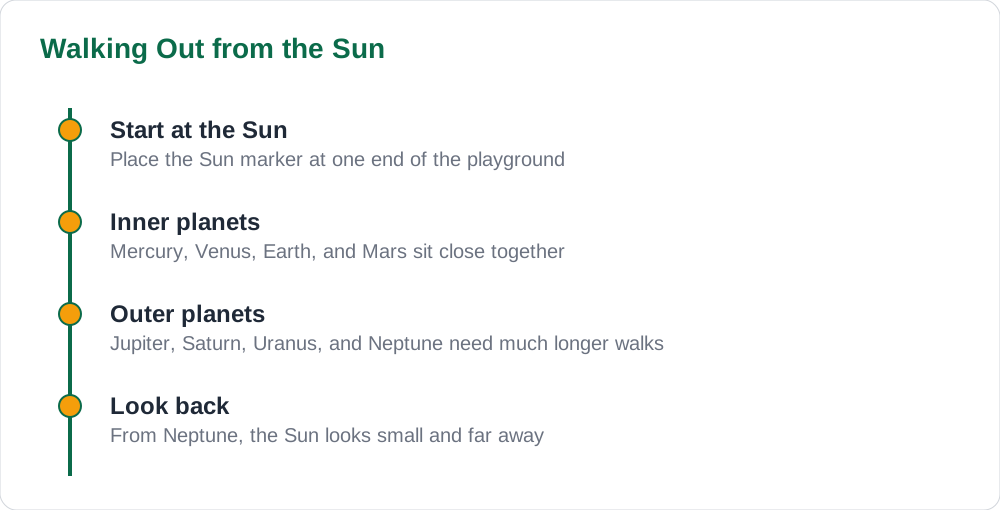
The inner planets Mercury, Venus, Earth, and Mars sit close together near the Sun. The outer planets Jupiter, Saturn, Uranus, and Neptune need much longer walks between them.
How can pupils record the model in their notebooks?
Draw the Sun and planets in order with the distances marked, note both scales used, and write one fact per planet. A short paragraph comparing the walk to Mercury with the walk to Neptune is a strong summary.
Is the Moon part of the solar system model?
The Moon orbits Earth, not the Sun directly, so it appears as a tiny marker near Earth in the model. That placement helps correct the common mistake of calling the Moon a planet.
Solved notes — preview free
These guides work best with the solved exercises. Preview the solved notes free on this website — 119 solved notes for Classes 6–10 in Sindhi, Urdu, English and Arabic medium. Or browse the full solved notes catalogue for your class and medium. New solved notes are added regularly — check the catalogue for coming-soon books.