Huqooq-ul-Ibad and Social Responsibility for Senior Pupils
Huqooq-ul-Ibad means the rights of people: the duties Muslims owe to one another as human beings. Senior Islamiat extends this idea far beyond kindness in general, asking how it applies to orphans, widows, disabled people, travellers, neighbours, and workers. This guide explains Huqooq-ul-Ibad at senior depth and shows how it becomes social responsibility: not just feeling sympathy, but acting fairly, protecting dignity, and meeting real needs. You will learn how to study the topic, how to write about it, and how to practise it in school and community life.
Huqooq-ul-Ibad: Rights, Not Favours
The most important senior insight about Huqooq-ul-Ibad is that these are rights, not favours. A favour can be withheld when you feel ungenerous, but a right is owed whether you feel like giving it or not. Parents have rights to respect and care, neighbours have rights to safety and consideration, workers have rights to fair wages paid on time, and guests have rights to hospitality. When you write about Huqooq-ul-Ibad, use the language of rights and duties, and explain why each right exists: because human dignity is given by Allah, not earned by wealth or status.
This distinction changes behaviour. A pupil who sees kindness as a favour helps only when it is convenient; a pupil who sees it as a duty helps reliably, even when it costs time or effort. In your notes, list each group of people in one column and their specific rights in the next, so that the topic becomes concrete. General statements like 'we should be kind to everyone' are a starting point, but senior answers need named groups, named rights, and named actions.
Orphans, Widows, and Vulnerable People
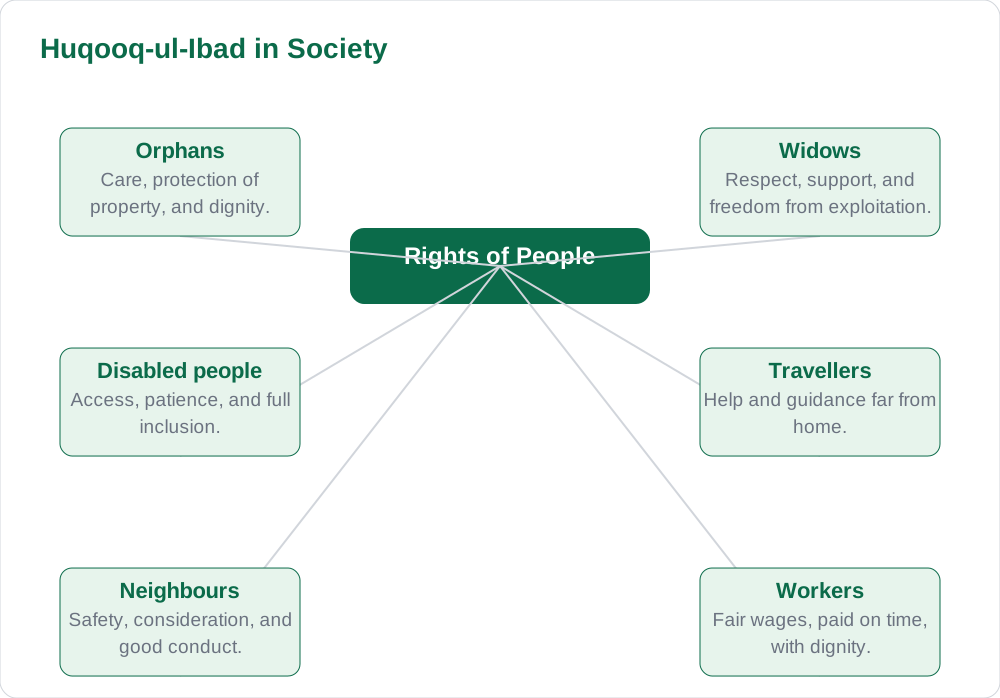
Senior Islamiat gives special attention to people who are vulnerable because they lack protection or support. Orphans deserve care for their property as well as their upbringing: their wealth must be protected, not used, and their dignity must be guarded, not pitied publicly. Widows deserve respect, support, and freedom from exploitation at a time of grief. Disabled people deserve access, patience, and full inclusion, not pity or exclusion. Travellers deserve help and guidance when they are far from home and support. A senior answer should name at least two such groups and explain their rights specifically.
The test of understanding here is specificity. Instead of writing 'help the poor', write how help should be given: privately to protect dignity, fairly without favouritism, and consistently rather than once. Instead of writing 'respect orphans', write that their property is a trust and their feelings deserve the same care as any child's. Pupils who practise this specificity in notes will find exam answers much easier, because the answer is already written in their revision pages.
From Personal Kindness to Social Responsibility
Social responsibility means that Huqooq-ul-Ibad is practised at the level of a community, not only by individuals. A school practises it when it includes every pupil fairly, protects weaker pupils from bullying, and gives everyone a voice. A neighbourhood practises it when neighbours check on elderly residents, keep shared spaces clean, and resolve disputes fairly. A society practises it when institutions protect the vulnerable and when citizens hold one another to standards of fairness. Senior pupils should be able to move between these levels in an answer: personal, school, neighbourhood, and society.
A good study exercise is to take one right, such as a worker's right to fair treatment, and trace it through all four levels. Personally, it means speaking respectfully to support staff. In school, it means valuing every role, from teacher to cleaner. In a neighbourhood, it means paying fairly and promptly for work done. In society, it means supporting fair rules. This tracing exercise produces answers with real depth, because it shows the same principle working at every scale.
Writing Answers on Huqooq-ul-Ibad
A strong answer on this topic opens with a clear definition: Huqooq-ul-Ibad are the rights of people that Muslims owe one another. Then it develops two or three groups in separate paragraphs, each naming the group, its specific rights, and one concrete action. Then it adds a paragraph on social responsibility, showing how the same rights work at school or community level. Finally, it closes with a short conclusion: a society that protects rights is peaceful because its members trust one another. This structure keeps answers organised and complete.
Avoid the two most common weaknesses: vagueness and repetition. Vagueness is writing 'be kind' for every group without saying how; fix it by naming one specific action per group. Repetition is writing the same point for orphans, widows, and travellers; fix it by asking what is different about each group's situation and needs. After drafting, read each paragraph and ask whether it could be swapped with another paragraph without anyone noticing. If it could, that paragraph needs a specific detail. For related character topics, see the justice and fairness guide.
Practising Huqooq-ul-Ibad This Week
Understanding Huqooq-ul-Ibad should change the coming week, not just the next exam. Choose three small, specific actions: help a classmate who struggles without drawing attention to it, speak respectfully to school support staff by name, and check on an elderly neighbour or relative. Do them quietly, without announcing them, because protecting dignity is part of the right itself. At the end of the week, note what was easy, what was hard, and what you would do differently. That honest review is itself an act of accountability.
Pupils sometimes worry that small actions do not count as social responsibility. They do, because societies are built from repeated small actions by many people. A school where pupils routinely include others, speak fairly, and help quietly becomes a different place from one where they do not, even though no single action seems large. Start with the small actions, do them consistently, and let the habit grow. Find your class book through the books collection and the solved notes pages to match your actions to what your textbook teaches.
AI Help: Muse AI
Muse AI is Meta's personal AI assistant. It can help with this topic by suggesting specific, dignified ways to practise Huqooq-ul-Ibad at school, or by helping you organise your notes by group and right.
Join Muse with invite code LTGSWD — in the Muse app, go to Settings > Redeem token and enter the code.
Disclosure: LTGSWD is the author's Muse invite code.
Muse AI does not give official STBB answers — always verify against your Sindh Textbook Board book and your teacher.
5 key points you must know
- Huqooq-ul-Ibad are rights owed to people, not optional favours.
- Orphans, widows, disabled people, and travellers each have specific, named rights.
- Help must protect dignity: privately, fairly, and consistently.
- Social responsibility applies the same rights at personal, school, and community levels.
- Strong answers name groups, rights, and one concrete action per group.
Frequently asked questions
What is the difference between Huqooq-ul-Ibad and general kindness?
Kindness is a feeling or favour, while Huqooq-ul-Ibad are rights that are owed whether you feel generous or not. This matters because rights must be met reliably, even when helping costs time or effort.
Why does senior Islamiat emphasise orphans and widows?
Because they are vulnerable through loss of protection or support, so their rights need special guarding. For orphans this includes protecting their property as a trust; for widows it includes respect and freedom from exploitation.
How can a pupil practise Huqooq-ul-Ibad at school?
Include every pupil fairly, protect weaker pupils from bullying, speak respectfully to support staff, and help classmates quietly without drawing attention. Small consistent actions build a fair school culture.
How do I avoid vague answers on this topic?
Name each group, its specific rights, and one concrete action, and ask what is different about each group's needs. If two paragraphs could be swapped without anyone noticing, add a specific detail to each.
Solved notes — preview free
These guides work best with the solved exercises. Preview the solved notes free on this website — 119 solved notes for Classes 6–10 in Sindhi, Urdu, English and Arabic medium. Or browse the full solved notes catalogue for your class and medium. New solved notes are added regularly — check the catalogue for coming-soon books.