Seerat Study for Senior Classes: Hijrat and Ghazwat
Seerat, the life of the Prophet Muhammad (peace be upon him), is one of the richest parts of senior Islamiat, and Hijrat and Ghazwat are two of its most examined themes. Hijrat-e-Madina, the migration to Madina, changed the Muslim community from a persecuted group into an organised society. Ghazwat, the battles and expeditions, tested that society's courage, discipline, and trust. This guide shows senior pupils how to study both themes at depth using one reliable pattern: causes, events, and lessons. Master that pattern and every Seerat question becomes manageable.
The Causes, Events, and Lessons Pattern
Every senior Seerat answer improves when it follows the causes, events, and lessons pattern. Causes explain why something happened: the pressures, needs, or decisions that led to it. Events describe what actually happened, in order, without unnecessary detail. Lessons draw out what the event teaches about faith, leadership, or community. Pupils who write in this order sound organised because their thinking is organised; pupils who mix all three together sound confused even when they know the facts. Before writing any Seerat answer, jot three headings, causes, events, lessons, and fill each with two or three points.
This pattern also guides revision. Instead of re-reading long passages, build a three-column table for each theme you study: causes in the first column, key events in the second, and lessons in the third. Revise by covering one column and rebuilding it from memory, then checking. A table that you can rebuild from memory is a table you truly know. Over time, these tables become the fastest revision tool you own, far better than pages of copied notes.
Studying Hijrat-e-Madina at Senior Depth
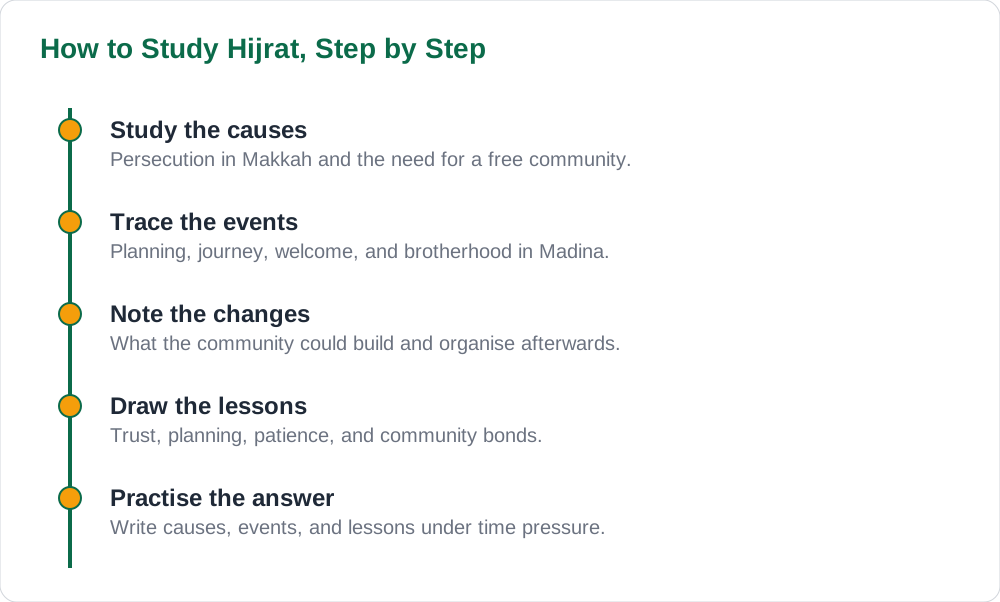
Hijrat-e-Madina is best studied as a turning point, not just a journey. Its causes included the persecution faced by Muslims in Makkah and the need for a place where they could practise and organise their community freely. Its events included careful planning, the journey itself, and the warm welcome and brotherhood established in Madina. Its lessons include trust in Allah combined with careful planning, patience under persecution, and the importance of community bonds. A senior answer should show all three layers, not only the journey narrative.
Senior depth also means noticing what changed after Hijrat. In Madina, the Muslim community could build a mosque as a centre of worship and learning, establish bonds between migrants and helpers, and organise agreements that protected the wider community. When you study Hijrat, always ask: what was different afterwards? That single question turns a story into an analysis, which is exactly what senior questions reward. Write your Hijrat notes as before-and-after comparisons to make this change visible.
Studying Ghazwat With the Same Pattern
Ghazwat should be studied with the same discipline, and with special care about accuracy. For each Ghazwa you study, note its causes, such as a threat to the community or a broken agreement, its key events in order, and its lessons, such as discipline, consultation, patience, or trust. Do not try to memorise every detail of every expedition; senior questions reward clear causes and thoughtful lessons far more than long lists of minor details. Choose the Ghazwat your textbook emphasises, study those deeply, and know the others in outline.
A common senior mistake is writing about Ghazwat as if they were only about fighting. The deeper lessons concern character and community: obedience to leadership, consultation before decisions, patience in hardship, and mercy after victory. When you write a Ghazwa answer, include at least one lesson about character and one about community for every description of events. That balance shows maturity and keeps your answer from reading like a simple battle story.
Writing Senior Seerat Answers
A senior Seerat answer opens with a short introduction stating the theme and its importance in one or two sentences. Then it moves through causes, events, and lessons as separate paragraphs, each with a clear opening line. Finally, it closes with a short conclusion linking the theme to a believer's life today, such as planning carefully while trusting Allah, or building community bonds in school and neighbourhood. This shape works for Hijrat, for Ghazwat, and for most other Seerat questions, so practising it once prepares you for many questions.
Accuracy is the non-negotiable rule of Seerat writing. Use only the facts your textbook teaches, and keep uncertain details out rather than guessing. If you are unsure whether an event belongs to one Ghazwa or another, write the causes and lessons you are sure about and leave the doubtful detail aside. Examiners reward a shorter accurate answer far more than a longer answer with confused facts. Check your Seerat notes against your class book through the books collection before final revision.
Revision Habits for Seerat Themes
Seerat revision works best in short, repeated sessions rather than one long session. In each session, pick one theme, rebuild its three-column table from memory, and then write one practice answer under time pressure. The next day, repeat the same theme before moving to a new one; this spaced repetition is what fixes causes and lessons in long-term memory. Pupils who revise Seerat this way often find that exam questions feel familiar, because they have already written the same pattern many times.
Discussion also helps Seerat revision more than most topics, because the themes involve decisions and leadership. Explain a theme to a classmate and ask them to challenge your lessons: does the lesson really follow from the events? If you can defend your lessons calmly with evidence from your notes, you understand the theme. If you cannot, you have found exactly what to revise next. For more senior Islamiat method, see the blog listing and the solved notes pages.
AI Help: Muse AI
Muse AI is Meta's personal AI assistant. It can help with this topic by quizzing you on the causes, events, and lessons of Hijrat and Ghazwat, or by helping you turn your three-column tables into practice answers.
Join Muse with invite code LTGSWD — in the Muse app, go to Settings > Redeem token and enter the code.
Disclosure: LTGSWD is the author's Muse invite code.
Muse AI does not give official STBB answers — always verify against your Sindh Textbook Board book and your teacher.
5 key points you must know
- Study every Seerat theme with the causes, events, and lessons pattern.
- Hijrat is a turning point: persecution, migration, and a newly organised community.
- Study Ghazwat for character and community lessons, not only for events.
- Build three-column revision tables and rebuild them from memory.
- Write only facts your textbook teaches; leave doubtful details out.
Frequently asked questions
What is the best structure for a Hijrat answer?
Use introduction, causes, events, and lessons, then a short conclusion linking Hijrat to life today. Jot the three headings before writing so that causes, events, and lessons stay in separate paragraphs.
Should I memorise every Ghazwa in detail?
No. Study the Ghazwat your textbook emphasises in depth, with causes, key events, and lessons, and know the others in outline. Senior questions reward clear causes and thoughtful lessons more than long lists of minor details.
How do I avoid confusing different Ghazwat?
Keep one three-column table per Ghazwa, with its own causes, events, and lessons, and revise one table at a time. When two Ghazwat blur together, compare their tables side by side and note what is different.
What makes a Seerat lesson strong?
A lesson that follows clearly from the events, such as patience under persecution or consultation before decisions, and that connects to life today. Avoid generic lessons that could fit any theme equally well.
Solved notes — preview free
These guides work best with the solved exercises. Preview the solved notes free on this website — 119 solved notes for Classes 6–10 in Sindhi, Urdu, English and Arabic medium. Or browse the full solved notes catalogue for your class and medium. New solved notes are added regularly — check the catalogue for coming-soon books.