Tauheed and Risalat: A Senior-Class Islamiat Study Guide
In senior Islamiat, Tauheed and Risalat are not topics to memorise in one line each. Tauheed is the belief in the Oneness of Allah, and Risalat is the belief that Allah sent messengers to guide humanity. At senior level, examiners expect you to explain what these beliefs mean, why they matter, and how they shape a Muslim's daily life. This guide shows you how to study both beliefs with deeper reasoning, so that your answers sound thoughtful instead of copied. You will learn how to define each belief clearly, support it with sound reasoning, and connect it to conduct, worship, and character.
Why Tauheed and Risalat Come First in Senior Islamiat
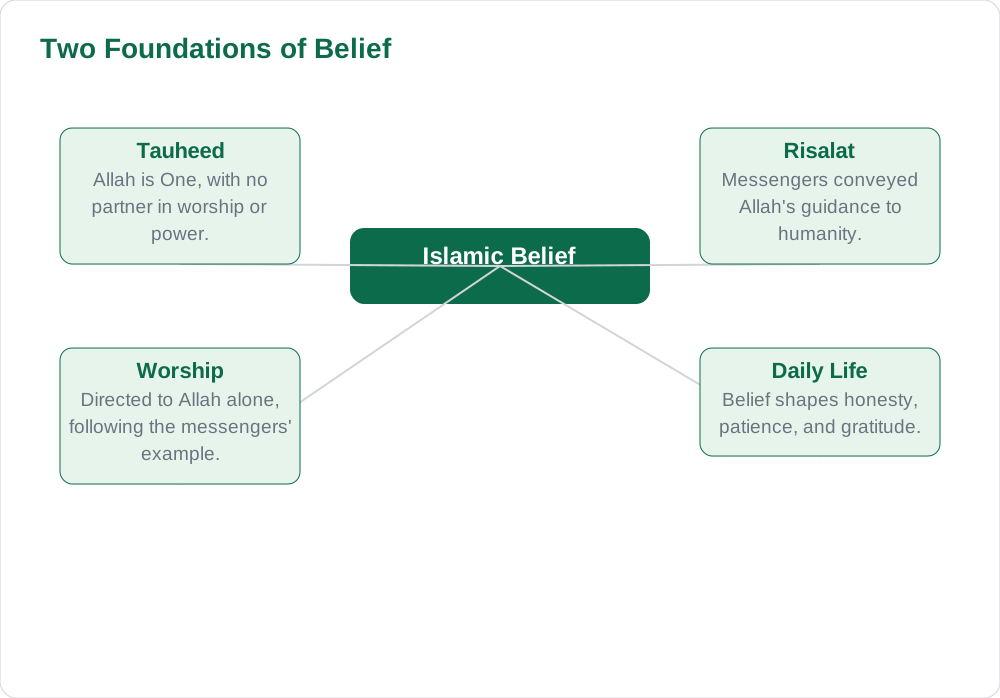
Tauheed and Risalat sit at the foundation of Islamic belief, which is why senior Islamiat returns to them again and again. Tauheed teaches that Allah alone is worthy of worship, that He has no partner, and that all power, knowledge, and mercy belong to Him. When a pupil truly understands this, many other topics become easier: worship makes sense because it is directed to Allah alone, gratitude makes sense because every blessing comes from Him, and patience makes sense because hardship and ease are both in His knowledge. A senior answer should therefore begin from this foundation rather than jumping straight to examples.
Risalat completes the picture because it explains how Allah's guidance reached people. Messengers were chosen human beings who received revelation and taught their people how to live by it. Studying Risalat at senior level means understanding the role of a messenger: to convey the message faithfully, to live it as an example, and to warn and guide with wisdom. When you study Tauheed and Risalat together, you can explain a complete chain of belief: Allah is One, He guides humanity, and the messengers show how that guidance works in real life.
Studying Tauheed With Deeper Reasoning
Senior study of Tauheed goes beyond repeating the definition. A good method is to ask three questions about every point you learn: what does it mean, why is it reasonable, and what difference does it make. For example, belief in One Allah means rejecting the worship of anything else, and it is reasonable because the order and unity of creation point to a single Creator. The difference it makes is practical: a person who believes in One Allah does not fear created things as if they controlled destiny, and does not seek help through means that contradict this belief. Practise writing one short paragraph for each of these three questions, and your answers will gain depth quickly.
Another useful habit is to separate Tauheed into simple study headings in your notes: the meaning of Oneness, the rejection of partners, and the effects on worship and character. Under each heading, write two or three points in your own words, and then test yourself by closing the book and explaining the heading aloud. If you cannot explain it simply, you have found a gap to fill. Browse the solved notes collection for the right class book before you begin, so that your headings match what your own textbook actually teaches.
Studying Risalat: Messengers and Their Message
When you study Risalat, focus on the pattern that all messengers shared rather than trying to memorise long lists. Every messenger called people to worship Allah alone, taught good character, and faced opposition with patience. The final messenger, Prophet Muhammad (peace be upon him), completed this guidance, and his life shows how revelation works in practice: honesty in trade, kindness to neighbours, patience in hardship, and justice even toward opponents. Senior answers become strong when they describe this pattern and then show one clear example of it in conduct.
A common senior-level mistake is to write about messengers as if they were only historical figures. Instead, always connect the message to the present: what does believing in Risalat require of a pupil today? It requires accepting the guidance sincerely, learning it from reliable sources, and following the Prophet's example in manners and dealings. Keep a two-column note page for this topic, with the messenger's role on one side and its lesson for today on the other, and revise from the lesson column when exams approach.
Turning Understanding Into Written Answers
A strong senior answer on Tauheed or Risalat usually follows a simple shape: definition, explanation, reasoning, and effect on life. Start with a clear definition in your own words, then explain the idea in two or three sentences, then give the reasoning behind it, and finish with one practical effect on a believer's life. This shape keeps you from writing everything you know in random order, and it helps the examiner see that you understand, not just remember. Practise this shape on past-style questions, and time yourself so that each answer fits comfortably in the space you expect in the exam.
Language matters as much as content. Use precise terms such as Tauheed, Risalat, worship, and guidance correctly, and avoid vague phrases such as 'it is very important' without saying why. After writing a practice answer, read it back and underline every sentence that gives a reason or an example. If most sentences are underlined, the answer is strong. If only one or two are, add reasoning before you move on. You can compare your method with the Hadith study method used by senior pupils for related belief topics.
Common Mistakes Senior Pupils Should Avoid
The first common mistake is writing a very long introduction that repeats the question without answering it. A senior answer should define the key term in the first two lines and then develop the idea. The second mistake is mixing Tauheed and Risalat into one blurred paragraph: keep them in separate paragraphs, each with its own definition and reasoning, and only connect them in a short concluding line. The third mistake is adding claims you cannot support, such as invented quotations or details your textbook does not teach. When you are unsure of a detail, leave it out and strengthen the reasoning you are sure about.
The final mistake is revising by reading only. Reading feels productive, but it hides gaps in understanding. After each study session, close the book and write three sentences from memory: one definition, one reason, and one effect on life. Then check your sentences against the book and correct them. This short writing habit is what turns senior Islamiat revision from passive reading into real preparation, and it works for every belief topic in the syllabus. For more revision support, explore the solved notes pages and pick the class that matches your own textbook.
AI Help: Muse AI
Muse AI is Meta's personal AI assistant. It can help with this topic by explaining Tauheed and Risalat in simpler words, or by turning your notes into short practice questions that test your definitions and reasoning.
Join Muse with invite code LTGSWD — in the Muse app, go to Settings > Redeem token and enter the code.
Disclosure: LTGSWD is the author's Muse invite code.
Muse AI does not give official STBB answers — always verify against your Sindh Textbook Board book and your teacher.
5 key points you must know
- Tauheed means belief in the Oneness of Allah, with no partner in worship or power.
- Risalat means belief that Allah sent messengers to convey His guidance to humanity.
- Senior answers need definition, reasoning, and a practical effect on life, not memorised lines alone.
- Study each belief under simple headings and test yourself by explaining it aloud without the book.
- Keep Tauheed and Risalat in separate paragraphs and connect them only in a short conclusion.
Frequently asked questions
How is senior study of Tauheed different from junior study?
Junior study usually asks for the definition, while senior study asks for meaning, reasoning, and effects on life. Practise answering three questions for each point: what it means, why it is reasonable, and what difference it makes in daily conduct.
How should I begin an answer on Risalat?
Begin with a clear definition of Risalat, then explain the messenger's role in conveying guidance and living it as an example. Follow with the shared pattern of the messengers' message and one practical lesson for today.
Should Tauheed and Risalat be written as one answer or two?
Unless the question asks for both together, treat them as separate ideas with separate paragraphs. If the question does ask for both, define each one separately first, then add a short concluding line showing how they complete each other.
What if I forget a detail during the exam?
Do not invent a detail or quotation. Write the definition and reasoning you are sure about, and develop the practical effect on life. A shorter, accurate answer scores better than a longer answer with an invented claim.
How can I revise Tauheed and Risalat in one sitting?
Use the three-sentence test: write one definition, one reason, and one effect on life for each belief from memory, then check both against your textbook. Correct any gaps immediately and repeat the test the next day.
Solved notes — preview free
These guides work best with the solved exercises. Preview the solved notes free on this website — 119 solved notes for Classes 6–10 in Sindhi, Urdu, English and Arabic medium. Or browse the full solved notes catalogue for your class and medium. New solved notes are added regularly — check the catalogue for coming-soon books.