How Sindh's NADRA Link Will Fight Fake Certificates and Impersonation in Exams
Every honest student in Sindh has a stake in one question: can people trust that a board certificate is real? Sindh's new agreement with NADRA, under the Academic Record Integration Project, is aimed squarely at that question. Its stated purpose is to prevent fake academic certificates and impersonation in examinations. This article explains what fake certificates and impersonation mean, why they hurt honest students, and how a digitally secured, verifiable record system is designed to fight them.
What Are Fake Certificates?
A fake certificate is a document that claims a student earned a result they did not actually earn. It might be a completely forged document, or a real-looking document with altered marks, a changed name, or a false board stamp. Whatever its form, its purpose is the same: to make someone appear qualified when they are not.
Fake certificates are not a victimless trick. Every time a fake certificate is used for admission or a job, it takes a seat or a position that should have gone to a student who earned it honestly. It also makes colleges and employers doubt genuine certificates, which means honest students face more checks, more delays, and more suspicion through no fault of their own. That is why the Sindh–NADRA pact focuses on making records digitally secured and verifiable, so a certificate can be checked against the board's own record rather than trusted on appearance alone.
- A fake certificate claims a result that was never actually earned.
- It may be fully forged or a real document with altered details.
- Fakes steal seats and jobs from honest students.
- Fakes make genuine certificates harder to trust.
What Is Impersonation in Exams?
Impersonation in examinations means someone else sits an exam pretending to be another student. The impersonator writes the paper, but the result is recorded under the other student's name. Like a fake certificate, it produces a result that was not honestly earned — and it is deeply unfair to every student in that exam hall who prepared and sat the paper themselves.
Impersonation also corrupts the whole result. If one student's paper was written by someone else, the marks, the merit list, and the pass record for that exam are all distorted. That is why exam centres check identity documents and roll number slips, and why a system that ties each record to a verified identity makes impersonation much harder to get away with. If you want your own result to be beyond doubt, the honest path is the only one: prepare with your Sindh Textbook Board books, practise with solved notes, and sit your own papers.
How the NADRA Link Fights Both Problems
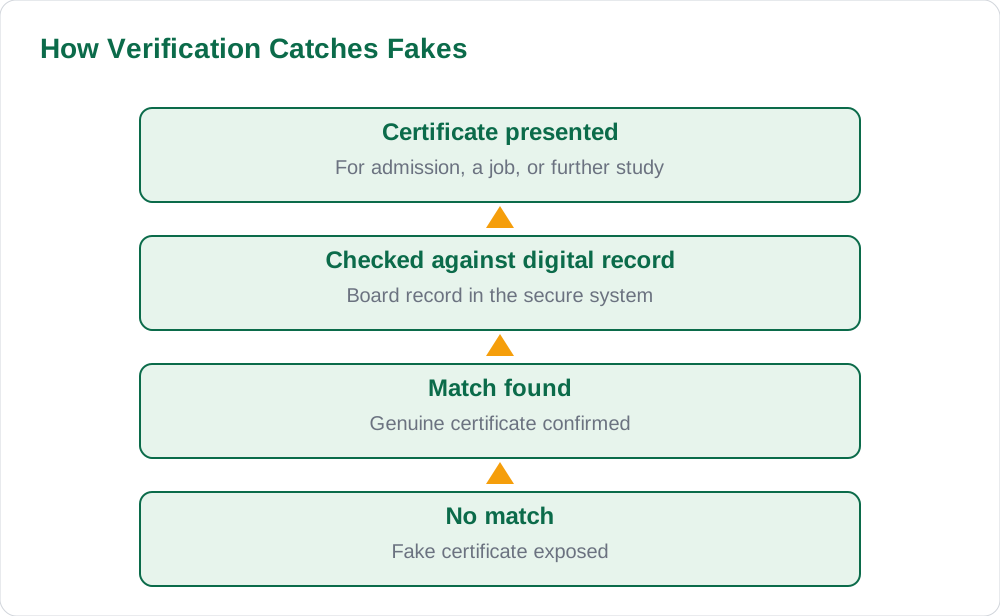
The Sindh–NADRA agreement connects all educational boards in Sindh with NADRA's secure digital system. Under the Academic Record Integration Project, students' educational records will be digitally secured and verifiable. That changes the fraud equation in two ways. First, a fake certificate becomes much easier to catch, because it can be checked against the secure digital record instead of judged by how real the paper looks.
Second, a mechanism will be developed to assign a unique identification number to every student for accurate identification and verification of academic records. When each record is tied to one verified student, it becomes much harder for an impersonator's result to be recorded as someone else's, and much harder for a forged document to pass as genuine. Verified academic certificates will also be available through the Pak ID mobile app, giving students a digital, checkable way to prove their result.
- Board records become digitally secured and verifiable.
- Fake certificates can be checked against the official digital record.
- A unique student number ties each record to one verified student.
- Verified certificates will be available through the Pak ID app.
Why This Protects Honest Students Most
Anti-fraud measures are sometimes described as if they punish students, but this one does the opposite: it protects the students who do the work. When fakes are easy to use, honest students compete against people who never earned their results. When fakes are easy to catch, the competition becomes fair again, and your genuine result carries its full value.
Verification also saves honest students time and stress. Instead of repeated manual checks, letters, and delays, a verifiable record can be confirmed quickly. That means fewer hurdles at admission time and fewer moments when you have to prove that your hard-earned certificate is real. The best way to benefit from that protection is to keep earning results you are proud of — through steady exam preparation, honest practice, and good time management in exams.
What Students Should Do
The most important step is the simplest: never be part of the fraud. Never use, buy, or share a fake certificate, never let anyone sit an exam in your place, and never sit an exam for someone else. The consequences of exam fraud can follow a student for years, and with a verifiable digital record, the chance of being caught is now much higher.
The second step is to protect your own identity and records. Keep your roll number slips, result cards, and certificates safe. Make sure the details on your school and board records match your official identity documents, and report any mismatch to your school early. Finally, follow only official board and school announcements about the new system, and never pay anyone who claims they can alter a digital record. If you want to understand how results are checked and corrected honestly, read our guide on how to check the Sindh board result online.
- Never use, buy, or share a fake certificate.
- Never let anyone sit an exam in your place.
- Keep your roll number slips and certificates safe.
- Report any mismatch in your records to your school early.
AI Help: Muse AI
Muse AI is Meta's personal AI assistant. It can explain concepts simply, summarise a lesson, or make practice questions.
Muse AI can explain in simple words why fake certificates harm honest students and how digital verification protects your genuine result.
Join Muse with invite code LTGSWD — in the Muse app, go to Settings > Redeem token and enter the code.
Disclosure: LTGSWD is the author's Muse invite code.
Muse AI does not give official Sindh Textbook Board answers — always verify against your Sindh Textbook Board book and your teacher.
5 key points you must know
- The Sindh–NADRA pact aims to prevent fake academic certificates and impersonation in examinations.
- Fake certificates steal seats and jobs from honest students and make genuine certificates harder to trust.
- Impersonation means someone else sitting an exam in a student's place — it corrupts the whole result.
- Digitally secured, verifiable records make fakes easier to catch and impersonation harder to hide.
- Honest students benefit most, because verification protects the value of a genuinely earned result.
Frequently asked questions
What is a fake board certificate?
A document that claims a student earned a result they did not actually earn — either fully forged or altered, for example with changed marks, a changed name, or a false board stamp.
What is impersonation in board exams?
Impersonation is when someone else sits an exam pretending to be another student, so the result is recorded under a name that did not earn it.
How does the NADRA link fight fake certificates?
Board records become digitally secured and verifiable, so a certificate can be checked against the board's own secure digital record instead of being trusted on appearance alone.
How does the unique student number help?
A mechanism will be developed to assign a unique identification number to every student, tying each record accurately to its owner and making impersonation and forgery harder to hide.
What should I do if someone offers me a fake certificate?
Refuse it. Never use, buy, or share a fake certificate. Exam fraud can follow a student for years, and a verifiable digital record makes getting caught much more likely.
Solved notes — preview free
These guides work best with the solved exercises. Preview the solved notes free on this website — 119 solved notes for Classes 6–10 in Sindhi, Urdu, English and Arabic medium. Or browse the full solved notes catalogue for your class and medium. New solved notes are added regularly — check the catalogue for coming-soon books.