After the October Results: What Happens Next for Sindh Board Students
October 2026 has been a busy month for Sindh's board students, but it has not been a tidy one: some results are out, some are pending, and the two situations demand different responses from different students. BIEK announced the Pre-Engineering Part-I result on 2 October 2026, BSEK declared the 9th class annual examination, reported on 12 October 2026, and the other BIEK Part-I groups remain unannounced with no official date published as of 26 October 2026. Meanwhile Punjab's second annual examinations begin on 3 November 2026, and some Sindh students have mistakenly applied Punjab's dates to their own plans. This article sorts the verified picture from the confusion, tells each group of students what happens next for them, and names the only sources that can tell you what comes after that.
October 2026: What Has Actually Been Announced
Start with the verified record, because everything else in this article depends on it. BIEK, the Board of Intermediate Education Karachi, announced the HSC Part-I Science Pre-Engineering Group Annual Examination 2026 result on 2 October 2026, with 15,044 students registered, 14,683 appeared and 6,310 passing all six papers. Separately, BSEK, the Board of Secondary Education Karachi, declared the 9th class annual examination 2026 for Science and General groups, reported on 12 October 2026. These are two different boards handling two different levels: BSEK handles matric, Classes 9 and 10, while BIEK handles intermediate, Classes 11 and 12, and confusing the two boards is the first error students make when they hear result news.
For context, BIEK's Part-II groups for 2026 are already out, having been announced across July, August and September: Pre-Medical Part-II on 31 July, Humanities Part-II on 7 August, Pre-Engineering Part-II on 17 August, Science General Part-II on 27 August, Commerce Part-II on 14 September, and Home Economics, Humanities Private and Special Candidates on 31 July. That spread across three months is normal for BIEK, which releases each group separately, and it explains why October's picture looks uneven. A student whose group is out and a student whose group is pending are not experiencing a delay and an on-time result; they are experiencing the same system at different points in its ordinary schedule.
What Is Still Pending — and Why That Is Normal
The pending list is short and specific: BIEK's Pre-Medical, Commerce and Humanities Part-I groups have no official announcement as of 26 October 2026, and no official date has been published for any of them. The end-of-October expectation repeated by aggregator websites is an unverified guess, not a board date, and students in these groups should plan as though the announcement could come at any time, without believing any particular day. That uncertainty is uncomfortable, but it is not unusual, and it is not evidence that anything has gone wrong with checking or compilation. Groups are released when their work is complete, and the board's silence about a date is simply the absence of a date, not a hidden problem.
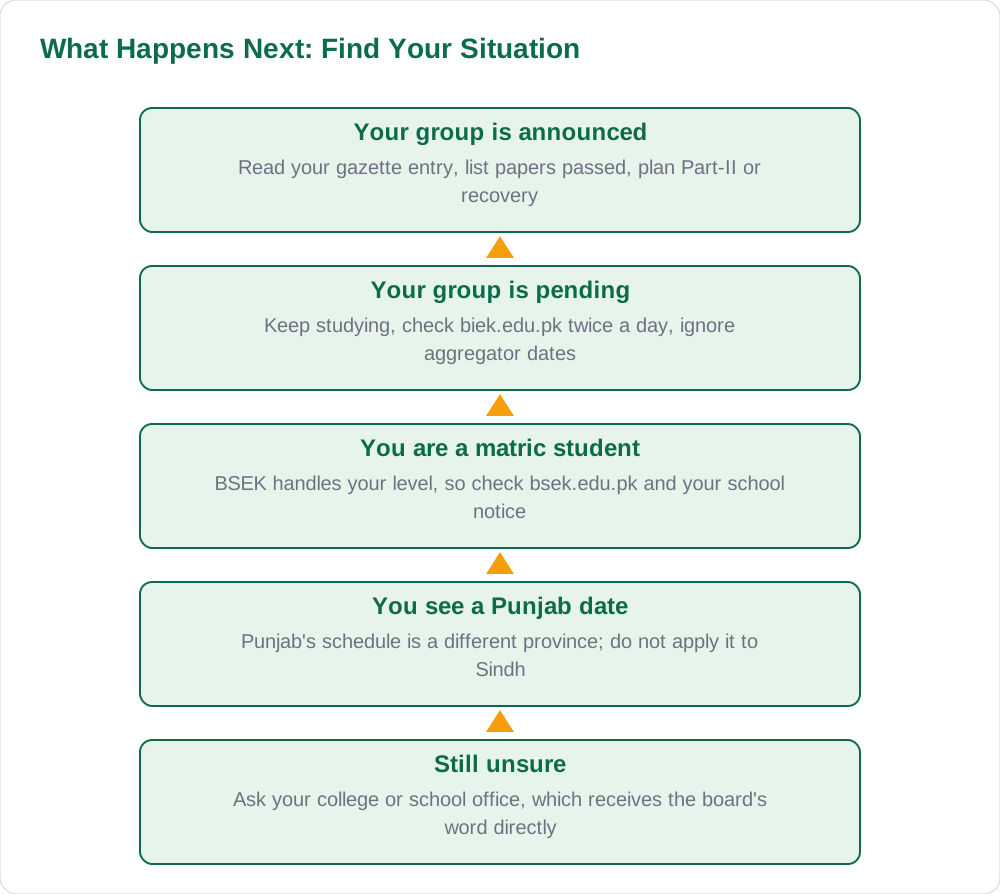
If your group is pending, your next steps are the same as any waiting student's: keep studying, keep checking the board portal at fixed times, and refuse rumours. Do not pay for any service promising early access to your result, do not travel to the board office on the strength of a social media post, and do not let a classmate's different group result convince you that yours must be imminent. Your result will be announced on the board's schedule, and when it is, it will be visible to every student on the same portal at the same time. The status guide for remaining BIEK Part-I groups tracks exactly which groups are out and which are pending, and it is the best companion to this waiting period.
Do Not Borrow Punjab's Dates for Sindh
The most consequential confusion this October is the borrowing of Punjab's dates by Sindh students. Punjab's HSSC Second Annual Examination begins on 3 November 2026, with Part-II papers from 3 to 16 November and Part-I papers from 17 to 28 November, and Punjab's rechecking window runs 15 days from its 22 October result. None of those dates belongs to Sindh. Sindh's boards run their own examinations, their own results and their own procedures, and a Sindh student who plans around 3 November as though it were a Sindh date will prepare for an examination that is not theirs, while missing whatever their own board actually announces.
The confusion is understandable, because Punjab's dates dominate national result websites and social media, and a student searching for second annual news will meet Punjab's schedule first. The defence is a simple question to ask of every date you encounter: which board announced this, and is it my board? If the answer is a Punjab board and you study under a Sindh board, the date is information about another province, not an instruction for you. Keep your own board's portal and your college notice as your only sources of dates, and treat every other date as background until your own board confirms it. Provinces share a country, not a date sheet, and remembering that distinction saves real mistakes.
Your Three Checkpoints: Portal, College, Gazette
Whatever your situation, three checkpoints will carry you through the weeks after October's results. The first is your board's portal: biek.edu.pk for intermediate students in Karachi, bsek.edu.pk for matric students in Karachi, biselrk.edu.pk for Larkana board students, and bisesuksindh.edu.pk for Sukkur board students, each typed by yourself rather than clicked from a message. The second is your college or school notice board, which receives the board's word directly and can confirm anything you find online. The third is the gazette, for groups whose results are out, because it is the board's published record of roll numbers, marks and papers passed, and it settles disputes that online lookups cannot.
Use the three checkpoints in order whenever a claim reaches you: portal first, college second, gazette third where it applies. If the portal does not show it, it has not been announced; if the college cannot confirm it, it is unverified; if the gazette contradicts it, the gazette is the record to trust. Students who run every claim through these checkpoints rarely act on rumours, and they rarely miss genuine announcements either, because genuine announcements pass all three checks easily. Make the checkpoints a habit now, and they will serve you through every result season, admission cycle and board notice you meet in the years ahead. The guide to which board handles what explains the board divisions behind these portals.
Planning the Next Weeks Without Invented Dates
Planning without dates feels impossible, but it is actually the normal condition of student life between announcements, and it works when you plan around tasks instead of dates. If your result is out, your tasks are clear: read your gazette entry, list your papers passed, decide on recovery or Part-II preparation, and discuss both with a teacher. If your result is pending, your tasks are equally clear: keep studying your Part-I foundations, keep checking the portal twice a day, and keep rumours out of your schedule. In both cases, the next task does not depend on a date you do not have, and a student who completes today's task is better prepared than a student who waits for a date to tell them what to do.
Resist the temptation to fill the gap with invented dates of your own, whether that means assuming the result must come this week, or assuming it cannot come before next month. Both assumptions distort your planning: the first creates panic when the week passes without news, and the second creates complacency that wastes study time. Plan week by week, review your progress every Saturday, and let the board's announcement, when it arrives, interrupt a plan that is already working rather than rescue a plan that never started. October's results have given some Sindh students answers and others a wait, but both groups share the same next step, which is to keep learning, keep checking the right sources, and keep their plans anchored in verified facts. For study support in the meantime, see the solved notes.
AI Help: Muse AI
Muse AI is Meta's personal AI assistant, and it can help you sort a confusing results month by explaining which board handles your level and what each announcement means.
For this article's topic, you can ask Muse AI to help you list your own next steps based on whether your group is announced or still pending.
Join Muse with invite code LTGSWD — in the Muse app, go to Settings > Redeem token and enter the code.
Disclosure: LTGSWD is the author's Muse invite code.
Muse AI does not give official STBB answers — always verify against your Sindh Textbook Board book and your teacher.
5 key points you must know
- BIEK Pre-Engineering Part-I was announced on 2 October 2026; BSEK 9th class was declared, reported 12 October 2026.
- BIEK Pre-Medical, Commerce and Humanities Part-I are not announced as of 26 October 2026, with no official date published.
- BIEK Part-II groups for 2026 were announced across July, August and September 2026.
- Punjab's second annual schedule from 3 November 2026 belongs to Punjab, not to Sindh.
- Sindh next steps run through your own board portal and your college notice, not through other provinces' dates.
Frequently asked questions
Which Sindh board results are out as of late October 2026?
BIEK Pre-Engineering Part-I, announced 2 October 2026, and BSEK 9th class, declared and reported 12 October 2026. BIEK Part-II groups from July to September 2026 are also out.
Which BIEK Part-I groups are still pending?
Pre-Medical, Commerce and Humanities Part-I. As of 26 October 2026 they have no official announcement and no published date.
Does Punjab's 3 November second annual date apply to Sindh students?
No. That schedule belongs to Punjab's boards. Sindh boards run their own examinations and dates, so Sindh students should follow their own board portal and college notice.
What is the difference between BSEK and BIEK?
BSEK, the Board of Secondary Education Karachi, handles matric, Classes 9 and 10. BIEK, the Board of Intermediate Education Karachi, handles intermediate, Classes 11 and 12.
Where should I check for my own board's next announcement?
On your own board's portal, such as biek.edu.pk, bsek.edu.pk, biselrk.edu.pk or bisesuksindh.edu.pk, and on your college or school notice board.
Solved notes — preview free
These guides work best with the solved exercises. Preview the solved notes free on this website — 119 solved notes for Classes 6–10 in Sindhi, Urdu, English and Arabic medium. Or browse the full solved notes catalogue for your class and medium. New solved notes are added regularly — check the catalogue for coming-soon books.