Sindh Boards Improvement Result 2026: How Improvement Exams Work
Every year, thousands of students across Sindh decide that their result does not reflect what they can do, and they choose to improve it. Improvement examinations exist for exactly that purpose: they give a student a second chance to raise marks in chosen papers, under the rules of their board. Improvement results for Sindh boards, including BSEK and BIEK Karachi, Hyderabad, Larkana, Sukkur, Aga Khan, and Shaheed Benazirabad, are issued through each board's official result channels. This article explains how improvement exams work, who can apply, how to check an improvement result, and what to do after it. It keeps to general, verified guidance and gives no specific unverified dates or figures, because improvement schedules differ by board and year.
What Improvement Exams Are and Who They Are For
An improvement examination is a chance to reappear in one or more papers to improve your marks, under your board's rules. It is for students who passed but believe they can do better, and in many boards it is also open to students who want to strengthen specific subjects before college admission or the next class. It is not the same as a supplementary examination for failed papers, although the two are sometimes confused. The key idea is improvement: you already hold a result, and you are trying to raise it by showing better performance in a fresh attempt at chosen papers.
Whether you should apply is a decision that deserves honest thought. Improvement makes sense when you have a clear reason: a paper that went badly on the day, a subject you have since studied properly, or a grade boundary that matters for your next step. It makes less sense when you are acting on disappointment alone, without a plan to prepare differently. Before you apply, talk to a teacher about which papers are realistic to improve, how much preparation each one needs, and whether the improved result will actually change your college or stream options. A focused improvement in one paper often beats a scattered attempt at four.
- Improvement exams let you reappear in chosen papers to raise marks
- They are for students who passed but believe they can do better
- Improvement is not the same as a supplementary exam for failed papers
- Apply with a clear reason and a preparation plan, not on disappointment alone
How Improvement Exams and Results Work Across Sindh Boards
Improvement results for Sindh boards are issued through each board's official result channels. That means there is no single improvement result page for all of Sindh. A BSEK Karachi student checks through BSEK channels, a BIEK Karachi student through BIEK channels, and students of Hyderabad, Larkana, Sukkur, Aga Khan, and Shaheed Benazirabad through their own boards' channels. Each board sets its own rules for which papers can be improved, how many papers a student may attempt, the form and fee, the deadline, and how the improved marks are recorded. Always read your own board's announcement rather than following another board's rules.
One rule is common enough to state generally: an improvement result replaces or updates the earlier result for the papers attempted, according to the board's rules, and the student receives an updated result for those papers. The exact mechanics, including whether a lower second attempt affects the earlier result, differ by board, so you must confirm them in your board's official notification. Do not rely on a friend's experience at another board, because the same situation can be handled differently in Karachi, Hyderabad, or Larkana. Your board's notification is the only authority for your case.
- Each board issues its own improvement results through its official channels
- Boards covered: BSEK and BIEK Karachi, Hyderabad, Larkana, Sukkur, Aga Khan, Shaheed Benazirabad
- Each board sets its own rules, forms, fees, and deadlines
- Confirm how improved marks are recorded in your own board's notification
How to Check Your Improvement Result
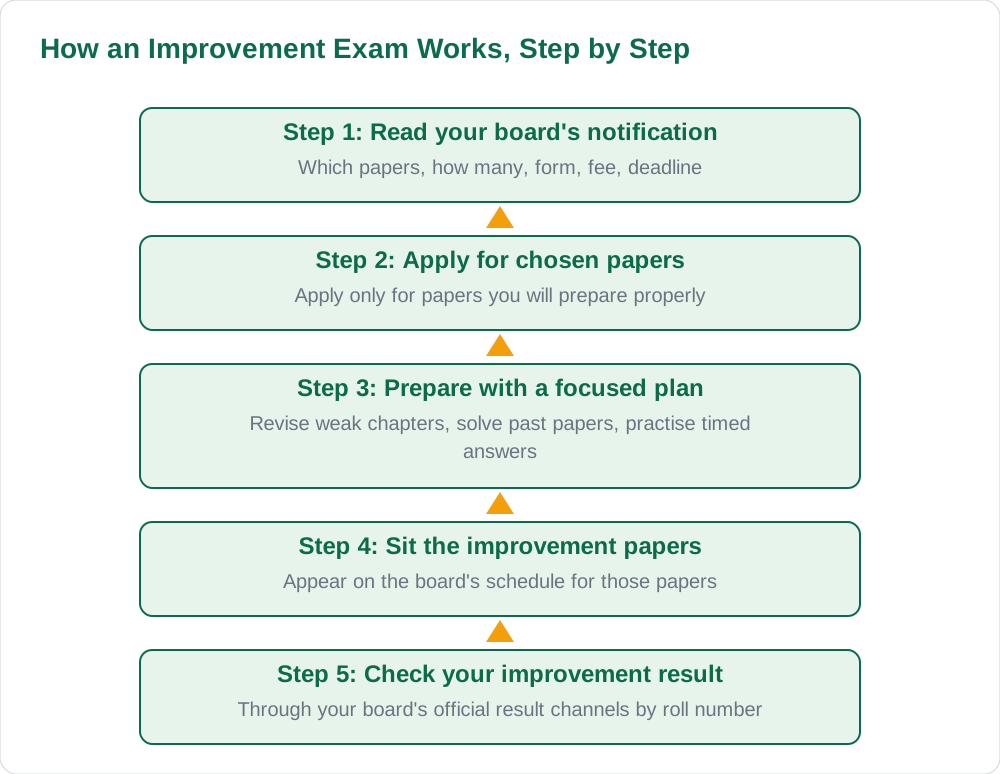
Checking an improvement result works like checking any board result: through your board's official result channels, by roll number. Keep your admit card or improvement examination slip safe, because you will need the roll number or reference printed on it. On result day, go to your board's official website, find the improvement result link for your examination, enter the required number exactly, and wait for your result to load. Board websites slow down on result day, so if the page does not load, wait a few minutes and try again rather than refreshing constantly.
Once your improvement result appears, save a screenshot or printout and read it paper by paper. Compare each improved paper with your earlier result, and check whether the updated result has been recorded as your board's rules describe. If any detail looks wrong, such as a missing paper or a roll number mismatch, contact your school or the board office through the official channels. Do not pay any stranger who promises to change an improvement result, because no genuine result can be changed through a private message. For the same checking discipline in regular results, see our guide on how to check the BSEK Matric Science result.
- Check through your own board's official result channels by roll number
- Keep your improvement examination slip or admit card safe
- Save or print your improvement result and read it paper by paper
- Compare improved papers with your earlier result carefully
What to Do After Your Improvement Result
If your marks improved, the next step is to use the better result. Collect or download the updated result document as your board provides it, and use it for college admission, stream choice, or the next class, as it applies to you. Tell your school or college about the updated result so their records match the board's. Then turn your attention forward: the habits that produced the improvement, such as focused revision and timed practice, are the same habits that will carry you through the next examination. Do not treat improvement as the end of effort. Treat it as proof that effort works.
If your marks did not improve as much as you hoped, resist the urge to make a hasty second decision. Talk to a teacher about what the result means for your options, and whether a further attempt is allowed and wise under your board's rules. Keep revising with your Solved Notes while you decide. Sometimes the honest answer is that the improvement was enough, and the next step is to move forward rather than to keep retaking the same paper. Sometimes the answer is that one more focused attempt, with a genuinely different preparation plan, is worth it. Either way, decide on evidence and advice, not on disappointment. Our guide on what to do after the Matric Science result can help you plan the next stage.
- Improved: collect the updated result document and update school records
- Use the better result for admission, stream choice, or the next class
- Not improved enough: talk to a teacher before deciding on a further attempt
- Decide on evidence and advice, not on disappointment
Common Mistakes to Avoid With Improvement Exams
The most common mistake is applying for too many papers at once. A student who attempts to improve four papers with the same preparation that produced the original result will usually repeat the original result. A student who attempts one or two papers with a genuinely different plan, with revised chapters, timed practice, and teacher feedback, has a real chance of improving. Choose fewer papers, prepare them properly, and treat the improvement attempt as a fresh examination, not as a repeat of the old one.
The second mistake is preparing the same way and expecting a different result. If your original preparation was mostly re-reading notes, your improvement preparation should add active recall, past-paper practice, and marked practice answers. If you never timed yourself before, time yourself now. If you skipped chapters before, cover them now. The third mistake is missing the deadline or using the wrong board's information. Read your own board's notification, note the deadline in your diary, and confirm the form, fee, and paper list with your school. A missed deadline is the one improvement failure that no amount of study can fix.
- Do not apply for too many papers at once; fewer, well-prepared papers win
- Do not prepare the same way and expect a different result
- Add active recall, timed practice, and marked practice answers
- Note your own board's deadline and confirm form, fee, and paper list
AI Help: Muse AI
Muse AI is Meta's personal AI assistant, and it can help you plan an improvement attempt by explaining a weak chapter simply, summarising your revision notes, or making practice questions for the papers you want to improve.
Join Muse with invite code LTGSWD — in the Muse app, go to Settings > Redeem token and enter the code.
Disclosure: LTGSWD is the author's Muse invite code.
Muse AI does not give official STBB answers — always verify against your Sindh Textbook Board book and your teacher.
5 key points you must know
- Improvement exams let students reappear in chosen papers to raise marks under board rules.
- Improvement results are issued through each Sindh board's official result channels.
- Boards covered include BSEK and BIEK Karachi, Hyderabad, Larkana, Sukkur, Aga Khan, and Shaheed Benazirabad.
- Each board sets its own rules, forms, fees, deadlines, and recording of improved marks.
- Fewer papers with a genuinely different preparation plan beat many papers prepared the old way.
Frequently asked questions
What is an improvement exam?
An improvement examination is a chance to reappear in one or more papers to improve your marks, under your board's rules. It is for students who passed but believe they can do better with fresh preparation.
How do I check my Sindh board improvement result?
Check it through your own board's official result channels by roll number. Each board issues its own improvement results, so use the channels of BSEK, BIEK, Hyderabad, Larkana, Sukkur, Aga Khan, or Shaheed Benazirabad as it applies to you.
Do all Sindh boards have the same improvement rules?
No. Each board sets its own rules for which papers can be improved, how many papers may be attempted, the form and fee, the deadline, and how improved marks are recorded. Always read your own board's notification.
How many papers should I apply to improve?
Fewer, well-prepared papers usually beat many papers prepared the old way. Talk to a teacher about which one or two papers are realistic to improve with a focused plan.
What should I do after my improvement result?
If marks improved, collect the updated result document and use it for admission or the next class. If not, talk to a teacher about whether a further attempt is allowed and wise, and decide on evidence, not disappointment.
Solved notes — preview free
These guides work best with the solved exercises. Preview the solved notes free on this website — 119 solved notes for Classes 6–10 in Sindhi, Urdu, English and Arabic medium. Or browse the full solved notes catalogue for your class and medium. New solved notes are added regularly — check the catalogue for coming-soon books.