Sindh's Curriculum Revision Next Year: Research, Creativity and Tolerance in Focus
Sindh's curriculum is set for change from the next academic year, according to a ministerial announcement reported around 20 October 2026, and the direction of that change deserves careful attention from students, teachers and parents alike. The announced emphasis falls on research, scientific thinking and creativity, alongside modern trends in science, technology, mathematics, languages and social sciences, plus religious tolerance, mutual respect, gender studies and environmental protection. This article presents that announcement as a direction for the coming year, not as a syllabus already in classrooms, because the distinction matters: students should keep studying their current books fully, while understanding what may evolve. The same inclusive direction is visible in the new Hindu religious textbooks for Grades 3 to 5, published for 2026-27, which show how curriculum change can widen respect and representation in practice.
What Was Announced, and What It Is Not Yet
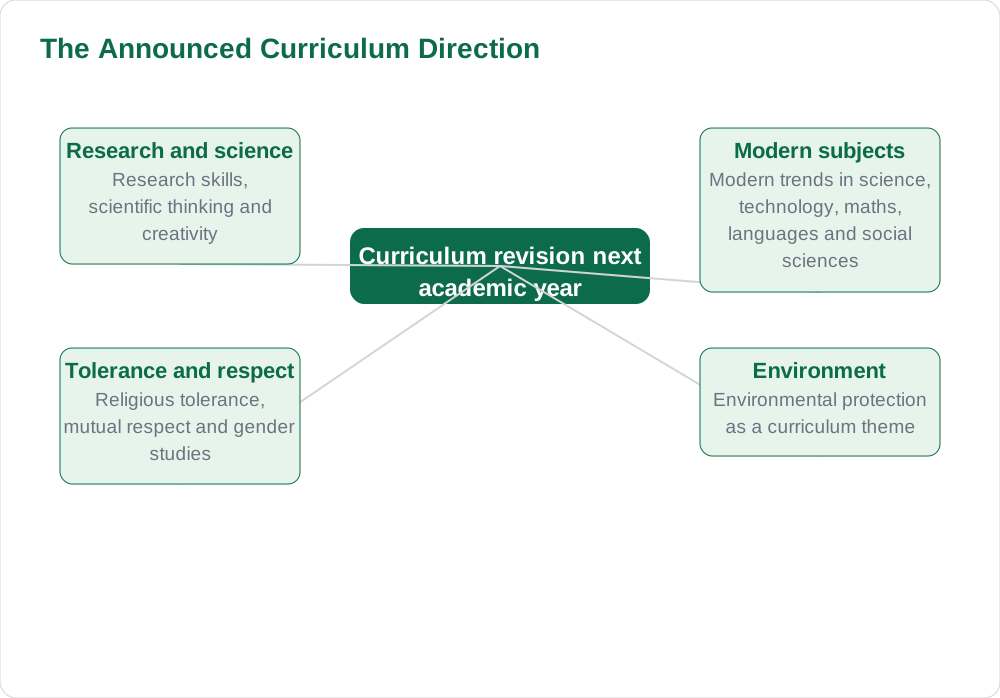
The minister's statement, reported around 20 October 2026, announced that curriculum changes will come from the next academic year, with a focus on research, scientific thinking and creativity, and on modern trends across science, technology, mathematics, languages and social sciences. It also emphasised religious tolerance, mutual respect, gender studies and environmental protection as part of the revised direction. These are announced priorities for the coming revision, not a published syllabus, textbook list or examination pattern, and no student should treat them as already-implemented changes to their current books or papers. Until new books and official guidance reach schools, the current curriculum remains the one students are examined on, and it deserves full attention.
Understanding this distinction protects students from two mistakes: ignoring current books in anticipation of new ones, and panicking that everything they have learned will be discarded. Curriculum revision usually builds on existing foundations rather than erasing them, adding emphasis, updating content and improving how subjects are taught. A student who masters current science, mathematics and language skills will be well placed for a revised curriculum that values research and creativity, because those skills transfer across any syllabus. Teachers, similarly, will receive guidance and materials as the revision reaches schools, and their instructions at that point will matter more than speculation now. For now, the announcement is a signal of direction, and the right response is informed curiosity, not disruption.
Research, Scientific Thinking and Creativity in the Classroom
Research, scientific thinking and creativity sound like large ideas, but in a classroom they translate into habits students can practise today. Research means learning to ask a clear question, find reliable information, compare sources and present findings honestly, rather than copying a single answer. Scientific thinking means observing carefully, forming a testable idea, checking evidence and changing your mind when evidence requires it, habits that strengthen every science subject and many others too. Creativity means generating original ideas, solving problems in more than one way, and expressing understanding through writing, projects, presentations and discussion, not only through memorised answers. A curriculum that values these habits rewards students who think, not only students who remember.
Students can begin building these habits with their current books, without waiting for revised materials. Ask why a science result happens, not only what it is; compare two explanations of the same topic and judge which is better supported; turn a lesson into a small project, a diagram, a summary in your own words, or a set of questions for your teacher. Teachers can support this shift by setting short investigations, class discussions and open questions alongside regular exercises, and parents can encourage it by asking children to explain what they learned rather than only what marks they scored. These habits do not replace syllabus knowledge; they deepen it, and they prepare students for higher education and work where independent thinking is expected. The solved notes and blog guides can support this kind of active, questioning study.
Modern Subjects, Languages and Social Sciences
The announced focus on modern trends in science, technology, mathematics, languages and social sciences reflects how quickly knowledge changes in each of these fields. Science and technology advance constantly, so textbooks and teaching must keep pace with new understanding and new tools, while mathematics remains the language that connects them. Languages matter because students need strong reading, writing and communication skills in the languages they study, and because Sindh's approach values mother tongues as subjects alongside other languages. Social sciences matter because they help students understand society, history, geography, economics and citizenship, and make sense of the world they live in. A revision that updates all of these together, rather than one in isolation, aims for a balanced education.
For students, the practical implication is to strengthen foundations across the board rather than specialising too early or neglecting a subject that feels less important. Read widely in languages, practise mathematics regularly, stay curious about science and technology news, and discuss social questions with teachers and classmates. A student who reads, writes, calculates and reasons well will adapt to revised content more easily than a student who memorised one set of notes. Teachers will play a central role when revised materials arrive, translating new priorities into daily lessons, and students should support that process by engaging actively rather than resisting change. Curriculum revision is ultimately about making learning more relevant to the lives students will lead, and that goal deserves an open mind.
Tolerance, Respect, Gender Studies and the Environment
Religious tolerance and mutual respect are not abstract additions to a curriculum; they shape how students treat classmates of different faiths and backgrounds every day. A curriculum that teaches tolerance explicitly helps students understand different beliefs, practise respectful discussion, and reject prejudice, which strengthens school communities and society beyond school. Gender studies, in this announced direction, similarly invites students to understand fairness, equal opportunity and respectful relationships, topics that affect every classroom and workplace. Environmental protection connects learning to the world students inhabit, from local cleanliness and water to climate and conservation, and encourages responsible action rather than passive awareness. Together, these themes aim to educate citizens, not only examination candidates.
Students can practise these values immediately, in ways that cost nothing and benefit everyone. Listen respectfully when a classmate expresses a different belief, include classmates fairly in group work, challenge unfair remarks calmly, and take part in school cleanliness and environmental activities. Teachers can model these values by creating classrooms where every student feels safe to ask questions and express views respectfully. Parents reinforce them at home by discussing difference, fairness and responsibility as everyday topics, not only as examination chapters. When curriculum revision brings these themes more formally into books and lessons, students who already practise them will recognise familiar values in new words, and that recognition is itself a sign of successful education.
A Living Example: Hindu Religious Textbooks for Grades 3 to 5
The Hindu religious textbooks for Grades 3 to 5 in the 2026-27 academic year offer a concrete example of the inclusivity direction in action. The Sindh School Education and Literacy Department directed the Sindh Textbook Board to publish and distribute these books, following a Sindh Curriculum Council Executive Committee meeting on 20 April 2026, with Sanatan Dharma as the compulsory subject for Hindu students in government primary schools. Previously, minority pupils were taught Ethics instead of their own faith, so this change gives Hindu primary students textbooks in their own religion for the first time in this programme. For 2026-27, publication costs are borne by Prem Sagar Sanstha Karachi, since STBB's budget was unavailable this year, with STBB to fund the books from the next academic year.
The scale behind this change is significant: over 129,000 Hindu students attend Sindh government schools, including 26,642 in Tharparkar and 21,584 in Umerkot, districts where Hindu communities are large and primary religious education matters deeply to families. For these students, a textbook in their own faith affirms identity, supports family and community teaching, and replaces a generic alternative with subject matter that reflects their beliefs. For classmates of other faiths, the existence of these books models the tolerance and mutual respect that the wider curriculum revision emphasises, showing that a shared school system can honour different faiths side by side. Curriculum change, at its best, looks like this: specific, respectful, and attentive to students who were previously overlooked. The books page can help families find the right official material for their child's class.
AI Help: Muse AI
Muse AI is Meta's personal AI assistant, and it can help you explore curriculum topics by explaining research skills in simple words, summarising an environmental or social science concept, or helping you draft questions for a class discussion on tolerance and respect.
Join Muse with invite code LTGSWD — in the Muse app, go to Settings > Redeem token and enter the code.
Disclosure: LTGSWD is the author's Muse invite code.
Muse AI does not give official STBB answers — always verify against your Sindh Textbook Board book and your teacher.
4 key points you must know
- Sindh's curriculum revision comes from the next academic year, as announced and reported around 20 October 2026
- Announced priorities: research, scientific thinking, creativity, modern science, technology, maths, languages and social sciences
- Also emphasised: religious tolerance, mutual respect, gender studies and environmental protection
- Hindu religious textbooks for Grades 3 to 5 in 2026-27 show the inclusivity direction in practice, for over 129,000 Hindu pupils
Frequently asked questions
When does Sindh's curriculum revision take effect?
Curriculum changes come from the next academic year, according to the minister's announcement reported around 20 October 2026. It is an announced direction, not a syllabus already implemented in classrooms.
What does the revision emphasise?
Research, scientific thinking and creativity; modern trends in science, technology, mathematics, languages and social sciences; religious tolerance, mutual respect, gender studies and environmental protection.
Should students stop studying their current books?
No. Until new books and official guidance reach schools, the current curriculum remains the one students are examined on, and its foundations transfer directly to a revised curriculum.
What are the new Hindu religious textbooks for Grades 3 to 5?
Sanatan Dharma textbooks for Hindu students in government primary schools for 2026-27, published and distributed through STBB, with 2026-27 costs borne by Prem Sagar Sanstha Karachi. Over 129,000 Hindu students attend Sindh government schools.
Solved notes — preview free
These guides work best with the solved exercises. Preview the solved notes free on this website — 119 solved notes for Classes 6–10 in Sindhi, Urdu, English and Arabic medium. Or browse the full solved notes catalogue for your class and medium. New solved notes are added regularly — check the catalogue for coming-soon books.