Sindhi Folk Tales and Their Moral Lessons
Every Sindhi child has heard a folk tale from a grandparent, a teacher, or an elder at night. A clever farmer outwits a greedy landlord. A kind girl shares her bread and is rewarded. A foolish traveller learns wisdom the hard way. The study of Sindhi folk tales moral lessons is not only about enjoying old stories. It is about learning how stories teach honesty, kindness, courage, and wisdom without lecturing. Folk tales use simple characters, clear problems, and memorable endings to carry lessons that stay in the heart. This guide explains what folk tales are, how their morals work, how to retell them well, and how to write about them in school answers.
What Makes a Folk Tale
A folk tale is a story passed from person to person, often without a known author. It belongs to the whole community. Folk tales use simple language, familiar places, and clear characters: a wise old woman, a greedy merchant, a brave child, a talking animal, or a kind neighbour. The story usually begins with a problem, such as hunger, injustice, or a journey, and ends with a result that feels fair. Good people are rewarded, greedy people lose, and foolish people learn. This clear pattern helps listeners remember the tale and its lesson. Unlike a modern afsana, a folk tale does not hide its message. The message stands in the open, like a lamp in a courtyard.
Folk tales also carry the culture of Sindh. They describe village wells, river journeys, harvests, weddings, and markets. They use muhavare, proverbs, and songs that elders know by heart. When you listen to a folk tale, you learn language as well as values. You hear how elders speak, how they joke, and how they warn. In school, folk tales appear as reading lessons, storytelling practice, and moral education. Pupils should enjoy them first and analyse them second. If you only hunt for the moral and never enjoy the story, you miss the pleasure that kept these tales alive for generations.
How Morals Work in Folk Tales
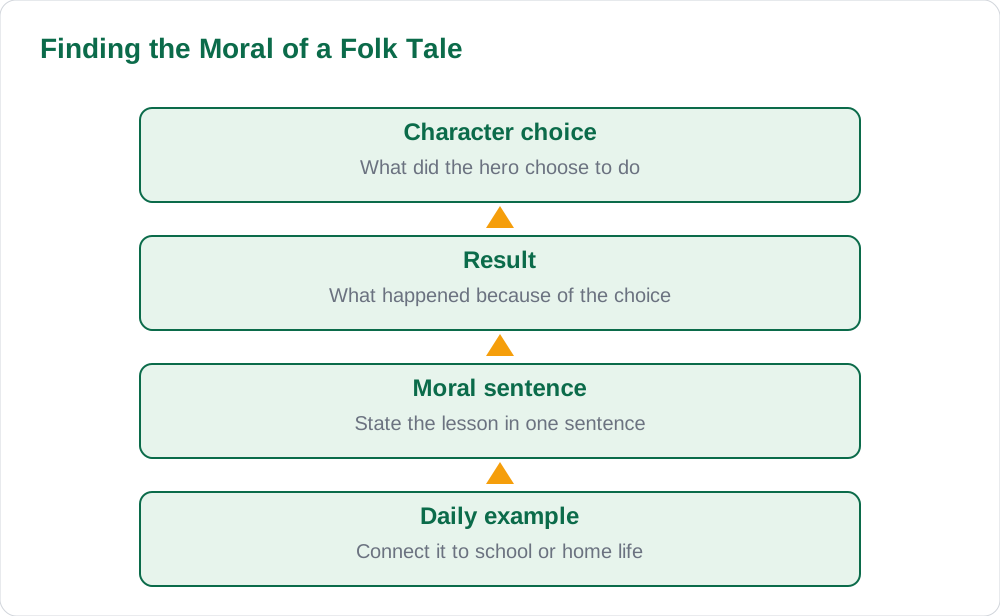
The moral of a folk tale is the lesson the story teaches. It is rarely stated as a rule at the start. It grows from what happens to the characters. A greedy character loses wealth because of greed. A kind character gains friends because of kindness. A patient character succeeds because of patience. The reader learns by watching results, not by memorising rules. When you analyse a folk tale, ask three questions: what did the main character choose, what happened because of that choice, and what should a wise reader learn. Those three questions give you the moral in one clear sentence. For example, the tale teaches that greed destroys what honesty could have kept.
Some tales carry more than one moral. A tale about a clever farmer may teach both wisdom and hard work. A tale about a kind girl may teach both generosity and courage. Choose one main moral for your answer and mention a second briefly if it fits. Avoid forcing a moral that the story does not support. If the tale ends with a funny twist, the moral may be about wisdom rather than goodness. Read the ending carefully. The ending is where the moral becomes clear. A tale that ends with laughter may still teach that cleverness beats strength, and that is a valid moral.
Familiar Tales and Their Lessons
Many Sindhi folk tales share common lessons. Tales of honesty show that a lie may bring quick gain but lasting shame. Tales of kindness show that sharing brings more joy than keeping. Tales of wisdom show that thinking before acting saves trouble. Tales of courage show that a small person with a brave heart can face a large problem. When you retell a tale, name its lesson early or late, but do not preach through the whole story. Let the story do the teaching. For example, tell how the kind girl shared her bread, how the traveller blessed her, and how the village learned of her kindness. The listener will feel the lesson without a long lecture.
Tales also teach social lessons: respect elders, protect guests, care for neighbours, and keep promises. These lessons matter in village life, where people depend on one another. A tale about a guest teaches hospitality. A tale about a promise teaches trust. A tale about a neighbour teaches that a good neighbour is worth more than a distant relative. In school answers, connect the tale moral to one daily example. A pupil who keeps a promise to a classmate practises the same trust the tale praises. This connection turns an old tale into a living lesson. The guide on Sindhi afsana analysis uses a similar choice-and-result method for modern stories.
Retelling a Folk Tale Well
Retelling is a skill every pupil can learn. Begin with the setting in one or two sentences: a village, a river, a market, or a home. Introduce the main character and the problem quickly. Tell events in order, without adding new characters or side stories. Use dialogue for key moments. A short spoken line, such as I will share my bread, makes the tale lively. End with the result and the moral in one sentence each. A good retelling takes three to five minutes when spoken, or about one page when written. It should feel like a story, not like a summary of points. Practise retelling one tale to a younger sibling or a parent. If they listen with interest and can repeat the moral, your retelling worked.
Use your own words when retelling. Do not try to memorise the textbook version word for word. Memorised retellings sound stiff and break if you forget one line. Your own words keep the story flowing even if you forget a detail. Use simple Sindhi, clear sentences, and natural pauses. If the tale includes a song or a repeated line, keep that line in its original form, because repetition is part of its charm. After retelling, ask your listener what lesson they heard. Their answer tells you whether your retelling made the moral clear. If they heard a different moral, discuss it. Folk tales allow honest discussion about meaning.
Writing About Folk Tales in Exams
A school answer on a folk tale follows a simple order. First, name the tale and its main character in one or two sentences. Second, summarise the story in five to seven sentences. Third, state the moral in one sentence with evidence from the ending. Fourth, add one lesson for daily life with a concrete example. For example, a tale about sharing can end with the lesson that sharing food in school builds friendship. This four-part answer is complete and easy to mark. Avoid writing a long summary that leaves no room for the moral. The moral is the heart of the answer, so give it a full paragraph.
For storytelling practice, choose one tale per week. Read it, retell it aloud, then write a one-page answer using the order above. Ask your teacher to mark the summary, the moral, and the daily example separately. If your moral is vague, add one detail from the ending as evidence. If your summary is too long, cut side details and keep only the main line of events. You can find folk tales in your class book through the books page, and solved material on the solved notes page. Folk tales remind us that wisdom does not need difficult words. It needs a good story, an honest heart, and a lesson that lives in daily action.
- Name the tale and its main character first.
- Keep the summary to five to seven sentences.
- State the moral in one sentence with ending evidence.
- Add one daily-life example of the moral.
- Retell in your own words, not memorised text.
AI Help: Muse AI
Muse AI is Meta's personal AI assistant, and it can help with retelling a Sindhi folk tale in your own words and naming its moral lesson. Muse AI does not give official Sindh Textbook Board answers — always verify against your Sindh Textbook Board book and your teacher.
Join Muse with invite code LTGSWD — in the Muse app, go to Settings > Redeem token and enter the code.
Disclosure: LTGSWD is the author's Muse invite code.
5 key points you must know
- Folk tales teach morals through character choices and results.
- Find the moral by asking what the character chose and what happened.
- Retell tales in your own words with short dialogue.
- State the moral in one sentence with evidence from the ending.
- Connect each moral to one daily-life example.
Frequently asked questions
What is a Sindhi folk tale?
A story passed from person to person in the community, with simple characters, a clear problem, and an ending that teaches a moral.
How do I find the moral of a folk tale?
Look at the main character choice and its result. The moral is the lesson a wise reader learns from that result.
Should I memorise folk tales word by word?
No. Retell them in your own words, keeping only repeated lines or songs in their original form.
Can a folk tale have more than one moral?
Yes. Keep one main moral at the centre and mention a second briefly if the story supports it.
Solved notes — preview free
These guides work best with the solved exercises. Preview the solved notes free on this website — 119 solved notes for Classes 6–10 in Sindhi, Urdu, English and Arabic medium. Or browse the full solved notes catalogue for your class and medium. New solved notes are added regularly — check the catalogue for coming-soon books.