Building an Urdu and English Word Bank for Sindhi-Medium Exams

Exam papers repeat the same instruction words again and again: define, explain, compare, describe, give reasons. If you know these words in Sindhi, Urdu, and English, you will never misread a question. This guide shows Sindhi-medium pupils how to build a three-column word bank covering recurring exam vocabulary, so every paper becomes easier to read, understand, and answer.
Why a Three-Column Word Bank Works
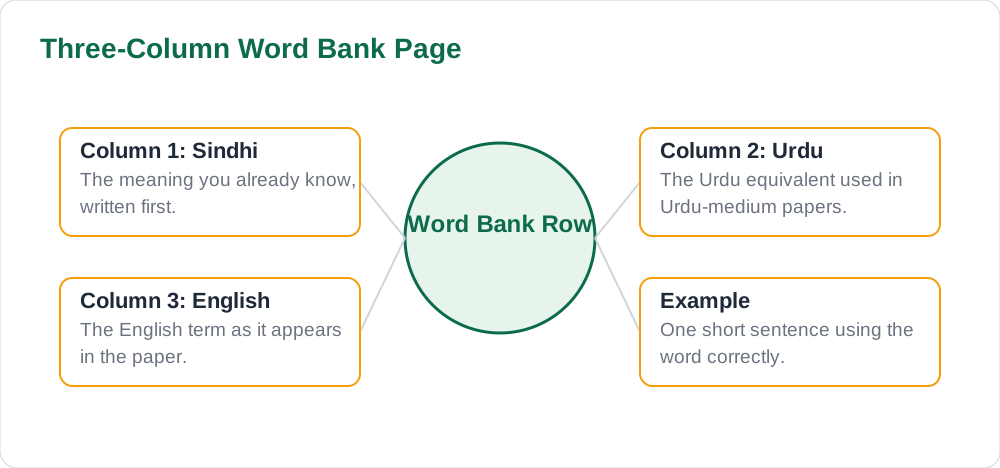
A three-column word bank has one row per idea: the Sindhi word, the Urdu word, and the English word. When you meet any one of the three in a paper, your mind recalls the whole row and the meaning becomes clear. This is faster than translating on the spot, and it prevents the most costly exam error: answering the wrong question because an instruction word was misunderstood.
Build the bank from real papers and lessons, not from a dictionary. Open your textbook and past practice questions, and copy the instruction words you actually meet: define, explain, compare, describe, list, discuss, give reasons. For exam preparation routines, see how to finish syllabus in 30 days.
- One row per idea: Sindhi, Urdu, English.
- Build from real papers and lessons, not random dictionaries.
- Instruction words matter most: define, explain, compare, describe.
Setting Up Your Word Bank Notebook
Rule a page into three columns: Sindhi, Urdu, English. Write the Sindhi word first, because it carries the meaning you already know. Then add the Urdu and English equivalents, and one short example sentence in the language you find hardest. Keep the bank in one notebook so it grows into a single trusted reference.
Organise the bank by use: instruction words, subject words, and everyday words. Instruction words tell you what to do. Subject words name concepts in science, maths, Islamiat, and social studies. Everyday words appear in passages and questions. Three small sections are easier to revise than one long mixed list.
Instruction Words: The Highest-Value Rows
Instruction words decide what the examiner wants. Define asks for a short meaning. Explain asks for meaning plus reasons or detail. Compare asks for similarities and differences. Describe asks for what something looks like or how it works. Give reasons asks for causes, not just facts. If you confuse explain with describe, you may write a correct paragraph that earns half marks.
For each instruction word, write the three-column row and one model answer starter. For explain: this means, followed by the reason. For compare: on the one hand, on the other hand. These starters help you begin each answer in the right shape. For answer structure, read how to write a perfect answer.
- Define: give a short, clear meaning.
- Explain: give meaning plus reasons or detail.
- Compare: give similarities and differences.
- Describe: say what it looks like or how it works.
- Give reasons: give causes, not just facts.
Subject Words and Everyday Words
After instruction words, add subject words from each subject: science terms, maths operations, Islamiat vocabulary, and social studies concepts. Add only the words you meet in lessons, with the Sindhi meaning and one example. A bank built from your own lessons stays relevant; a bank copied from elsewhere grows stale.
Then add everyday words from passages: words for home, school, market, weather, and feelings. Passages in exams use these words constantly, and knowing them in all three languages makes comprehension passages far easier. Add five words a week, and review the whole bank every Sunday.
- Subject words: science, maths, Islamiat, social studies terms.
- Everyday words: home, school, market, weather, feelings.
- Add five words a week from your real lessons.
- Review the whole bank every Sunday.
Revising the Word Bank Before Exams
Before exams, revise the bank in three passes. First pass: cover the Urdu and English columns and recall them from the Sindhi word. Second pass: cover the Sindhi column and recall the meaning from the English word. Third pass: write one short answer using three instruction words correctly. Three passes across three days fix the bank in memory better than one long cramming session.
On exam day, read each question, underline the instruction word, and recall its row from your bank before writing. That ten-second habit prevents misread questions and gives every answer a clean start. For time habits on exam day, read how to manage time during exams.
- Pass one: recall Urdu and English from Sindhi.
- Pass two: recall Sindhi meaning from English.
- Pass three: write one answer using three instruction words.
- Exam day: underline the instruction word before writing.
AI Help: Muse AI
Muse AI is Meta's personal AI assistant. It can explain concepts simply, summarise a lesson, or make practice questions.
For this topic, ask Muse AI to take five instruction words from your word bank and give you the Sindhi, Urdu, and English forms plus one model answer starter for each.
Join Muse with invite code LTGSWD — in the Muse app, go to Settings > Redeem token and enter the code.
Disclosure: LTGSWD is the author's Muse invite code.
Muse AI does not give official Sindh Textbook Board answers — always verify against your Sindh Textbook Board book and your teacher.
5 key points you must know
- Build a three-column word bank: Sindhi, Urdu, English, one row per idea.
- Start with instruction words: define, explain, compare, describe, give reasons.
- Add subject words and everyday words from your real lessons only.
- Revise in three passes: recall across columns, then use the words in answers.
- On exam day, underline the instruction word before writing any answer.
Frequently asked questions
What goes in a three-column word bank?
One row per idea: the Sindhi word, the Urdu equivalent, and the English term, plus one short example sentence. Start with instruction words, then add subject and everyday words.
How many words should I add per week?
Five words a week is a strong pace. Small, steady additions from real lessons beat long lists copied from a dictionary.
What is the difference between explain and describe?
Explain asks for meaning plus reasons or detail. Describe asks for what something looks like or how it works. Knowing the difference keeps your answer in the right shape.
How do I revise the word bank before exams?
Use three passes: recall Urdu and English from Sindhi, recall Sindhi meaning from English, then write one short answer using three instruction words correctly.
Should the word bank be in one notebook?
Yes. One notebook, organised into instruction words, subject words, and everyday words, becomes a single trusted reference you can revise quickly.
Solved notes — preview free
These guides work best with the solved exercises. Preview the solved notes free on this website — 119 solved notes for Classes 6–10 in Sindhi, Urdu, English and Arabic medium. Or browse the full solved notes catalogue for your class and medium. New solved notes are added regularly — check the catalogue for coming-soon books.