Tashreeh Method for Sindhi Poetry Passages

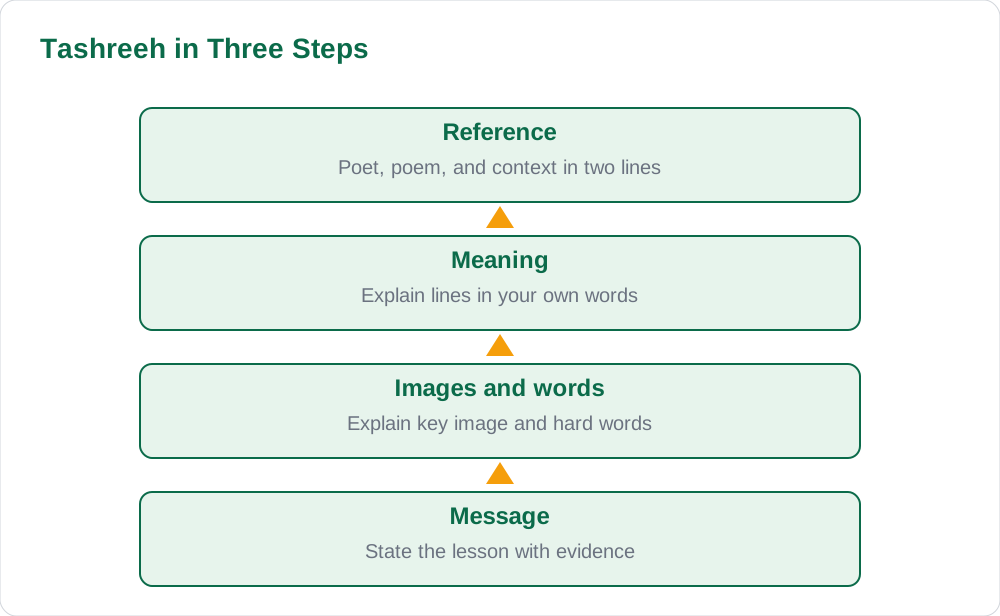
Tashreeh is the part of the Sindhi exam where many pupils feel most nervous. A short poetry passage appears, and you must explain it clearly. The tashreeh method Sindhi poetry passages pupils need is simple: reference, meaning, and message. Reference tells where the passage comes from. Meaning explains what the poet says in your own words. Message states what the reader should learn. Many pupils lose marks because they write only a summary, or only a translation, or a long introduction with no explanation of the lines. This guide shows a step-by-step method, a model answer shape, and checking habits that turn tashreeh from a fear into a steady source of marks.
What Tashreeh Really Asks For
Tashreeh means detailed explanation. The examiner does not ask you to repeat the passage in harder words. The examiner asks you to prove that you understood the passage. A good tashreeh answer does three things. It names the poet and the poem or Sur. It explains the meaning of the lines in simple, connected language. It states the message and shows how the lines support it. If any of these three parts is missing, the answer feels incomplete. If all three are present, even a short answer can earn good marks. Think of tashreeh as a conversation with the examiner. You are saying: here is where these lines come from, here is what they mean, and here is why they matter.
Before you write, read the passage three times. The first reading is for sound and general sense. The second reading is for hard words and images. The third reading is for the message. Underline the words you must explain. Mark the image, such as a journey, a river, or a waiting heart. Ask yourself what the poet wants the reader to feel or learn. This three-reading habit takes only two or three minutes, but it prevents the most common error: writing an answer about the wrong theme because you rushed. Pupils who plan tashreeh for two minutes write clearer answers than pupils who start writing at once.
Step One: Reference in Two Lines
Reference, called hawala in school language, tells the source of the passage. Write it in one or two lines: the name of the poet, the name of the poem or Sur, and the context if you know it. For example, these lines are taken from a Sur in Shah Jo Risalo by Shah Abdul Latif Bhittai, where the poet describes the journey of Sasui. That single sentence gives the examiner the source and the situation. Do not write a long biography of the poet in the reference. A long biography wastes time and space. If you are unsure of the exact Sur name, write the poet name and the general theme, and move on. A short honest reference is better than a long guessed one.
Some passages in exams come from poems you studied in class, and some come from unseen passages. The reference method works for both. For a seen passage, name the poet and poem. For an unseen passage, name the theme and the kind of poetry, such as a verse about patience and journey. Do not invent a poet name or a poem name. If you do not know it, say that the passage speaks of a general theme and focus your energy on meaning and message. Examiners mark meaning and message more heavily than a perfect reference. Accuracy matters more than pretending.
Step Two: Meaning in Your Own Words
Meaning is the longest part of tashreeh. Explain the passage line by line, but in connected paragraphs, not as a list of translations. Begin with the first line or beit, explain its words and image, then move to the next line and show how it continues or deepens the idea. Use your own Sindhi words, not the textbook words repeated. If the poet says that the traveller walks alone at night, you can explain that the traveller faces darkness and loneliness but keeps walking. This rephrasing shows understanding. If a line contains a muhavara or a fixed phrase, explain it as one unit, not word by word. The guide on Sindhi muhavare shows how to learn idioms as pictures and situations.
Explain hard words inside the meaning, not in a separate list. When you meet a difficult word, write its simple meaning in brackets or in the same sentence. For example, the word for thirst here means longing, not only need for water. This method keeps the meaning flowing. Avoid copying the textbook explanation word for word. Examiners can tell memorised answers from understood answers. A memorised answer often uses words the pupil cannot explain. An understood answer uses simple words the pupil controls. Keep your sentences short. One idea per sentence makes your meaning clear and easy to mark.
Step Three: Message With Evidence
After the meaning, write the message in one or two sentences. The message answers the question: what does the poet want the reader to learn, feel, or do. State it directly. For example, the poet teaches that patience in hardship leads to nearness to the goal. Then support it with one detail from the passage. The detail can be an image, a verb, or a repeated word. If the passage repeats a word for walking, the repetition proves that the poet values steady effort. Without evidence, the message sounds like a guess. With evidence, it sounds like an argument. This is the difference between an average answer and a strong one.
Do not add a second, unrelated message. One clear message with evidence beats two vague messages. If the passage truly carries two ideas, such as patience and honesty, mention the second briefly and link it to the first. For example, the traveller patience is possible because of honesty of heart. That linking sentence shows mature thinking. Avoid moralising beyond the passage. If the passage is about a traveller, do not turn it into a lecture on ten other topics. Stay close to the lines. The examiner wants to see that you can read what is there, not that you can write about everything you know.
Model Shape and Checking Habits
A model tashreeh answer has a clear shape. Paragraph one: reference in two lines. Paragraph two: meaning of the first part of the passage. Paragraph three: meaning of the second part, with images explained. Paragraph four: message with evidence and a short closing line. The whole answer fits on about one to one and a half pages. This shape works for seen and unseen passages, for Shah Latif, Sachal, and other poets. Pupils who practise this shape find that tashreeh becomes predictable. They no longer stare at the passage wondering where to start. They start with reference, move to meaning, and finish with message.
For practice, choose one poetry passage per week from your textbook. Read it three times, write the tashreeh using this shape, and ask your teacher to mark reference, meaning, and message separately. This feedback tells you which part needs work. Many pupils find that their meaning is good but their message is vague, or their reference is too long. Fix one weakness at a time. For more help with reading poetry before tashreeh, see the beit-by-beit method and the Shah Latif guide. You can find poetry passages in your class book via the books page. With steady practice, tashreeh becomes one of your strongest exam skills.
- Read the passage three times before writing.
- Keep the reference to one or two honest lines.
- Explain meaning in connected paragraphs, not word lists.
- State the message with one detail as evidence.
- Check that every paragraph stays close to the given lines.
AI Help: Muse AI
Muse AI is Meta's personal AI assistant, and it can help with drafting a practice tashreeh outline of reference, meaning, and message for a passage you have read. Muse AI does not give official Sindh Textbook Board answers — always verify against your Sindh Textbook Board book and your teacher.
Join Muse with invite code LTGSWD — in the Muse app, go to Settings > Redeem token and enter the code.
Disclosure: LTGSWD is the author's Muse invite code.
5 key points you must know
- Tashreeh needs three parts: reference, meaning, and message.
- Read the passage three times before writing.
- Explain meaning in your own connected words.
- Support the message with one detail from the passage.
- Keep the answer to about one to one and a half pages.
Frequently asked questions
How long should a tashreeh answer be?
About one to one and a half pages: a short reference, two meaning paragraphs, and a message paragraph with evidence.
Should I translate the passage word by word?
No. Explain the meaning in connected sentences in your own words, with hard words explained inside the meaning.
What if the passage is unseen?
Use the same method. Give a theme-based reference, explain the meaning from context, and state the message with evidence.
Can I write more than one message?
Keep one main message. Mention a second idea only briefly and link it to the first, with evidence.
Solved notes — preview free
These guides work best with the solved exercises. Preview the solved notes free on this website — 119 solved notes for Classes 6–10 in Sindhi, Urdu, English and Arabic medium. Or browse the full solved notes catalogue for your class and medium. New solved notes are added regularly — check the catalogue for coming-soon books.