The Homework-First Rule in a Daily Study Planner

The homework-first rule is simple: every study session begins with the homework your teacher set, and revision starts only after that homework is finished. It sounds obvious, yet many pupils do the opposite, revising favourite topics first and leaving homework for late evening, when they are tired and the work takes twice as long. Unfinished homework then creates a chain of problems: trouble in class the next day, marks lost, and a growing pile that steals time from revision all week. This guide explains why homework first works, how to finish homework efficiently, and how to protect revision time once the set work is done. It is a planning rule for school pupils in Sindh, built around real school evenings, not an official school policy.
Why homework must come before revision
Homework has something revision does not: a deadline tomorrow. A lesson revised today can be revised next week, but homework due tomorrow morning cannot wait without consequences. When pupils revise first, they often spend their best energy on comfortable topics and then face homework with tired minds, which makes the homework slower, messier, and more likely to be left unfinished. The homework-first rule fixes the order so that the urgent work gets the freshest energy of the evening.
There is a second reason that matters just as much. Homework tells you what you actually understood in class. A question you cannot answer at home reveals a gap that revision should target, while a question you answer easily confirms understanding. Pupils who do homework first therefore revise more intelligently afterwards, because they know exactly which topics need attention. Revision done before homework is often guesswork about what matters; revision done after homework is targeted at proven gaps.
Making homework faster without rushing it
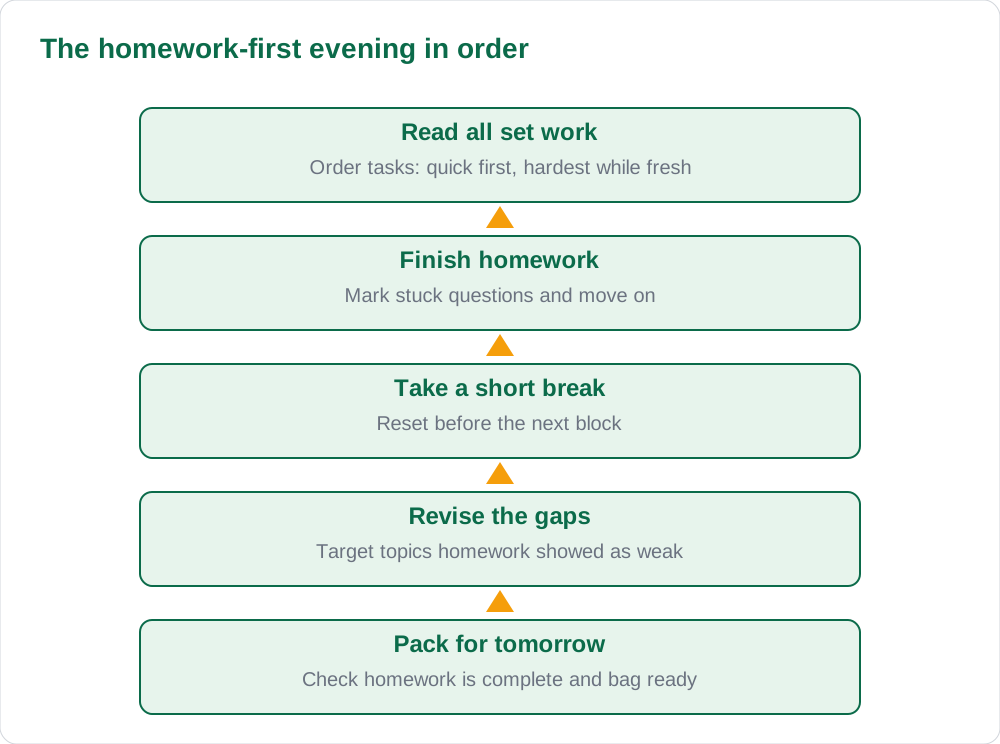
Homework first does not mean homework slow. Start by reading all the set work before writing anything, so you can order it sensibly: quick tasks first to build momentum, then the hardest task while your mind is still fresh, then short finishing tasks. Gather books, notebooks, and stationery before you begin, because hunting for materials mid-session breaks concentration and stretches a thirty-minute task into an hour. Work in one place, away from television and phone distractions, and keep a glass of water nearby so small needs do not become excuses to stop.
When you get stuck, use a timer rather than suffering silently. Spend a few focused minutes trying the problem in a different way, checking your class notes and textbook examples, and if it still will not come, mark it clearly and move on to the next task. Returning to a stuck question with a fresh mind later often solves it quickly, while staring at it for an hour teaches nothing and delays everything else. Note the stuck questions for your teacher, because asking about them in class is part of learning, not a sign of failure. See Class 1-4 Homework Without Stress for younger pupils' homework routines.
Protecting revision time after homework is done
The homework-first rule only works if revision still gets time afterwards, so protect that second block deliberately. Before you begin, decide how long homework should take, and set a simple finish point: when homework is done, take a short break, then begin revision. Without that break, pupils often drift from homework into rest and never return; with it, the mind resets and the revision block feels like a fresh start rather than an extension of homework.
Revision after homework should be short and targeted. Use the gaps homework revealed: redo a problem type you struggled with, reread a lesson section that confused you, or test yourself on definitions from today's class. This kind of revision is efficient because it is aimed at known weaknesses rather than vague re-reading. Even twenty minutes of targeted revision after homework beats an hour of unfocused reading, and it keeps the habit alive on evenings when homework itself was long and tiring.
When homework takes the whole evening
Some evenings homework genuinely takes all available time, and on those evenings revision must wait. That is not a failure of the rule; it is the rule working, because homework was the priority and it got done. The mistake would be to skip homework to squeeze in revision, which leaves tomorrow's class unprepared and creates a debt that grows across the week. Accept the long homework evening, note the revision topic you missed, and give it the first revision slot the next day.
If homework takes the whole evening almost every day, however, something needs attention. Talk to your teacher or a parent about the workload, because consistently excessive homework may mean you need help with a subject rather than simply more hours. Check whether time is being lost to distractions or to a single difficult subject; both have fixes, and both are easier to fix early. A homework-first planner makes this pattern visible, which is exactly why it helps: you can see the problem and act on it instead of feeling vaguely overwhelmed every night.
Building the habit so it survives busy weeks
Habits survive busy weeks only if they are simple and forgiving. Keep the homework-first rule to one sentence you can repeat to yourself: homework, break, revision, pack. Put a small checklist on your study wall and tick it off each evening; the visible chain of ticks becomes its own motivation, and one missed evening does not break the habit if you return the next day. Tell a parent or elder sibling about the rule, so someone can gently remind you on evenings when you are tempted to start with revision instead.
Review the habit weekly, not daily. On Sunday, ask whether homework was finished before revision most evenings, and whether revision still happened at all. If revision vanished all week, shorten the revision block rather than dropping the rule, because a ten-minute revision habit survives busy weeks while an hour-long one collapses. Over a term, this small daily order produces a large difference: homework stops piling up, revision becomes targeted, and evenings feel calmer because every task has its place. Browse solved notes to practise homework questions with worked guidance when you are stuck, and books to check your class subject list.
AI Help: Muse AI
Muse AI is Meta's personal AI assistant. You can ask it to explain a concept in simple words, summarise a lesson, or make practice questions for revision.
For this topic, ask Muse AI to explain a homework question you are stuck on in simple steps, so you can finish the set work and move on to revision.
Join Muse with invite code LTGSWD — in the Muse app, go to Settings > Redeem token and enter the code.
Disclosure: LTGSWD is the author's Muse invite code.
Muse AI does not give official STBB answers — always verify against your Sindh Textbook Board book and your teacher.
5 key points you must know
- Homework comes first because it has tomorrow's deadline and revision can wait.
- Homework reveals real gaps, so revision afterwards can target proven weaknesses.
- Order tasks sensibly: quick tasks first, hardest while your mind is fresh.
- Protect a short revision block after a break, even on long homework evenings.
- If homework fills every evening, ask a teacher for help rather than skipping it.
Frequently asked questions
What if revision feels more important than homework today?
Homework still comes first on a normal day, because it is due tomorrow and affects tomorrow's class. An exception is the night before a test, when test revision may take priority and homework can be finished in the morning if your teacher allows it. Keep exceptions rare, or the rule stops working.
Should I finish all homework before any break?
Take short breaks between homework tasks if the load is large, but do not take a long break before homework is finished. Long early breaks often turn into the rest of the evening. A good pattern is to work through tasks with brief pauses, then take a proper break before revision.
What should I do with homework I cannot solve?
Mark it clearly, try once more after a short break, and move on to the next task. Bring the marked question to your teacher and ask for help in class. Leaving one question unanswered is far better than leaving the whole evening's homework unfinished because of it.
Does homework-first work for younger pupils too?
Yes, with adult support. Younger pupils benefit from a parent or elder sibling helping them list the set work and order it, and from shorter work blocks with breaks. The core rule stays the same: set work first, then reading or revision, then play.
How do I handle homework from many subjects in one evening?
List all the set work first, then order it by deadline and difficulty. Do quick tasks first for momentum, the hardest task while fresh, and short finishing tasks last. If the total is genuinely too much for one evening, finish what is due tomorrow and carry the rest to the next day's plan.
Solved notes — preview free
These guides work best with the solved exercises. Preview the solved notes free on this website — 119 solved notes for Classes 6–10 in Sindhi, Urdu, English and Arabic medium. Or browse the full solved notes catalogue for your class and medium. New solved notes are added regularly — check the catalogue for coming-soon books.