Imla and Darust Khat: Spelling Accuracy in Urdu

To improve Urdu imla darust khat spelling accuracy, you need steady habits, not last-minute cramming. Imla means dictation and spelling, and darust khat means correct writing. In Urdu, small spelling changes can change meaning, and examiners notice spelling in every answer: mazmoon, letters, tashreeh, and short questions. Many pupils lose marks not because their ideas are weak, but because their spelling is careless. This guide targets the common Urdu spelling confusions pupils face, gives dictation lists you can practise, and shows self-check routines you can use before handing in any written work.
Why Urdu Spelling Is Tricky
Urdu spelling is tricky for three reasons. First, several letters can sound similar, so pupils write the wrong letter for a sound they hear. Second, some words look similar but carry different meanings, so a small slip changes the sense. Third, Urdu joining rules mean a letter changes shape by position, and a broken join can make a word hard to read. None of these problems means you are weak at Urdu. They mean you need a method: listen carefully, write slowly, and check what you wrote.
The good news is that spelling improves fast with short, daily practice. Ten minutes of dictation a day, plus a two-minute check before handing in work, can reduce most spelling errors within weeks. The key is to practise the words you actually confuse, not random lists. Keep a personal error notebook: every time a teacher marks a spelling error, copy the correct spelling into the notebook. That notebook becomes your personal dictation list, and it targets exactly what you need.
Common Confusion Groups
Most Urdu spelling errors fall into small confusion groups. One group is letters with similar sounds: pupils mix letters that sound alike but are written differently. Another group is words with similar shapes: pupils add or drop a dot, a stroke, or a join. A third group is long and short vowels: pupils stretch or shorten a vowel, which changes the word. A fourth group is borrowed words and names, where spelling follows usage rather than sound. Learning these groups helps you spot your own pattern instead of treating every error as random.
To find your pattern, look back at your last three marked assignments and sort the spelling errors into groups. Do most errors involve similar-sound letters, dots, vowels, or joins? Focus your practice on your largest group first. This targeted approach is faster than practising everything at once. Ask your teacher to confirm the correct spelling of any word you are unsure about, because a word learned wrongly takes longer to fix than a word learned correctly the first time.
Dictation Lists That Work
A good dictation list is short, personal, and repeated. Short means ten to fifteen words, not fifty. Personal means it includes words you actually confuse, drawn from your error notebook and your current lessons. Repeated means you practise the same list on three days, not once. On day one, a partner reads each word aloud while you write it. On day two, you write the words from memory and check them. On day three, you use each word in a sentence. This three-day cycle moves words from short-term memory into lasting spelling.
Build dictation lists from three sources: your error notebook, the vocabulary of your current Urdu lesson, and the words your teacher marks in class. Mix easy and hard words so the list feels achievable. Include the correct spelling only; do not copy wrong spellings into the list. After each dictation, circle the words you missed and carry only those forward to the next list. This keeps practice focused and shows progress clearly, because the missed-word list shrinks over time.
Self-Check Routines Before Handing In
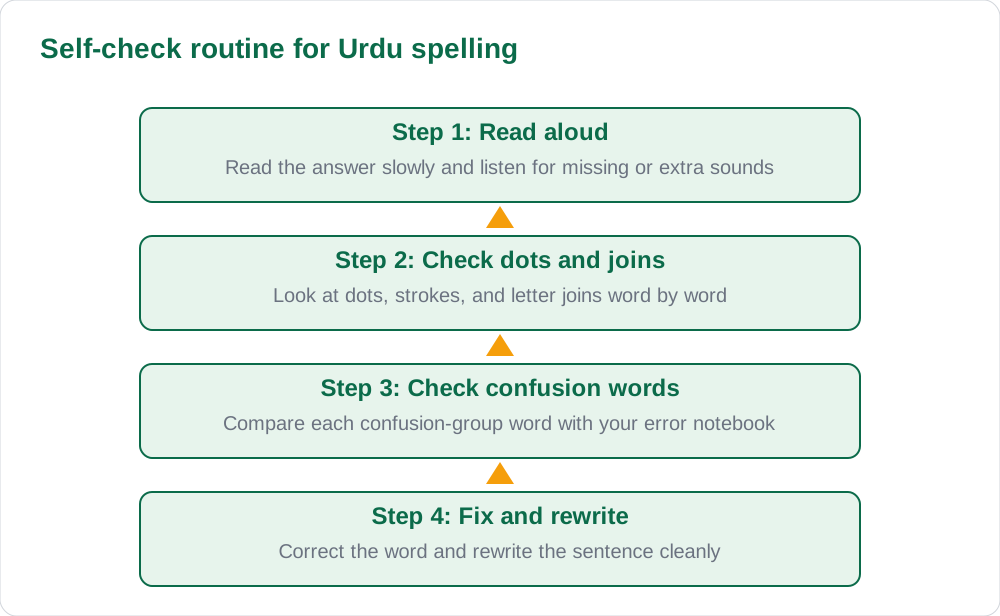
A self-check routine is a short, fixed habit you use before handing in any written work. First, read the answer aloud slowly and listen for missing or extra sounds. Second, check dots, strokes, and joins word by word, especially in words from your confusion groups. Third, compare each confusion-group word with your error notebook. Fourth, fix errors by rewriting the whole sentence, not only the word, because rewriting the sentence helps you remember the correct form in context. This routine takes about two minutes and catches most careless errors.
Use the routine for every kind of Urdu writing: mazmoon, letters, tashreeh, and short answers. Spelling matters in all of them, and a small error in a short answer is as visible as an error in a long essay. If time is short in an exam, check the words you most often confuse first, then check names and dates, then check the rest. This order gives you the best return on limited checking time. The same checking habit helps when you write Urdu letters, where names and dates must be exact.
Reading, Copying, and Writing
Three activities build spelling together: reading, copying, and writing. Reading shows you correct spelling in context. When you read, pause at words you find hard and look at their spelling closely. Copying trains the hand to form correct shapes. Copy one paragraph from your book slowly, looking at the spelling of each word as you write it. Writing from memory tests whether the spelling has settled. After copying, close the book and write the same paragraph from memory, then compare. This read, copy, write cycle is a classic method because it uses eyes, hand, and memory together.
Use the cycle for your hardest words. Choose five hard words, read them in a sentence, copy the sentence, then write the sentence from memory. Repeat the cycle for three days. Avoid copying without looking, because copying while thinking of something else does not teach spelling. Slow, attentive copying beats fast, careless copying. Over weeks, this cycle builds a store of words you can spell without thinking, which frees your mind to focus on ideas in exams.
Building a Personal Error Notebook
Your error notebook is the most useful spelling tool you own. Divide each page into three columns: the word, the correct spelling, and a sentence using it. Each time a teacher marks a spelling error, add the word to the notebook the same day. Do not copy the wrong spelling. Write only the correct form, so your eyes learn the right shape. Review the notebook for two minutes before each Urdu lesson. Before a test, practise dictation from the notebook rather than from a general list, because the notebook targets your real errors.
Keep the notebook small and honest. A notebook with fifty words you revise is better than a notebook with two hundred words you never open. When a word stays correct for three dictations in a row, mark it as learned and move it to a learned-words page. This shows progress and keeps the active list short. For wider Urdu writing practice, see types of mazmoon and the solved notes, and check the books catalogue for the right lesson.
AI Help: Muse AI
Muse AI is Meta's personal AI assistant, and it can help you practise dictation by reading out words from your personal error list. Muse AI does not give official STBB answers — always verify against your STBB book and your teacher.
Join Muse with invite code LTGSWD — in the Muse app, go to Settings > Redeem token and enter the code.
Disclosure: LTGSWD is the author's Muse invite code.
Muse AI does not give official Sindh Textbook Board answers — always verify against your Sindh Textbook Board book and your teacher.
5 key points you must know
- Keep a personal error notebook with correct spellings only.
- Practise short dictation lists of ten to fifteen words over three days.
- Use a two-minute self-check routine before handing in any work.
- Use the read, copy, write cycle for hard words.
- Focus practice on your largest confusion group first.
Frequently asked questions
How can I improve Urdu spelling quickly?
Practise ten minutes of dictation a day from your personal error notebook, plus a two-minute self-check before handing in work. Target your largest confusion group first for the fastest gains.
Should I memorise spelling rules or word lists?
Both help, but personal word lists matter more. Rules explain patterns, while lists target the words you actually confuse. Build lists from your marked errors and current lessons.
What if I keep spelling the same word wrongly?
Use the read, copy, write cycle for that word over three days, and write it in a sentence each time. If it still fails, ask your teacher to check the correct form and give an example sentence.
Does spelling matter in short answers?
Yes. A spelling error in a short answer is very visible, and it can change meaning. Use the self-check routine for short answers as well as for essays and letters.
Solved notes — preview free
These guides work best with the solved exercises. Preview the solved notes free on this website — 119 solved notes for Classes 6–10 in Sindhi, Urdu, English and Arabic medium. Or browse the full solved notes catalogue for your class and medium. New solved notes are added regularly — check the catalogue for coming-soon books.