Structuring Compare-and-Contrast Long Questions
Structuring compare contrast long questions well starts before you write a single paragraph. These questions ask you to do two things at once: show how two things are alike and how they differ, and give both sides fair treatment. The most common failure is an unbalanced answer that spends most of its space on one side and squeezes the other into a rushed ending. A simple method prevents this: build a two-column table first, then turn it into parallel paragraphs that treat each point on both sides in turn. This guide explains how to plan the table, how to write the parallel paragraphs, and how to finish with a balanced judgement.
What compare-and-contrast questions really ask
A compare-and-contrast question is not two mini-essays placed side by side. It asks you to examine the same features in both subjects, so the examiner can see the relationship between them. If you write everything about the first subject and then everything about the second, the examiner must do the comparing work themselves — and marks are lost. The skill being tested is judgement: which similarities matter, which differences matter, and what the comparison as a whole shows.
Start by reading the question twice and underlining the two things being compared and the instruction word. Words like compare, contrast, distinguish, and discuss both sides each signal a slightly different emphasis, but all of them require balance. Ask yourself what basis of comparison makes sense: features, causes, effects, advantages, or uses. Choosing the basis first keeps the answer focused; without it, students drift into listing facts about each subject without ever connecting them.
Step one: the two-column table
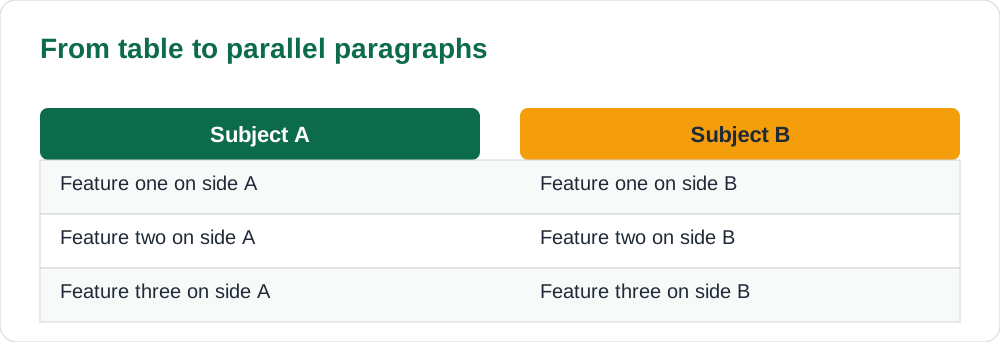
Before writing, draw a simple table with two columns, one for each subject, and rows for each feature you will compare. Fill it with short notes, not sentences: a word or phrase per cell is enough. This table does two jobs at once. It forces you to find matching information for both sides — if one column has a gap, you know you need to think harder or choose a different feature — and it gives you the skeleton of your answer in about five minutes.
Choose three or four features, not eight. A long answer with three features examined thoroughly on both sides scores better than one that skims eight features in a sentence each. Pick features that genuinely separate or connect the subjects, and drop features where both sides are identical unless the similarity itself is worth noting. When the table is complete, you can see the balance at a glance: if one column is much fuller than the other, rebalance before you start writing. This planning habit is also the core of Writing Answer Outlines for Long Questions Before Drafting.
Step two: parallel paragraphs, point by point
Turn each row of the table into one paragraph that covers both sides of that feature. Start with a topic sentence naming the feature, explain side A, then explain side B, then state the comparison in one sentence: are they similar here, different, or partly both? This parallel pattern — same feature, both sides, one judgement — repeated for each feature, is what makes the answer feel balanced and easy to mark. The examiner never has to hunt for the comparison because it sits at the end of every paragraph.
Use comparison language deliberately: similarly, in contrast, whereas, on the other hand, both, while. These words signal that you are comparing, not merely describing. Be careful with fairness: give each side a similar amount of explanation, and avoid loaded language that praises one side and dismisses the other unless the question asks for an evaluation. If one side genuinely has a stronger case on a feature, say so and give the reason — a reasoned preference is stronger than pretending both sides are equal on every point.
- One paragraph per feature, covering both sides before moving on.
- End each paragraph with a one-sentence comparison or judgement.
- Use linking words such as whereas, similarly, and in contrast.
- Give both sides roughly equal space and explanation.
- Keep the same feature order in every paragraph for easy reading.
Introduction and conclusion for comparison answers
The introduction to a comparison answer should name both subjects and state the basis of comparison. In three or four lines, say what you are comparing, on which features, and — if the question invites it — hint at the overall judgement you will reach. This opening tells the examiner that the answer will be organised by feature, not by subject, and it sets up the parallel paragraphs that follow. Avoid starting with a long history of either subject; that material belongs in the body if it belongs anywhere.
The conclusion should answer the comparison as a whole: on balance, are the subjects more alike or more different, and on which feature does the difference matter most? This is the one place where an overall judgement is expected, so make it clear and support it with the points you actually discussed. Do not introduce a new feature in the conclusion, and do not simply repeat the introduction. A conclusion that weighs the evidence — for example, noting that the subjects agree on purpose but differ sharply in method — shows the examiner that you compared, rather than merely described. The general frame is explained in Introduction, Body, Conclusion: A Frame for Long Questions.
Common mistakes and how to avoid them
The most common mistake is the split essay: half the answer on one subject, half on the other, with no comparison until a rushed final line. The parallel-paragraph method fixes this directly, because every paragraph contains the comparison. The second mistake is imbalance, usually caused by knowing one side better than the other; the planning table exposes this early, when you can still choose features you can discuss on both sides. The third mistake is listing without judging — pages of similarities and differences that never say what they mean.
To avoid these traps, check your finished answer against three questions. Does every paragraph cover both sides? Is the space roughly equal? Does the conclusion give an overall judgement? If any answer is no, revise that part before moving on. You can practise on everyday comparisons first — two study methods, two forms of transport — before applying the method to exam topics, and you can check general guidance in books and solved notes for how topics are organised. With practice, the table-and-parallel-paragraph habit becomes fast enough to use under exam time pressure.
AI Help: Muse AI
Muse AI is Meta's personal AI assistant. You can ask it to explain a concept in simple words, summarise a lesson, or make practice questions for revision.
For this topic, ask Muse AI to suggest matching features for comparing two things, or to check whether a draft paragraph covers both sides fairly.
Join Muse with invite code LTGSWD — in the Muse app, go to Settings > Redeem token and enter the code.
Disclosure: LTGSWD is the author's Muse invite code.
Muse AI does not give official STBB answers — always verify against your Sindh Textbook Board book and your teacher.
5 key points you must know
- Compare-and-contrast answers must examine the same features on both sides.
- A two-column planning table exposes gaps and imbalance before you write.
- Parallel paragraphs cover one feature on both sides, then state the comparison.
- Comparison words like whereas and in contrast signal the judgement clearly.
- The conclusion gives an overall judgement based on the features discussed.
Frequently asked questions
Should I write about one subject fully, then the other?
No — that is the split-essay mistake. Write point by point instead: one paragraph per feature, covering both sides in each paragraph, so the comparison is visible throughout the answer rather than left to the end.
How many features should I compare in a long answer?
Three or four features, examined thoroughly, usually beat a long list of thin points. Choose features where the comparison is meaningful, and make sure you can say something about both sides for each one.
What if I know much more about one side than the other?
Choose features you can discuss on both sides, and use the planning table to spot the imbalance early. It is better to compare three features fairly than to write a long, one-sided answer that only pretends to compare.
Does the conclusion have to pick a winner?
Not necessarily a winner, but it should give an overall judgement: are the subjects more alike or more different, and which difference matters most? A conclusion without any judgement reads as description, not comparison.
Solved notes — preview free
These guides work best with the solved exercises. Preview the solved notes free on this website — 119 solved notes for Classes 6–10 in Sindhi, Urdu, English and Arabic medium. Or browse the full solved notes catalogue for your class and medium. New solved notes are added regularly — check the catalogue for coming-soon books.