Punjab 11th Class Rechecking 2026: How to Apply, Fee and Deadline Guide
If your Punjab HSSC Part-I result on 22 October 2026 left you staring at marks far below what you expected, rechecking may be worth considering, but only if you understand exactly what it does. Rechecking is a formal request to your board to verify your paper, and the window for it runs for about fifteen days from the result date, according to board notices. That window is approximate, so your first step must always be to confirm your own board's notice, because each of the nine Punjab boards publishes its own instructions. This guide explains who should apply, how the application process generally works through the board portal, what rechecking can and cannot change, and how to decide between rechecking and a supplementary examination. It does not invent fees or deadline dates, because those vary by board and must come from the official notice you read yourself.
What Rechecking Actually Means in Punjab
Rechecking, sometimes called re-totaling or scrutiny depending on the board's wording, is a verification process, not a fresh marking of your answer book by a new examiner. In general, the board checks that every answer you wrote was marked, that marks were added correctly, and that no part of your paper was left unmarked. Some boards also verify that marks were transferred correctly to your result card. What rechecking usually does not do is reward answers differently because a second examiner liked your wording better, so students who expect a large jump purely on opinion-based answers are often disappointed. Understanding this distinction before you apply saves both money and false hope, and it helps you decide whether your case is strong.
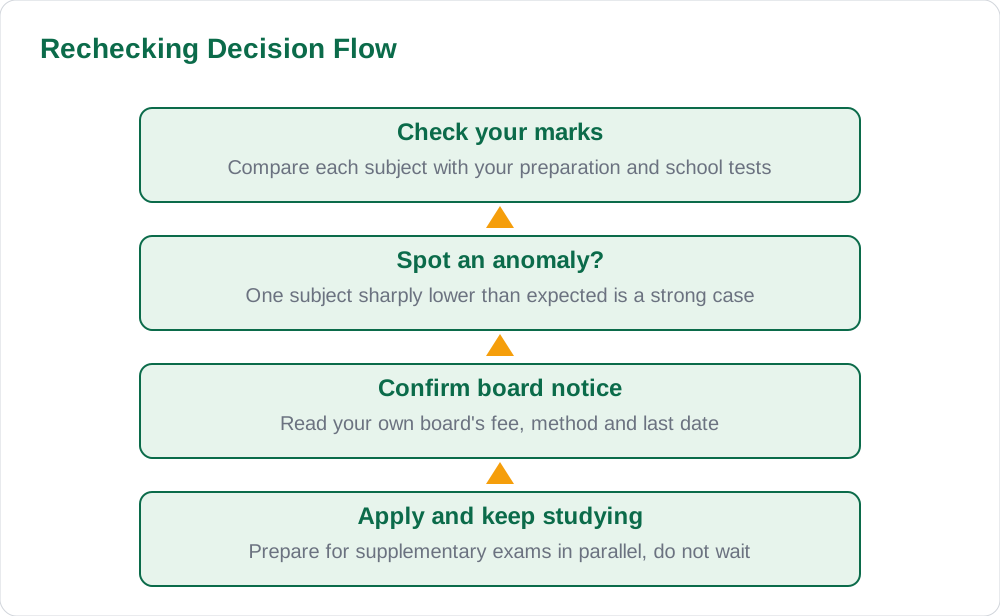
A strong rechecking case has a clear signal: your marks in one subject are sharply out of line with your performance in other subjects, your school tests, or the effort you know you put into that paper. A weaker case is a paper where you already know your preparation was incomplete, where you left questions blank, or where you are hoping for a general improvement across all subjects. Rechecking one paper with a real anomaly is sensible; applying for every paper in frustration rarely changes anything and costs time you could spend preparing for supplementary examinations. Read your result card subject by subject, compare it honestly with your preparation, and discuss borderline cases with your teacher, who has seen many result patterns before. The solved notes and blog guides can help you judge your real preparation level in each subject.
The Rechecking Window and Why You Must Confirm Your Board's Notice
Board notices indicate a rechecking window of about fifteen days from the 22 October 2026 result date, but this guide deliberately does not state a single closing date as fact, because each Punjab board — Lahore, Gujranwala, Faisalabad, Multan, Rawalpindi, Sargodha, Sahiwal, Bahawalpur and Dera Ghazi Khan — issues its own schedule. A date that is correct for one board may be wrong for another, and relying on a forwarded message or a social media post is how students miss their window. Open your own board's official website or notice board, find the rechecking notification for HSSC Part-I First Annual 2026, and note the last date, the fee per paper and the application method exactly as written. Take a screenshot or printout of that notice for your records.
Treat the window as short even if it sounds generous, because the days after a result pass quickly while students discuss, hesitate and gather documents. Apply in the first few days if you have decided, rather than on the last day when portals are busy and mistakes are harder to fix. If you are also preparing for supplementary examinations beginning 3 November 2026, do not let a rechecking application delay your studies; the two tracks can run side by side. Keep your roll number, result card and any application reference safe, and check the portal after submission to confirm your application shows as received. If anything looks wrong, contact your board's office promptly rather than assuming it will resolve itself. For the supplementary side of the decision, see our supplementary preparation guide.
How to Apply Through Your Board Portal, Step by Step
While exact screens differ by board, the general portal process follows a familiar pattern, and knowing it in advance prevents errors. First, visit your own board's official website and look for the rechecking or re-totaling link for HSSC Part-I 2026, not a third-party site that promises faster results. Enter your roll number and the other details the form asks for, select only the papers you genuinely want rechecked, and double-check your subject codes before submitting, because a wrong subject selection wastes your fee. Next, pay the prescribed fee through the method your board specifies, which may be a bank challan, online payment or another official channel, and keep the receipt or transaction reference. Finally, submit the form and save or print the confirmation, noting any tracking number the portal gives you.
Common mistakes are easy to avoid once you know them. Do not apply through an unofficial agent or a website that charges extra for the same form, and never share your roll number and personal details with strangers offering guaranteed increases. Do not select every subject out of frustration, and do not enter a wrong roll number or session, because corrections after submission may not be possible. If your school or college offers to collect applications, confirm that they use the official process and give you a receipt for your own records. Students who apply through their institution should still verify online that their application is recorded. After applying, your job is patience plus preparation: rechecking outcomes take time, and your supplementary preparation should continue regardless of the result.
- Use only your own board's official website and notice, never an agent or aggregator
- Select subject codes carefully; a wrong selection wastes the fee
- Pay only by the board's prescribed method and keep the receipt
- Save the confirmation and tracking reference after submission
- Keep preparing for supplementary exams while you wait for the outcome
What Rechecking Can and Cannot Change
Rechecking can change your result when a genuine verification error is found: an unmarked answer, a totalling mistake, or marks not transferred correctly to your result card. In those cases the correction is real and deserved, and your updated result reflects what you actually earned. Rechecking cannot, however, turn a weak answer into a strong one, reward a different writing style, or compensate for questions you left blank or chapters you did not study. Students sometimes expect rechecking to add ten or twenty marks across a paper, but verification errors are usually small and specific, which is why most rechecking outcomes leave the original marks unchanged. Going in with realistic expectations protects you from disappointment and from neglecting supplementary preparation.
It also helps to know that rechecking outcomes are final under the board's rules for that process, and that a result can in principle move in either direction if an error is found, although large downward changes are uncommon. Do not treat rechecking as a lottery ticket, and do not delay important decisions, such as supplementary preparation or 12th class enrolment, while waiting. If your rechecking result improves a paper to a pass, that is excellent news; if it does not, your supplementary preparation means you have lost no time. Either way, the students who come out best are those who treated rechecking as one careful step inside a larger plan, not as the whole plan. Talk to your teacher about your specific paper before applying, and let their experience guide whether your case is worth the fee.
After You Apply: Waiting, Results and Next Steps
Once you have applied, check your board's portal periodically for updates, but do not check obsessively every hour, because rechecking takes time and constant checking only raises anxiety. Use the waiting period productively: revise the supplementary subject, start reading 12th class material, and organise your notes for the year ahead. When the rechecking outcome is published, compare it carefully with your original result card and keep both documents, since schools and colleges may ask for them during admission or verification. If a paper changes from fail to pass, confirm with your school how that affects your supplementary registration, so you do not appear for a paper you no longer need to take.
If the outcome does not change, that is not a judgement on your worth as a student; it simply means no verification error was found in that paper. Your supplementary examination remains the route to completing Part-I, and the preparation you did while waiting puts you ahead. Many students who clear a supplementary paper go on to perform strongly in Part-II, because the extra practice deepens their understanding of the subject. Whatever the outcome, keep your documents organised, stay in touch with your teachers, and move forward into 12th class with a clear plan. Your Part-I marks matter, but they are one stage in a longer journey, and how you respond to them often matters more than the marks themselves.
AI Help: Muse AI
Muse AI is Meta's personal AI assistant, and it can help you with rechecking decisions by explaining the difference between rechecking and re-marking in plain language, or by helping you draft a checklist of questions to ask your teacher about a surprising result.
Join Muse with invite code LTGSWD — in the Muse app, go to Settings > Redeem token and enter the code.
Disclosure: LTGSWD is the author's Muse invite code.
Muse AI does not give official STBB answers — always verify against your Sindh Textbook Board book and your teacher.
4 key points you must know
- The rechecking window is about fifteen days from the 22 October 2026 result, per board notice — confirm your own board's exact dates
- Rechecking verifies marking and totalling; it is not a fresh re-marking of your paper
- Apply only through your own board's official portal and keep your fee receipt and confirmation
- Prepare for supplementary exams in parallel so a rechecking outcome never costs you study time
Frequently asked questions
How long do I have to apply for Punjab 11th class rechecking in 2026?
Board notices indicate about fifteen days from the 22 October 2026 result date, but each board publishes its own schedule. Confirm the exact last date on your own board's official notice and apply early rather than on the final day.
Does rechecking mean my paper will be marked again by a new examiner?
No. Rechecking generally verifies that all answers were marked, marks were added correctly, and marks were transferred correctly. It does not re-mark answers for a different opinion on quality, so large changes are uncommon.
What fee do I pay for rechecking?
The fee is set per paper by your own board and is stated in its rechecking notice. This guide does not quote a single fee because it varies by board; read your board's official notice before paying, and pay only by its prescribed method.
Should I still prepare for supplementary exams if I apply for rechecking?
Yes. Supplementary examinations begin on 3 November 2026, and rechecking outcomes take time. Preparing in parallel means a favourable rechecking result is a bonus, while an unchanged result costs you no preparation time.
Solved notes — preview free
These guides work best with the solved exercises. Preview the solved notes free on this website — 119 solved notes for Classes 6–10 in Sindhi, Urdu, English and Arabic medium. Or browse the full solved notes catalogue for your class and medium. New solved notes are added regularly — check the catalogue for coming-soon books.