Punjab 11th Class Supplementary Exams November 2026: How to Prepare in Two Weeks
If your Punjab HSSC Part-I result on 22 October 2026 brought a supplementary in one or more subjects, you have a short but workable window before supplementary examinations begin on 3 November 2026. Two weeks is not a long time, yet it is enough to turn a failed paper around when every study hour is aimed at the exact topics that cost you marks. This guide gives you a realistic crash plan, subject by subject, so you stop panicking and start scoring. The overall picture from the result was mixed across boards, with Lahore at 60.03 percent, Faisalabad at 61.68 percent, Multan at 65.15 percent and Dera Ghazi Khan at 66.06 percent, which shows that thousands of students across Punjab are in exactly your position. A supplementary is a second chance, not a verdict on your ability, and students who use it well often enter 12th class stronger than before.
What the 22 October Result Means for Supplementary Students
All nine Punjab boards announced the HSSC Part-I First Annual 2026 result together on Thursday 22 October 2026 at 10:00 AM, and the board-wise pass percentages tell a clear story. Lahore recorded 60.03 percent with 99,191 passes out of 165,245 candidates, Rawalpindi 54.23 percent, Bahawalpur 53.46 percent and Gujranwala 56.99 percent, while Multan, Faisalabad and Dera Ghazi Khan did better. These figures matter because they prove that failing a paper is common, even in strong districts, and that supplementary examinations exist precisely for this large group of students. Your first job is to read your detailed marks sheet carefully, subject by subject, and separate papers you narrowly missed from papers where your preparation was genuinely weak. That distinction decides whether you revise or relearn, and it saves you from wasting your two weeks on topics you already know.
A supplementary examination is not the same as repeating the whole year, and it does not have to delay your 12th class studies permanently. You appear only in the subjects you did not clear, and once you pass them your Part-I result is completed. Many students make the mistake of treating the supplementary as a small test they can pass with a few days of reading, but the paper follows the same syllabus and standard as the annual examination. Treat it with the seriousness of a board paper, protect your study hours from distractions, and tell your family and teachers that you need focused support for the next two weeks. Students who plan their days hour by hour, rather than studying whenever they feel like it, consistently cover more syllabus and walk into the examination hall calmer. For general study structure, the study guides on our blog and the solved notes can help you organise revision alongside your textbook.
Your Two-Week Crash Plan, Day by Day
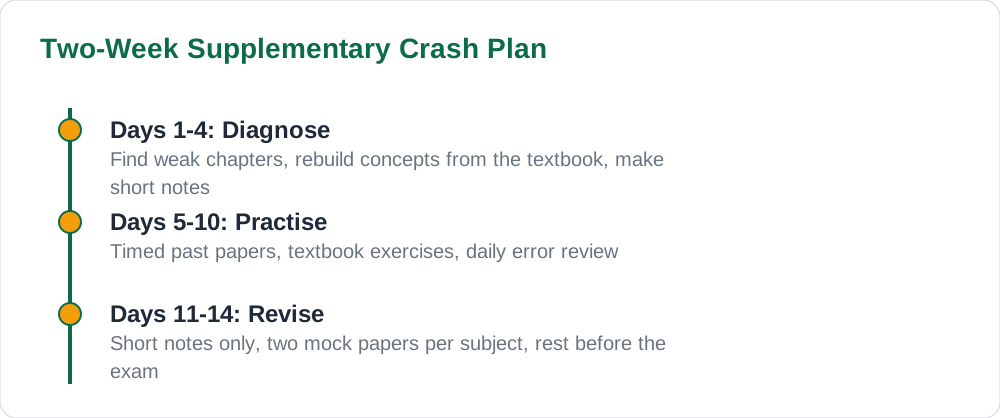
Divide your fourteen days into three blocks: four days of diagnosis and rebuilding, six days of intensive practice, and four days of revision and mock papers. In the first block, work through your failed subject chapter by chapter, marking every concept you cannot explain in your own words, and rebuild those concepts from your textbook before touching any past paper. In the second block, solve past papers and textbook exercises under timed conditions, because board papers reward speed and presentation as much as knowledge. In the final block, revise only your short notes, formulas and repeated mistakes, and attempt at least two full mock papers for each supplementary subject. This rhythm prevents the common trap of reading passively for twelve days and discovering, too late, that you cannot reproduce answers under pressure.
Each day should have a fixed shape: two long study sessions in the morning for your weakest subject, a shorter afternoon session for your second subject, and an evening hour for writing practice and error review. Keep your phone away during study blocks, and end every day by writing down three things you learned and one mistake you will not repeat. If you have two supplementary subjects, alternate the morning focus so neither subject goes untouched for more than a day. Sleep matters more than late-night cramming in the final three days, because a tired mind forgets formulas and misreads questions. Eat properly, revise in daylight where possible, and keep one rest evening in the second week so you do not burn out before the paper. You can also check the companion guide on rechecking for Punjab 11th class if you are unsure whether to apply for rechecking instead.
Subject-Wise Tactics for Common Supplementary Papers
In mathematics and physics, marks come from working, so never revise by reading solved examples alone. Rewrite each type of question yourself, step by step, and keep a formula sheet that you test yourself on every morning. In physics, practise numerical problems from every chapter and learn to draw labelled diagrams neatly, because diagrams and units earn marks even when a final answer goes wrong. In chemistry, separate numerical work from memorised reactions and definitions, and revise reactions by writing them out rather than staring at them. Biology rewards diagrams and precise terms, so practise drawing and labelling the diagrams your textbook repeats, and learn definitions word for word where the board expects them.
In English and Urdu, students often lose marks not on knowledge but on presentation and time management. Practise essay and letter formats, learn the structure of summaries and comprehension answers, and write at least one full-length answer every day so your handwriting and speed improve together. For Urdu, revise grammar rules and the central ideas of lessons and poems, and quote accurately where the question asks for it. In Islamiat and Pakistan Studies, short answers must be precise and complete, so practise writing answers that cover every part of the question without wandering off topic. Whatever your subject, read each past paper question twice before writing, underline the command words, and plan your answer in two lines before you begin. That small habit alone can lift a borderline paper into a pass.
- Mathematics and physics: solve, do not just read; test formulas daily
- Chemistry: write reactions out by hand; separate numericals from theory
- Biology: practise labelled diagrams and exact scientific terms
- English and Urdu: one full written answer daily for speed and presentation
- Islamiat and Pakistan Studies: short, complete answers covering every part of the question
Rechecking or Supplementary: How to Choose
Some students face a genuine choice: apply for rechecking of a paper, or prepare for the supplementary examination in that paper. Rechecking suits a paper where your expected marks and awarded marks differ sharply, where you are confident your answers were complete, or where a totalling error seems possible. The rechecking window runs for about fifteen days from the result date, according to board notices, so you must confirm your own board's notice rather than relying on a date someone told you. Rechecking can correct errors, but it does not re-mark your paper from scratch in the way many students imagine, so it is not a substitute for preparation. If you failed a paper clearly, preparing for the supplementary is the safer and more certain route.
The smart approach for many students is to do both where the rules allow: apply for rechecking promptly if you have a real case, and still prepare for the supplementary as if rechecking will not change anything. That way a favourable rechecking result is a bonus, not a gamble your whole plan depends on. Do not wait for a rechecking outcome before opening your books, because the supplementary examinations begin on 3 November 2026 and every lost day is a chapter unrevised. Keep copies of your application, fee receipt and roll number slip, and note your board's official instructions carefully. Our detailed rechecking guide explains what rechecking can and cannot change, and the books page can point you back to the textbooks you need.
Exam Week: What to Do in the Final Days
In the final three days before each supplementary paper, stop learning new material and switch entirely to revision, mock papers and rest. Attempt one mock paper in the morning under real time limits, mark it honestly in the afternoon, and spend the evening only on the mistakes you made. Prepare your examination kit the night before: roll number slip, pens, geometry instruments, admit card and any other item your board requires. Reach the centre early, read the paper calmly for the first ten minutes, and answer the questions you know best first so your confidence builds before you tackle harder ones. Manage your time per section, leave the last ten minutes for checking, and never leave a question blank when a partial answer can earn marks.
After each paper, resist the urge to compare answers endlessly with friends, because post-paper anxiety damages preparation for the next subject. Note only whether the paper felt manageable, then move on to the next subject's revision the same evening. Once all supplementary papers are done, return to your 12th class studies without delay, since the syllabus does not wait for supplementary results. Students who clear their supplementary papers and immediately join their class in 12th class studies lose almost no ground. Remember that a supplementary pass completes your Part-I, and from that point your focus should be entirely on building strong 12th class preparation so that Part-II becomes your best result yet.
AI Help: Muse AI
Muse AI is Meta's personal AI assistant, and it can help you study by explaining a difficult concept in simple words, summarising a lesson, or turning your weak chapters into short practice questions for your supplementary preparation.
Join Muse with invite code LTGSWD — in the Muse app, go to Settings > Redeem token and enter the code.
Disclosure: LTGSWD is the author's Muse invite code.
Muse AI does not give official STBB answers — always verify against your Sindh Textbook Board book and your teacher.
4 key points you must know
- Punjab supplementary examinations begin 3 November 2026, following the 22 October 2026 HSSC Part-I result
- A two-week plan works best in three blocks: diagnose, practise under time, then revise and mock-test
- Rechecking suits sharply unexpected marks; a clear fail is best handled by supplementary preparation
- Write answers by hand every day — board marks reward working, presentation and speed, not passive reading
Frequently asked questions
When do Punjab 11th class supplementary exams begin in 2026?
Supplementary examinations begin on 3 November 2026, following the HSSC Part-I First Annual 2026 result announced on 22 October 2026. Confirm the exact date sheet for your subject on your own board's official notice.
Can I prepare for a supplementary exam in just two weeks?
Yes, if you focus only on the failed subject, diagnose weak chapters first, practise timed past papers daily, and revise short notes in the final days. Two weeks is short, so every study session must target marks, not general reading.
Should I choose rechecking or a supplementary exam?
Choose rechecking when your awarded marks are sharply lower than expected or a totalling error seems likely, and prepare for the supplementary at the same time where rules allow. A clear fail is best handled by supplementary preparation, since rechecking does not guarantee a change.
How many hours should I study each day for a supplementary paper?
Aim for two long morning sessions on your weakest subject, a shorter afternoon session for a second subject, and an evening hour for writing practice and error review. Quality and timed practice matter more than simply counting hours.
Solved notes — preview free
These guides work best with the solved exercises. Preview the solved notes free on this website — 119 solved notes for Classes 6–10 in Sindhi, Urdu, English and Arabic medium. Or browse the full solved notes catalogue for your class and medium. New solved notes are added regularly — check the catalogue for coming-soon books.