Tashreeh-e-Ashaar: A Method for Urdu Poetry Explanation

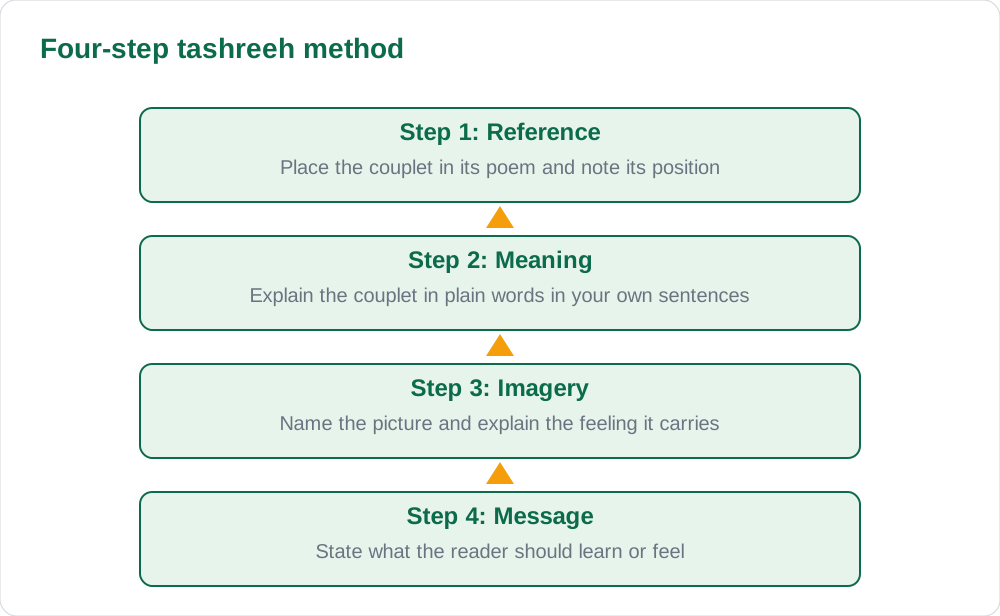
To use the tashreeh-e-ashaar method Urdu poetry questions expect, you need a clear, repeatable structure. Tashreeh means explanation, and ashaar means couplets. A tashreeh question asks you to explain a couplet: what it says, how it says it, and what it means. Many pupils answer with a short paraphrase only, and lose marks because they skip the imagery and the message. A stronger answer follows four steps: reference, meaning, imagery, and message. This guide teaches that four-step method with a worked couplet, so you can write a complete, organised tashreeh for any couplet in your Sindh Textbook Board book.
What Tashreeh Asks You to Do
Tashreeh is not summary and not praise. It is a careful explanation of how a couplet works. The examiner wants to see that you understand the words, the image, and the idea together. A good tashreeh therefore moves in layers. First, it places the couplet: which poem or ghazal it comes from, and what comes before or after it if that matters. Then it explains the meaning in plain words. Then it explains the imagery: what picture the poet paints and what feeling it carries. Finally, it states the message: what the reader should learn or feel.
This layered approach matters because a couplet is short but dense. Two lines can carry a picture, a feeling, and a thought at once. If you write only the meaning, you miss the picture. If you write only praise, you miss the thought. The four-step method makes sure you cover all three. It also keeps your answer organised, which helps the examiner follow your thinking and award marks for each part.
Step 1: Reference
Reference, called hawala in class, places the couplet in its poem. Write one or two lines naming the poem or ghazal, the poet if known, and the place of the couplet in the poem. For example, you might note that the couplet comes at the start of the poem, where the poet sets the scene, or near the end, where the poet draws a conclusion. Keep the reference short. Its job is to orient the reader, not to retell the whole poem. If the couplet is from a ghazal, you may also note the mood of the ghazal, since each sher in a ghazal stands on its own.
A common mistake is writing a long introduction about the poet's life. A tashreeh answer does not need a biography. One line of reference is enough. Save your space for meaning, imagery, and message, where the marks lie. If you are unsure of the poet's name, do not guess. Write the reference from what you know: the poem, its place, and its mood. Honest, accurate reference earns more than a guessed biography.
Step 2: Meaning in Plain Words
Meaning is the heart of tashreeh. Read the couplet slowly, work out hard words from context, and then write the meaning in two or three plain sentences in your own words. Do not copy the textbook wording from memory. Your own sentences show that you understand. Keep the order of the couplet: explain the first line, then the second line, then how the two lines fit together. If the couplet contains a comparison, name both sides of the comparison clearly, so the reader can see what is being compared to what.
Check your meaning with a simple test: could a younger pupil understand your explanation? If not, simplify the language without losing the thought. Avoid adding ideas the couplet does not contain. If the couplet speaks of patience, do not turn it into a lecture on many virtues. Stay close to the words. The same care with words helps when you practise reading a ghazal sher by sher, where meaning must also stay close to the text.
Step 3: Imagery and Feeling
Imagery is the picture the poet paints and the feeling it carries. Name the image first: is it light, a river, a garden, a mirror, a journey, or a season? Then explain what feeling the image carries in this couplet. The same image can carry different feelings in different poems, so always judge by context. A river might suggest steady effort in one couplet and the passing of time in another. Your explanation should show why this image fits this thought, not only that an image exists.
Link imagery to meaning with one clear sentence. For example, you might write that the image of a lamp fits the thought of guidance, because a lamp shows the path in darkness just as good advice shows the way in difficulty. That sentence connects picture and thought. Without such a link, the imagery paragraph floats apart from the meaning paragraph. The link is what turns two separate paragraphs into one explanation. The same linking skill helps when you analyse theme and imagery in a nazm.
Step 4: Message and Closing
The message states what the reader should learn or feel from the couplet. Write it in one or two lines, tied to the couplet. A good message sentence names the idea and the evidence, such as 'the couplet teaches patience, because the poet shows that steady effort, like a river, reaches its goal'. Avoid general praise that could fit any couplet. The message must come from this couplet, not from a memorised line. If the couplet explores a feeling rather than teaching a lesson, state the insight: what the couplet helps the reader see more clearly.
Close the tashreeh with one line that gathers the explanation. Do not introduce new points in the closing. A simple closing might restate the message in fresh words. Keep the whole tashreeh balanced: reference short, meaning clear, imagery linked, message tied to the couplet. This balance is what examiners reward. Practise the method on one couplet at a time, and compare your answer with your teacher's guidance.
A Worked Couplet Example
Consider a couplet in which the poet compares steady effort to a river that keeps moving despite stones in its path. Reference: the couplet comes from a poem about patience, placed where the poet moves from difficulty to hope. Meaning: the poet says that a person who keeps working, even when obstacles appear, reaches the goal, just as a river keeps flowing around stones. Imagery: the river is the image, and it carries feelings of steady movement, patience, and quiet strength. The stones are the image of obstacles, small but real.
Message: the couplet teaches that patience is not waiting quietly but continuing to move despite obstacles. Notice how each step builds on the last: reference places the couplet, meaning explains it, imagery shows how it works, and message states what it teaches. When you write your own tashreeh, follow the same order and keep each step short. For more Urdu poetry practice, browse the solved notes and the books catalogue.
- Reference: one or two lines placing the couplet in its poem.
- Meaning: two or three plain sentences in your own words.
- Imagery: name the picture, explain the feeling, link to meaning.
- Message: one or two lines tied to this couplet.
AI Help: Muse AI
Muse AI is Meta's personal AI assistant, and it can help you practise writing the meaning of a couplet in two plain sentences. Muse AI does not give official STBB answers — always verify against your STBB book and your teacher.
Join Muse with invite code LTGSWD — in the Muse app, go to Settings > Redeem token and enter the code.
Disclosure: LTGSWD is the author's Muse invite code.
Muse AI does not give official Sindh Textbook Board answers — always verify against your Sindh Textbook Board book and your teacher.
5 key points you must know
- Tashreeh explains a couplet in four steps: reference, meaning, imagery, and message.
- Reference is short: poem, place, and mood, not a biography.
- Meaning must be in your own plain sentences, close to the words.
- Imagery needs a link: why this picture fits this thought.
- Message must come from this couplet, not from a memorised line.
Frequently asked questions
How long should a tashreeh answer be?
Long enough to cover all four steps, usually four short paragraphs: reference, meaning, imagery, and message. A balanced tashreeh with clear links earns more than a long paraphrase.
Must I quote the couplet in my tashreeh?
Yes, if your teacher asks for it. Write the couplet correctly at the top, then follow with the four steps. Check spelling carefully, especially in quoted lines.
What if I cannot find an image in the couplet?
Look again for any word picture: light, journey, garden, mirror, season, or river. If the couplet is plain, say so honestly and focus on meaning and message rather than inventing an image.
Can the message be a feeling rather than a lesson?
Yes. Some couplets explore a feeling rather than teaching a lesson. In that case, state the insight: what the couplet helps the reader feel or see more clearly.
Solved notes — preview free
These guides work best with the solved exercises. Preview the solved notes free on this website — 119 solved notes for Classes 6–10 in Sindhi, Urdu, English and Arabic medium. Or browse the full solved notes catalogue for your class and medium. New solved notes are added regularly — check the catalogue for coming-soon books.