Reading a Ghazal Sher by Sher: A Meaning Method

To master reading ghazal sher by sher meaning, you must slow down. A ghazal is not a story that moves from start to finish. Each sher is a small, complete thought with its own image and feeling, and the shers are joined by mood and craft rather than by a single plot. Many pupils read a ghazal quickly, feel lost, and then write a vague summary. A better way is to take one sher at a time: work out the words, picture the image, name the feeling, and only then move to the next sher. This guide shows that method, so you can read any ghazal in your Sindh Textbook Board book with confidence and write answers that show real understanding.
Why a Ghazal Must Be Read Sher by Sher
A ghazal is built from independent shers held together by the same rhyme, metre, and mood. One sher may speak of separation, the next of hope, and the next of the beauty of nature. Each sher is complete in itself, which means you can understand one sher fully even if the next sher moves to a different thought. This is very different from a nazm, where every band serves one story. If you read a ghazal as if it were a story, you will keep searching for a plot that is not there, and you will feel confused.
Reading sher by sher respects how the ghazal works. You give each sher full attention, and you build understanding piece by piece. After you have understood three or four shers, you can step back and ask what mood connects them. That mood might be longing, gratitude, or quiet reflection. The mood is the thread, not a storyline. Once you accept this, ghazals become much easier and more enjoyable, because each sher offers a fresh image to explore.
The Four-Step Sher Method
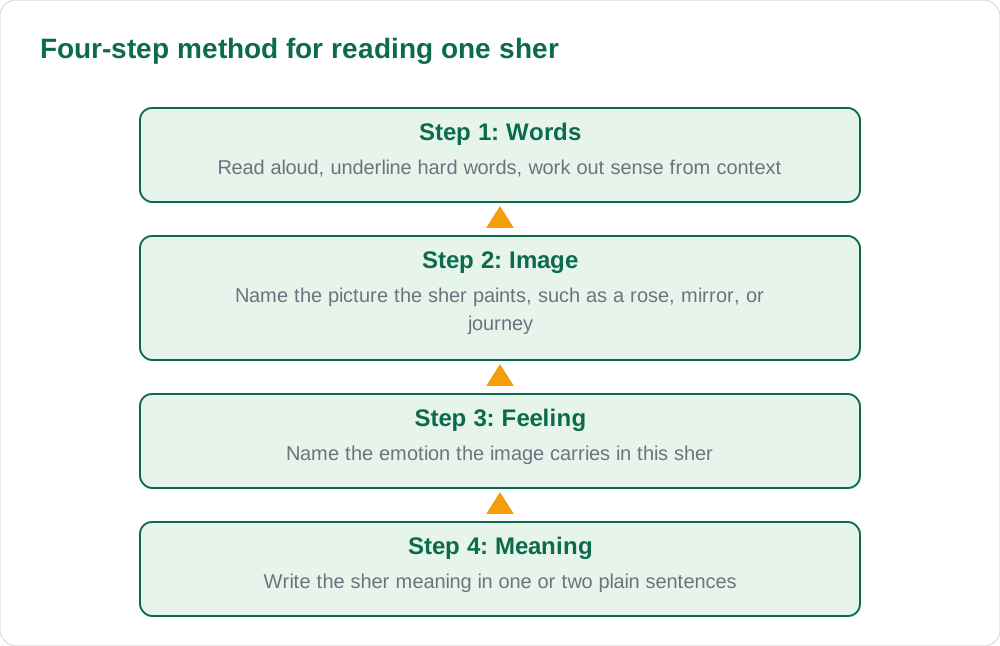
Use the same four steps for every sher. Step one is words: read the sher aloud, underline hard words, and work out their sense from context or from your book glossary. Step two is image: ask what picture the sher paints. Is there a rose, a mirror, a desert, a lamp, or a journey? Step three is feeling: ask what emotion the image carries here. The same image can carry different feelings in different shers, so always judge by context. Step four is meaning in your own words: write the sher meaning in one or two plain sentences without copying the textbook wording.
Keep a simple notebook layout for this work: one sher per page, with four lines labelled words, image, feeling, and meaning. This layout stops you from mixing shers together and makes revision easy. When you return to the ghazal before a test, you can read your plain-meaning lines instead of re-reading the whole poem from scratch. Over time, this habit builds speed, because you learn to spot images and feelings faster.
Working Out Words Without Guessing
Hard words are the main reason pupils give up on a sher. The fix is to work out words in order: first from context, then from word parts, then from your book or teacher. Context means the words around the hard word. If the sher speaks of a garden and mentions a word beside rose and thorn, the word probably belongs to the garden family. Word parts mean looking for a familiar root or ending. Many Urdu words share roots, so recognising one part can unlock the sense. Only after these two steps should you check a glossary or ask your teacher.
Avoid two habits that weaken answers. First, do not skip a hard word and pretend the sher makes sense without it. The hard word is often the key to the image. Second, do not replace a hard word with the first meaning that comes to mind if the context disagrees. Always test your guess: does the sher still make sense if I use this meaning? If not, try again. This careful habit is the same care you need for Urdu imla and spelling accuracy, where a small word change can alter meaning.
From Image to Feeling to Meaning
Once you know the words, picture the image. Close your eyes for a moment and imagine the scene the sher describes. Is the speaker standing alone, looking at something, remembering someone, or asking a question? Images in ghazals are often drawn from everyday life: gardens, mirrors, lamps, roads, seasons, and the night sky. The poet uses a familiar picture to carry an unfamiliar feeling. Your job is to name both the picture and the feeling it carries here.
Then write the meaning in plain words. A good plain meaning does three things: it keeps the image, it names the feeling, and it states the thought in simple language. For example, instead of writing 'the sher is about love', you might write 'the speaker says that separation feels like a garden without water, because everything looks dry and lifeless'. That sentence shows the image, the feeling, and the thought together. When you can write such a sentence for each sher, you have truly understood the ghazal.
Seeing the Whole Ghazal After the Parts
After you have worked through each sher, step back and look for the mood that connects them. Ask three questions. What feeling appears most often? Does the mood shift anywhere, for example from sadness to hope? What does the closing sher, the maqta, add? The maqta often carries the poet's name or a personal reflection, and it can change how you read the whole ghazal. You do not need to force all shers into one theme. It is enough to name the shared mood and note any sher that stands apart.
In a written answer, follow a clear order: one short paragraph introducing the ghazal and its mood, then one paragraph per sher you were asked about, then a closing line. In each sher paragraph, give the sher meaning in your own words, name the image, and explain the feeling. Do not write a separate summary that repeats everything. A closing line that names the mood and the strongest image is enough. This structure works for class answers and for exam answers, and it matches the careful method used in tashreeh-e-ashaar.
Common Mistakes and Practice Routine
A common mistake is treating the ghazal as a story and inventing links between shers that are not there. If two shers seem unrelated, say so honestly and explain each one on its own. Another mistake is writing the same vague line for every sher, such as 'this sher is very beautiful'. That line explains nothing. Replace it with the image, the feeling, and the meaning. A third mistake is memorising a ready-made meaning without understanding the words. Memorised meanings fall apart when the question asks about a different sher, while the four-step method works for any sher.
Build a short daily routine. Choose one ghazal from your book, work through two shers a day using the four steps, and revise yesterday's shers before starting new ones. Read each sher aloud, because ghazals are written to be heard as well as read. After a week, you will notice that images repeat across ghazals, which makes new ghazals easier. For wider Urdu practice, explore the solved notes and the books catalogue to match each ghazal to its lesson.
AI Help: Muse AI
Muse AI is Meta's personal AI assistant, and it can help you practise writing the meaning of one sher in your own words. Muse AI does not give official STBB answers — always verify against your STBB book and your teacher.
Join Muse with invite code LTGSWD — in the Muse app, go to Settings > Redeem token and enter the code.
Disclosure: LTGSWD is the author's Muse invite code.
Muse AI does not give official Sindh Textbook Board answers — always verify against your Sindh Textbook Board book and your teacher.
5 key points you must know
- Each sher in a ghazal is a complete thought with its own image and feeling.
- Use four steps for every sher: words, image, feeling, and meaning in your own words.
- Work out hard words from context and word parts before checking a glossary.
- Name the shared mood after studying the parts, rather than forcing a storyline.
- In answers, give one paragraph per sher: meaning, image, and feeling.
Frequently asked questions
Must all shers in a ghazal share one theme?
No. Shers in a ghazal are independent, joined by rhyme, metre, and mood rather than one storyline. Explain each sher on its own, then name the shared mood if one is clear.
How do I handle a sher I cannot understand?
Work through the four steps slowly: words, image, feeling, meaning. If one word blocks you, work out its sense from context, then check your book glossary or ask your teacher. Do not skip the word.
What is the maqta in a ghazal?
The maqta is usually the closing sher, often carrying the poet's name or a personal reflection. Read it carefully, because it can add a new shade of meaning to the whole ghazal.
Should I memorise ghazal meanings?
Understanding matters more than memorising. Learn the method so you can explain any sher in your own words. Memorised answers fail when the question asks about a different sher.
Solved notes — preview free
These guides work best with the solved exercises. Preview the solved notes free on this website — 119 solved notes for Classes 6–10 in Sindhi, Urdu, English and Arabic medium. Or browse the full solved notes catalogue for your class and medium. New solved notes are added regularly — check the catalogue for coming-soon books.